
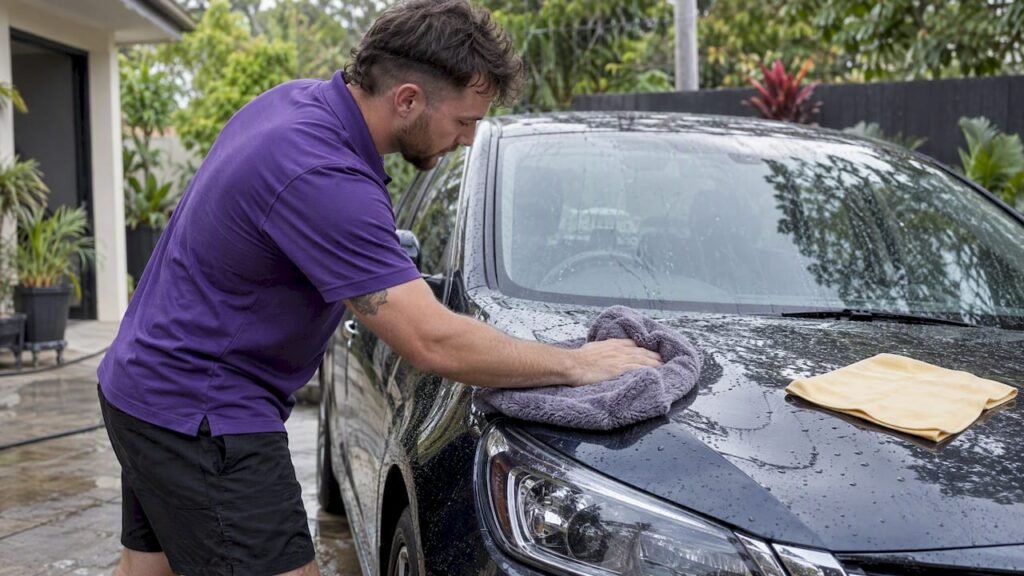
For most cars, a plush or twisted-loop microfibre towel is the better drying tool. It holds more water, cushions stray grit away from the paint and is easy to wash. A chamois still has a place: it is quick to wring out, handy for glass, and fine on a clean car if you accept the extra care it needs. The detail that decides the result is less the material than how clean the surface and the cloth are when they touch.
Below we compare the two on the things that matter, explain how to dry a car without leaving swirls, and cover how to look after each cloth. We also cover the environmental trade-off with microfibre, which many owners on the Sunshine Coast ask us about.
TL;DR
- Microfibre wins for paint safety and capacity. A deep pile gives grit somewhere to go, and a large towel can dry a whole panel in one or two passes.
- A chamois is fast to wring and good on glass, but it has no pile, so any grit left on the paint is dragged straight across it.
- Care decides the outcome. Wash microfibre separately with no fabric softener or bleach. Keep a chamois clean and damp, never left to dry hard and dirty.
- Sheet the water first. Letting water run off panels before you touch the car cuts the friction you need from either tool.
- Buy fewer, better towels. Quality microfibre lasts longer and sheds less plastic over its life than cheap disposable cloths.
Table of Contents
- The short comparison
- How a chamois works, and where it falls short
- How microfibre differs
- Which one for which car
- Drying is a technique, not just a tool
- Looking after each cloth
- The environmental trade-off
- Our perspective
- When it is worth leaving it to us
- Drying the interior and other surfaces
- FAQ
- Sources
The short comparison
| Microfibre drying towel | Chamois (natural or synthetic) | |
|---|---|---|
| Paint safety | Deep pile cushions grit; plush or flagged-tip types are gentlest | No pile, so trapped grit is pressed into the paint |
| Water capacity | High, especially twisted-loop designs | Good for its size, but you wring it often |
| Speed on a large vehicle | Fast with a big towel | Slower; more wringing and more passes |
| Best on | Paint, large panels, dark or soft paint | Glass, small flat areas, quick touch-ups |
| Washing | Machine washable with the right detergent | Hand rinse; keep it damp and clean |
| Main weakness | Ruined by fabric softener, bleach or a dirty wash | Drags contamination, can stiffen and tear |
| Environmental angle | Sheds synthetic microfibres in the wash | Natural versions avoid that, but synthetic ones are common |
How a chamois works, and where it falls short
A chamois is a flat, smooth sheet that soaks up water like a sponge. Traditional ones are leather. Many sold today are synthetic, and these are still popular where speed matters. Synthetic chamois remain common in high-volume commercial detailing because they wring out quickly and are simple to use.
The trouble is structural. A chamois has no deep pile to act as a cushion. If a speck of grit is still on the paint when you wipe, a flat surface presses it against the clear coat. Professionals warn this raises the risk of swirl marks, and it is a big reason many detailers have moved to plush or twisted-loop microfibre for premium work.

That does not make a chamois useless. On a car that has been properly washed and sheeted, a clean, wet chamois does a decent job, and plenty of owners have used one for years without trouble. The risk is cumulative and depends on your wash method. If your car is dusty, parked under trees, or you dry it after a quick bucket wash, the margin for error shrinks.
How microfibre differs
Microfibre is a blend of polyester and polyamide split into filaments far finer than a human hair. According to one Australian microfibre supplier, the polyester does the scrubbing and the polyamide does the absorbing, and a higher polyamide share gives a softer, more absorbent cloth.
For drying, three construction types matter:
- Twisted-loop towels are the heavyweights. They are preferred by professionals and enthusiasts for speed and water-holding capacity. A large one, around 90 cm x 60 cm, suits 4WDs and caravans.
- Waffle-weave towels dry out faster between jobs, which makes them good for glass and smaller vehicles.
- Plush, flagged-tip towels are the softest option. For delicate or classic paint, guidance from an Australian car care brand recommends them for their lower risk of micro-scratches. Smaller 70 cm x 40 cm plush towels are easier to handle for precise work.
Density matters too. A denser towel holds more water, so a thin, cheap cloth will leave you wringing and re-wiping, which means more contact with the paint.
Which one for which car
There is no single winner for every driver. Here is how we would match tool to vehicle:
- Dark or black paint, new cars, soft clear coats: a plush or twisted-loop microfibre towel. These finishes show every defect.
- Large vehicles such as a 4WD, ute, van or caravan: a big twisted-loop towel. Drying that much surface with a chamois means constant wringing.
- Small hatchback, light colour: a medium waffle-weave or plush towel will be quick and easy to handle.
- Windows and mirrors: a waffle-weave towel or a clean chamois both work. Keep a separate cloth for glass so wax or sealant residue from the paint does not smear across the windscreen.
- Coated or sealed paint: a soft microfibre towel, used with light pressure. If your car has a ceramic or graphene coating, you are protecting a finish worth looking after, so avoid anything that can drag grit.
Drying is a technique, not just a tool
The biggest improvement most owners can make costs nothing: reduce how much water you have to wipe. Try the sheeting method. Take the nozzle off the hose and let a gentle stream flood the panels, so most of the water runs off in one sheet before a towel touches the car. Combined with a drying aid or a hydrophobic sealant, drying becomes faster and safer because there is less friction.
A simple routine:
- Wash properly first. Rinse thoroughly, wash with a clean mitt and rinse again. Grit left on the paint is what causes damage in the drying stage.
- Sheet the water with the open hose from the top down.
- Lay the towel flat and pull it across the panel in one direction. Skip circles and hard scrubbing.
- Use a second, drier towel for the last streaks and for door jambs and mirrors.
- Do it out of direct sun. On the Sunshine Coast, summer heat can bake water spots onto paint in minutes, so dry in shade or early in the morning.
- Treat drying as the last step of the process. A dirty or badly washed towel can undo hours of preparation.
If you wash at home, our guide to a car detailing workflow at home with less harmful runoff covers the wash stage in more detail.
Looking after each cloth
Microfibre care
A common mistake is treating microfibre as set-and-forget. The towel works as an extension of your products, and a clogged one will leave marks on a finish you spent time protecting.
- Wash microfibre separately from other laundry, otherwise lint transfers onto the fibres.
- Skip fabric softener, bleach and fragrances. Softener coats the fibres and fills the gaps that absorb water, so an expensive towel ends up smearing water instead of lifting it.
- Use a dedicated microfibre wash and dry on a cool or warm setting, according to Australian care guidance.
- If the pile has matted, brushing it gently by hand while air-drying with a hairdryer can help restore some of the plush texture.
- Retire any towel that has dropped on the ground, even once. Grit embeds deep and a wash will not reliably remove it.
Chamois care
- Rinse it thoroughly in clean water after every use and wring it out gently.
- Store it damp in a clean container, or follow the maker’s instructions. Many natural chamois go stiff if they dry out dirty.
- Keep it away from detergents and solvents unless the maker says otherwise.
- Replace it when it hardens, tears or no longer feels smooth. A rough chamois on paint is a bad trade.
In general, a chamois is simpler to maintain by hand and a microfibre towel is simpler to maintain if you own a washing machine and use the right detergent. Neither is fussy once it becomes a habit.
The environmental trade-off
If you care about the environment, microfibre has a real downside. Synthetic textiles shed fibres in the wash, and NSW EPA notes that washing synthetic textiles is a significant source of microplastic pollution. The same page says the Commonwealth Government has committed to action under the National Plastics Plan 2021, and Western Australian research from 2019 links synthetic textiles and laundry water to marine microplastic pollution. WasteSorted says a single synthetic item can shed more than 1,900 microfibres each time it is washed.
That does not mean avoiding microfibre. It means using it sensibly:
- Buy fewer, better towels that last for years instead of bags of cheap cloths that you replace each season.
- Wash only when the towels need it, and with full loads.
- Use a washing machine with a finer filter where you can, or add a laundry filter bag. Government environment departments recommend this approach in the WasteSorted laundry advice.
If you want a leather chamois for this reason, that is a fair choice, as long as you accept the care it needs and keep the car very clean before you dry it. For more on greener habits, see our simple steps for eco-friendly car cleaning.
Our perspective
We detail cars on driveways, at workplaces and near the beach across the Sunshine Coast, so we see what salt air, dust and sun do to paint every week. Our view is simple. The towel is the last thing to touch the paint before it is protected, so it should be the softest and cleanest thing in the process.
That is why, on paint we are going to polish or protect, we lean on plush or twisted-loop microfibre rather than a chamois. A chamois is not wrong, but it leaves less room for error, and a coated or freshly corrected finish is not the place to test it. We keep cloths for glass, paint and interiors separate, and we retire any that have been dropped.
We also try to be honest about the trade-off. We use eco-friendly products where we can, and we would rather own fewer good towels and look after them than churn through cheap ones. If you are drying your own car, buying one large, quality towel and washing it properly will serve you better than a stack of bargain cloths.
— isaac’s
When it is worth leaving it to us
If the car already has swirls, or you want to protect the paint properly after a polish, drying technique is only part of the story. We come to your home, workplace or a spot near the beach and carry out the work on site.
Our Deluxe Detail and Revival Detail cost 375-575 AUD and 575-775 AUD, depending on vehicle size and package. If you want a longer-lasting finish, look at our ceramic coating service or the graphene spray sealant package at 339-739 AUD. For defects in the paint, see our cut and polish service. Our ceramic coating lifespan guide explains how washing and drying habits affect how long a coating lasts.
Drying the interior and other surfaces
A few jobs call for a different cloth altogether. After shampooing seats or carpets, a clean, dry microfibre cloth helps lift surface moisture, but extraction does the heavy lifting. Our car fabric protection workflow explains why you clean first and protect after. For a family car with pets, our guide to keeping pet-friendly cars clean and fresh covers what to use inside.

Keep exterior and interior cloths apart. A towel that has wiped wheel arches or door sills should never go near paint. Labelling or colour-coding your cloths removes the guesswork, and it takes a minute to set up.
FAQ
Is a chamois or a microfibre towel better for drying a car?
For most cars, microfibre is better. It holds more water, cushions grit in its pile and is easy to wash. A chamois can work on a very clean car and suits glass, but it has no pile, so any grit on the surface is dragged across the paint.
Does a chamois scratch paint?
A clean, wet chamois on a properly washed car is unlikely to cause obvious damage. The risk comes from leftover grit, because a flat surface has nowhere to put it. Over repeated washes this can add fine swirl marks, especially on dark paint.
What are the downsides of microfibre towels?
They need correct care: no fabric softener, bleach or fragrance, and a separate wash. A dirty or clogged towel can mark paint. They also shed synthetic fibres in the wash, so use a filter and buy a few good towels rather than many cheap ones.
Can I use a microfibre towel on a ceramic-coated car?
Yes, and it is the safest choice. Use a clean, soft, plush or twisted-loop towel with light pressure, and sheet the water off first. Avoid abrasive or worn cloths, and never use one that has touched the ground.
Sources
- Your essential car washing guide
- Microfibre drying towels: safe and effective drying
- Keeping your microfibre clean and working like new
- A simple guide to washing, drying and protecting your car
- Car drying towels and chamois
- Microfibre for car detailing and automotive
- Plastics Plan 2.0, NSW EPA
- Microplastic pollution and synthetic textiles study, Western Australia
- In your laundry, WasteSorted