
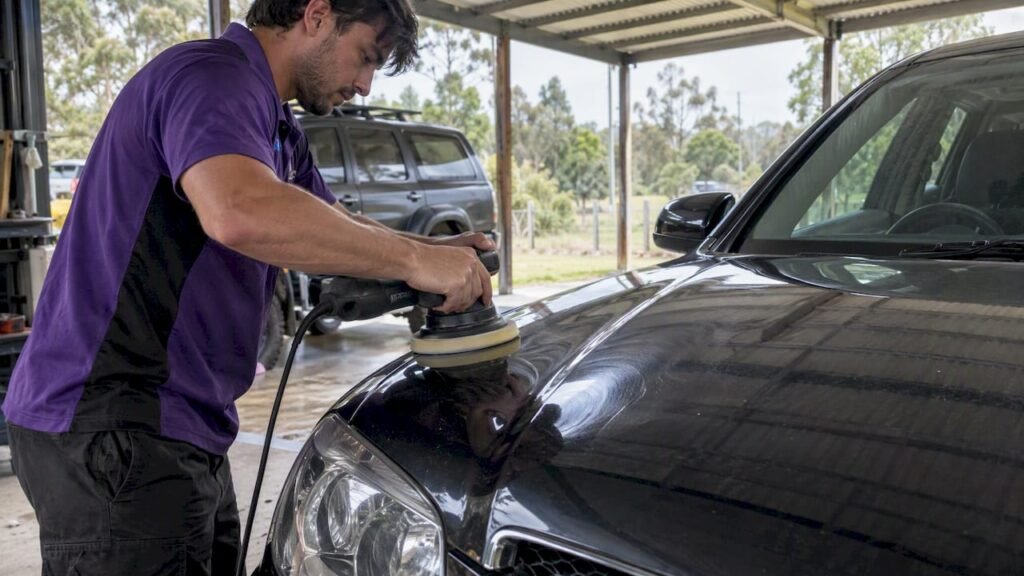
Mostly, they are the same job under two names. Both mean machine polishing the paint with abrasives to level out defects such as swirls, light scratches and oxidation. The real difference is how much work is done and how it is measured. A “cut and polish” is often sold as a quick refresh of gloss. “Paint correction” usually promises a more deliberate, defect-by-defect result. Ask any detailer what they mean by the term before you compare quotes.
TL;DR
- Cut and polish and paint correction both describe machine polishing. The label matters less than the number of stages, the inspection and the paint-thickness checks behind it.
- A single-stage polish suits light swirls and dull gloss. Deeper scratches and heavy oxidation need a cutting stage followed by a finishing polish.
- Every cut removes some clear coat, and clear coat is finite. More aggressive is not better.
- Correction only pays off if you then protect the paint. On the Sunshine Coast, UV and salt make that step important.
- Ask for a test patch before the whole car is cut.
Table of Contents
- Why the same job gets two names
- What the stages actually involve
- Is paint correction worth it?
- Which one do you need?
- What does it cost on the Sunshine Coast?
- Protect the paint afterwards
- Our perspective
- Book a cut and polish at your place
- FAQ
- Sources
Why the same job gets two names
Search this topic and you will find detailers saying the terms are interchangeable, and others saying they are quite different. Both are partly right.
Machine polishing uses a rotary or dual-action polisher, a pad and an abrasive liquid. The abrasive shaves a very thin layer off the clear coat, the transparent top layer of modern paint, so the surface is flat again. Scratches and swirl marks are grooves in that layer. Level the surface and the grooves disappear. They are not filled in.
The terms drifted apart in the trade like this:
- Cut and polish is the older, blunter phrase. To some people it means a one-pass shine-up. To others it means a proper two-step: cut with a more aggressive compound, then polish with a finer one to restore clarity.
- Paint correction is the newer phrase. It suggests a process led by inspection: lights to find the defects, test panels to choose the pad and product, and a plan for how much paint to take.
So the useful question is not “which one is better?” It is “how many stages, on which panels, and how will you know when to stop?”
What the stages actually involve
Detailers talk about one-, two- and three-stage work. The stage count describes how many passes with different pad and polish combinations the car gets.
| Approach | What it does | Suits | Trade-off |
|---|---|---|---|
| One-stage polish | A single pass to lift light swirls and bring back gloss | Newer or well-kept cars, dull but not damaged paint | Will not remove deeper scratches |
| Two-stage (cut then polish) | A cutting pass for defects, then a finishing pass for clarity | Daily drivers with visible swirls, water spotting, mild oxidation | Takes more time and removes more clear coat |
| Multi-stage correction | Several passes, often panel by panel, tailored to each area | Neglected paint, heavy swirling, a show-finish goal | Highest cost, most clear coat used, needs the most skill |
Each added stage takes more time, so the price rises. That is fair only when the extra stage is needed. Detailers who list higher prices for “more” stages without saying what is involved are the ones to question.
Good work is also led by inspection. Detailers use bright LED or colour-corrected lights to find swirls, oxidation, scratches and etching that the naked eye misses, checking from several angles and distances, as one Australian coating guide describes.
Is paint correction worth it?
It is worth it when the defects bother you, the paint has enough clear coat left, and you plan to protect the result. It is not worth it as a repeating annual treatment.
It tends to be worth it when:
- you are about to apply a ceramic coating and want to lock in a clean surface rather than coat in the swirls
- the car is new to you and the paint looks tired in sunlight
- you are selling and the gloss will help the first impression
- the car is a keeper and you want it to look its best
It tends not to be worth it when:
- the scratches are deep enough to catch a fingernail. Polishing will soften them but not remove them, and chasing them risks the clear coat
- the paint is already thin from earlier polishing, or has been resprayed with unknown film thickness
- the clear coat is failing, peeling or flaking. That needs a refinisher, not a polisher
- you wash at the servo brush every week and the swirls will be back in a month
The clear coat is not renewable
This is the part many owners are never told. Correction does not restore paint. It removes a little to level out what is left. Clear coat is thin, and aggressive cutting uses up your margin each time. That is why a competent detailer takes a small test patch first and works out the least aggressive pass that gets the result. We cover this approach in our guide to paint correction stages and the PTG and 2×2 tests.
A paint thickness gauge (PTG) reads the paint depth in different spots, so you know whether a panel has room to be cut. The 2×2 test is a small square of paint polished first so you can see the result before committing the car. If you want a more specific read on the single-stage side, see why a 2×2 test patch saves paint before a single-stage polish.

Which one do you need?
Match the defect to the process rather than the label.
Light swirls and dull gloss
These are the fine circular scratches you see in direct sun, usually from automatic car washes, dry wiping or dirty wash mitts. A one-stage polish is often enough. Our article on removing swirl marks while preserving clear coat explains how to judge it.
Water spots and etching
Fresh spots may only be mineral deposits sitting on top and can come off with chemistry, not abrasion. Spots that have etched into the clear coat need polishing. Test the gentler option first. We lay out DIY water spot removal against a mobile pro for that decision.
Oxidation and faded paint
Oxidised paint looks chalky or cloudy, common on cars that live outside under strong Queensland sun. A cutting stage followed by a finishing polish usually brings it back, provided there is clear coat left. If the surface looks peeling or has lost its gloss entirely at the edges, stop and get the paint assessed before anything is cut.
Polish or wax?
Polish changes the paint surface. Wax only sits on top and adds temporary protection. If you are unsure which one the car needs, our 50x50mm test for polish versus wax gives a simple way to tell.
What does it cost on the Sunshine Coast?

Cut and polish pricing varies with vehicle size, paint condition and how many stages are needed. We do not publish a flat price for a standalone cut and polish because a hatchback with light swirls and a dual-cab ute with years of oxidation are different jobs. We quote after seeing the car, and you can start from our cut and polish page.
For context, our published detail packages are:
| Package | Published price |
|---|---|
| Deluxe Detail | 375-575 AUD |
| Revival Detail | 575-775 AUD |
| The “holy Grail” detail | 600-1000 AUD |
| Ultimate Protection Package | 1500-2200 AUD |
The ranges reflect vehicle size and package. See the Deluxe and Revival Detail page and the Holy Grail detail page for what each includes.
When you compare quotes from different detailers, look for these things rather than only the total:
- How many stages are included, and on which panels
- Whether paint thickness is measured
- Whether a test patch is done first
- Whether protection (sealant or coating) is included or extra
- Where the work is done, and whether it is indoors or in shade
Protect the paint afterwards
A freshly corrected panel is bare. It has no old wax, no sealant and a very clean surface. If you leave it unprotected under Sunshine Coast UV, you are paying to start the clock again.
Options run from a sealant through to a ceramic coating. RACV explains that a ceramic coating is a liquid polymer that forms a chemical bond with the paint, giving a hydrophobic, glossy surface that helps guard against UV, oxidation and bird droppings. Longevity varies a lot. Drive’s guide to coatings says a coating can last anywhere from 12 months on a street-parked, rarely washed car to five years or more, and that it needs maintenance and the occasional top-up. It is not a lifetime shield.
If you are weighing options, our guides on ceramic coating for Sunshine Coast car owners and how to extend ceramic coating lifespan go into the detail. One caution: coatings are hard to take off, so read about ceramic coating removal risks before you decide.
Our perspective
We are a mobile detailer, so we see cars in driveways, car parks and at the beach, in the light they actually live in. A few things we have learned shape how we approach correction.
The label is a sales word. We would rather describe what we will do to your paint: what defects we found, how many passes the car needs, and what we will leave alone. Where a car only needs a light polish, we say so.
Stopping early is a skill. The goal is not to remove every mark. It is to get a result you are happy with while leaving as much clear coat as possible for the next owner, and for the next polish years from now.
Protection is part of the job, not an upsell. If we correct paint and then send the car back into a Sunshine Coast summer with nothing on it, we have not finished. That is why our packages are built around protection, including our ceramic coating service, and why our positioning is all-inclusive packages with no hidden extras. We also use eco-friendly products and stand behind our work with a 100% satisfaction guarantee.
A test patch costs a few minutes and tells you both what is possible and what is not. We would rather you see it before we commit to the whole car.
— isaac’s
Book a cut and polish at your place
We come to your home, workplace or wherever the car is parked across the Sunshine Coast. If you are not sure whether you need a light polish or a full correction, tell us about the car and the marks you see, and we will advise on the right level. Start with the cut and polish page, or see all our services from the Isaac’s Pro Detailing home page.
FAQ
Is paint correction just polishing?
In practice, yes: it is machine polishing with abrasive compounds to level the clear coat. What makes it “correction” is the planning around it, meaning inspection under proper lights, test patches, paint thickness checks and a stage count matched to the defects.
Should I cut and polish or just polish?
If the defects are light swirls and dull gloss, a single polish usually does it and removes the least paint. If you have visible scratches, water etching or oxidation, a cutting stage first is needed, followed by a finishing polish. A test patch will show which one your paint needs.
What’s the difference between cutting and polishing?
Cutting uses a more aggressive pad and compound to remove defects faster, and it takes more clear coat. Polishing uses a finer combination to refine the surface and bring back clarity and gloss. Most two-stage jobs use both, in that order.
How long does a cut and polish last?
The correction itself is permanent, because the defects are levelled out, not filled. The gloss lasts only as long as you keep the paint from new damage. Improper washing will bring swirls back, and unprotected paint will dull under UV, so washing technique and a sealant or coating decide how long it looks fresh.
Can I repeat paint correction every year?
Not sensibly. Each cutting stage removes clear coat, which cannot be replaced. A light polish now and then is much less risky than repeated heavy cutting, and a thickness gauge will tell you how much margin the panel has.