
TL;DR:
- Car cleanliness significantly influences buyer perception, valuation, and the speed of vehicle sales. Maintaining a clean vehicle can increase resale value by up to 20% and positively impact negotiation outcomes. Consistent professional detailing and a well-maintained sales environment help sellers maximize their revenue and build buyer trust.
Car cleanliness is a direct driver of sales performance, shaping buyer trust, vehicle valuation, and the speed at which deals close. A dirty car signals neglect before a buyer reads a single spec sheet. Clean vehicles, by contrast, command higher asking prices, attract more serious buyers, and give sales professionals a stronger negotiating position. Understanding why car cleanliness affects sales performance is not optional for anyone serious about maximising revenue from vehicle sales.
How does car cleanliness influence buyer perception during sales?
Buyers form opinions about a vehicle within seconds of seeing it. That first impression is almost entirely visual and sensory, and cleanliness controls both. A spotless exterior, a fresh-smelling cabin, and streak-free glass all communicate one thing: this vehicle has been cared for. Buyers translate that care into confidence about the mechanical condition of the car, even before they open the bonnet.
Research confirms this effect is measurable. Customers spend up to 15% more time inside clean retail spaces like car showrooms. More time spent inspecting a vehicle means more emotional investment, and more emotional investment means a higher likelihood of purchase.
The olfactory dimension is underestimated by most sellers. A musty or stale interior triggers an instinctive negative reaction that buyers struggle to articulate but cannot ignore. Neutral, fresh-smelling cabins remove that subconscious barrier entirely. Clean showrooms signal brand quality and encourage positive psychological responses, with environmental cues like streak-free glass directly influencing perceived brand integrity.
Key factors that shape buyer perception through cleanliness:
- Exterior shine: Swirl-free paint and clean tyres suggest the owner took pride in the vehicle.
- Interior condition: Stain-free seats and clean carpets imply careful daily use.
- Odour neutrality: A fresh cabin removes a common reason buyers walk away.
- Glass clarity: Clean windows signal attention to detail throughout.
Pro Tip: Schedule a professional interior extraction and exterior wash at least 48 hours before any viewing or open-day event. This gives surfaces time to dry fully and odours to dissipate, so the car presents at its absolute best.
What is the impact of vehicle cleanliness on car valuation and sales price?
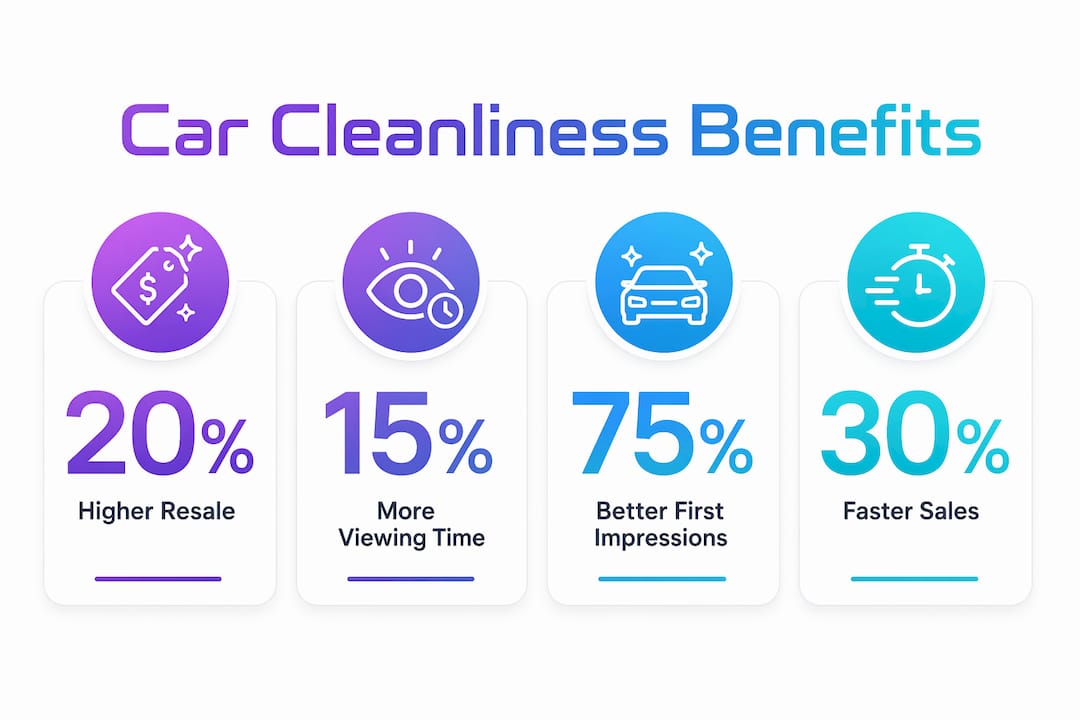
Vehicle presentation has a direct and quantifiable effect on the price a seller can achieve. Professional detailing increases a vehicle’s resale value by 15% to 20%. That figure is not cosmetic. It represents real dollars recovered from an investment that typically costs a fraction of the value gained.
The negotiation dynamic shifts entirely when a car is immaculate. A spotless vehicle interior reduces buyers’ ability to negotiate price reductions based on visible flaws. Buyers use scuffs, stains, and worn surfaces as leverage to justify lower offers. Remove those friction points and you remove their ammunition.
The concept of “friction points” deserves specific attention. Scuffed door sills and worn seats are psychological cues buyers use to assess owner care. Visible marks imply potential neglect of mechanical aspects, which affects price offers even when the service history is perfect. A buyer who sees a dirty car assumes the worst about what they cannot see.
Practical ways cleanliness protects your sale price:
- Document your detailing: Keep receipts from professional services to present as proof of care during negotiations.
- Address high-wear areas first: Door sills, steering wheels, and gear knobs show wear fastest and attract the most scrutiny.
- Protect surfaces proactively: Fabric protection and interior care treatments prevent staining that is costly to reverse.
- Time your detailing correctly: A detail completed one to two weeks before listing gives protective coatings time to cure and surfaces time to settle.
The return on a professional detail is rarely matched by any other pre-sale investment. Repainting a bumper or replacing worn carpet costs far more than preventing the damage in the first place.
Why does vehicle presentation affect sales team performance and confidence?
The environment a sales team works in shapes how they perform. Clean showrooms boost sales team professionalism, making selling interactions smoother and more confident. Staff who present vehicles they are proud of engage buyers with more energy and conviction. That enthusiasm is contagious and buyers notice it.
The reverse is equally true. A sales professional who knows the car they are presenting has a stained headliner or a musty smell will unconsciously avoid drawing attention to the interior. That hesitation reads as evasiveness to buyers, which erodes trust at the worst possible moment.
Maintaining a fresh, clean sales environment elevates staff morale, leading to better customer interactions and smoother sales. This is not a soft benefit. It shows up in conversion rates and average deal values.
Benefits of a clean sales environment for your team:
- Reduced time spent apologising for or explaining away visible flaws.
- Stronger opening statements when presenting a vehicle that looks genuinely impressive.
- Higher confidence during price discussions because the product supports the asking figure.
- Fewer objections to manage, freeing up time for relationship building.
Pro Tip: Build a pre-presentation checklist for your sales team that covers exterior shine, interior odour, glass clarity, and tyre condition. A five-minute walk-around before every buyer meeting catches issues before they cost you a deal.
What are best practices to maintain car cleanliness for maximising sales success?
Consistent maintenance outperforms reactive cleaning every time. Proactive, regular detailing is more effective and cost-efficient than late-stage restoration attempts. A vehicle maintained on a regular schedule never reaches the point where a costly rescue clean is needed. That saves money and preserves value simultaneously.
A practical maintenance framework for sales-focused vehicle owners:
- Schedule professional detailing at least twice yearly. For high-kilometre or frequently used vehicles, quarterly detailing is the better standard. This keeps paint protection intact and interiors fresh without requiring major intervention.
- Apply fabric and leather protection after every interior clean. Protection treatments repel spills and reduce staining, which is the single most common reason buyers discount a vehicle’s interior condition.
- Use model-specific protection for high-traffic areas. Door sills, boot lips, and centre consoles take the most punishment. Targeted protection films or coatings on these areas prevent the friction points that buyers use to negotiate.
- Photograph vehicles immediately after detailing. Listing photos taken on a clean vehicle in good natural light generate more inquiries than photos taken days later when dust and water spots have returned.
- Avoid last-minute rescue cleans. A rushed clean the morning of a viewing rarely removes embedded odours or deep staining. It also risks water spots on glass and streaks on paintwork that make the car look worse than before.
| Cleaning approach | Outcome |
|---|---|
| Regular scheduled detailing | Preserves value, prevents deep staining, reduces negotiation leverage for buyers |
| Reactive pre-sale clean | Removes surface dirt but rarely resolves embedded odours or worn surfaces |
| No pre-sale preparation | Maximum buyer negotiation leverage, longer listing time, lower final sale price |
The detailing approach that saves money is always the one that starts early. Waiting until a vehicle is listed to address its condition is the most expensive decision a seller can make.
How does car cleanliness integrate with online sales and customer expectations?
Online listings are now the first point of contact for the majority of vehicle buyers. Buyers decide within seconds whether to inquire about a car based on photo quality and vehicle presentation. Listings with poor photos and an unclean vehicle attract fewer inquiries and sit on the market longer. That extended listing time compounds costs and reduces final sale prices.
A clean vehicle transforms listing photography. Reflections are sharper, paint depth is visible, and interiors look inviting rather than lived-in. These qualities are impossible to fake with editing and immediately apparent to experienced buyers scrolling through dozens of listings.
Cleanliness also drives online reputation. Buyers who inspect a vehicle in person after seeing polished listing photos expect the car to match. When it does, reviews reflect that consistency. When it does not, the gap between expectation and reality generates negative feedback that damages future sales.
Practical steps for maximising online presentation:
- Shoot in open shade or on overcast days. Direct sunlight creates harsh reflections and hides paint depth. Overcast light reveals true colour and surface condition.
- Clean the background as well as the car. A cluttered driveway or dirty workshop floor undermines even a perfectly detailed vehicle in photos.
- Capture the interior from the driver’s door opening. This angle shows the full dashboard, seats, and carpet in one shot, and a clean interior at this angle is immediately compelling.
- Use the listing photos as a quality benchmark. If the car does not look as good in person as it does in the photos, schedule another detail before viewings begin.
The visual impact of detailing extends well beyond the physical inspection. It shapes the buyer’s expectations before they ever contact you, and meeting those expectations is the foundation of a smooth, high-value sale.
Key takeaways
Vehicle cleanliness directly increases sale price, reduces buyer negotiation leverage, and shortens time on market, making it one of the highest-return investments a seller can make.
| Point | Details |
|---|---|
| Cleanliness drives valuation | Professional detailing adds 15%–20% to resale value, outperforming most other pre-sale investments. |
| Buyer perception is immediate | Buyers form opinions within seconds, and a clean car removes the subconscious objections that stall deals. |
| Friction points cost money | Scuffs, stains, and odours give buyers leverage to negotiate lower prices, even when the service history is perfect. |
| Regular care beats rescue cleans | Scheduled detailing preserves condition and avoids the higher cost of late-stage restoration before sale. |
| Online presentation is critical | Clean vehicle photos generate more inquiries and set buyer expectations that support the asking price. |
What I have learned from watching clean cars outsell dirty ones
After years of working with vehicle owners across the Sunshine Coast, the pattern is impossible to ignore. The cars that sell fastest and closest to asking price are almost never the newest or the lowest-kilometre. They are the ones that have been consistently cared for and presented with intention.
What surprises most sellers is how little it takes to shift a buyer’s psychology. A clean door sill, a fresh-smelling cabin, and a streak-free windscreen do more for a sale than a freshly serviced engine that the buyer cannot see. Buyers buy what they can perceive. Cleanliness is the most visible signal of value available to any seller.
The sellers I see leave money on the table are the ones who treat cleaning as a last-minute task rather than an ongoing investment. They spend more on a rushed pre-sale detail than they would have spent on six months of regular maintenance, and they still achieve a lower price because the embedded wear cannot be undone in a single session.
My honest advice: treat your vehicle’s presentation as part of your sales strategy from the day you acquire it. Every clean, every protective treatment, and every scheduled detail is a deposit into the value you will recover at sale time. The return is real, it is measurable, and it consistently exceeds the cost.
— Isaac’s
Professional detailing that supports your sales outcomes
A well-presented vehicle is not an accident. It is the result of consistent, professional care applied at the right intervals. Isaac’s Pro Detailing Sunshine Coast provides fully mobile detailing services across the Sunshine Coast, coming to your home, workplace, or wherever your vehicles are located. From comprehensive interior extractions and exterior cut and polish to advanced ceramic coatings that protect paint for years, every service is designed to maximise the condition and value of your vehicle. For sellers and fleet operators who want their vehicles to command the strongest possible price, explore the car detailing services that deliver a measurable return at sale time.
FAQ
Does a clean car actually sell for more money?
Professional detailing adds 15%–20% to resale value, making it one of the most cost-effective pre-sale investments available to any seller.
How does car condition affect a buyer’s negotiation position?
A spotless vehicle removes the visible flaws buyers use to justify lower offers. Presentation communicates care, which limits the negotiation leverage available to the buyer.
How often should I detail a vehicle I plan to sell?
Regular scheduled detailing at least twice yearly is more effective and cost-efficient than a single pre-sale clean. High-use vehicles benefit from quarterly attention.
Why do online listings perform better with clean vehicles?
Buyers decide within seconds based on photo quality, and a clean vehicle produces sharper, more appealing images. Poor presentation leads to fewer inquiries and longer time on the market.
Does showroom cleanliness affect sales staff performance?
Clean showrooms directly improve staff confidence and the quality of buyer interactions. Well-maintained spaces positively affect employee behaviour, which buyers notice and respond to during the sales process.