
TL;DR:
- Car paint on Sunshine Coast cars is more fragile than it appears due to UV radiation, salt air, and coastal grime. Proper protection methods like PPF and ceramic coatings address different damage types and should be layered strategically for optimal durability. Regular professional maintenance and surface prep are essential to maximize paint protection across busy lifestyles.
Your car’s paint looks tough, but it’s far more fragile than it appears. Understanding why protect car paint matters is the difference between a vehicle that holds its value and one that fades, chips, and corrodes faster than it should. On the Sunshine Coast, where intense UV radiation, salt air, and coastal grime are daily realities, paint degradation happens faster than in most other parts of Australia. This guide breaks down exactly what’s attacking your paint, which protection methods actually work, and how to keep your car looking sharp without adding another job to your already full week.
Table of Contents
- Understanding why your car’s paint needs protection
- Comparing paint protection options: film, ceramic coatings and wax
- How UV stabilisers and coatings preserve your car’s finish
- Practical paint protection advice for busy Sunshine Coast car owners
- Comparing impact protection and chemical resistance: why combine methods?
- A fresh look at car paint protection for busy Sunshine Coast owners
- How professional detailing services ease paint protection for Sunshine Coast owners
- Frequently asked questions
Key Takeaways
| Point | Details |
|---|---|
| Protection prevents paint damage | Active paint protection shields your car from UV, chemicals and physical harm that degrade the finish. |
| Layer methods for best defence | Combining paint protection film with ceramic coatings covers both physical impact and chemical/UV damage. |
| Maintenance prolongs protection | Regular professional detailing every 6 to 12 months keeps protective barriers effective and your paint glossy. |
| Focus on vulnerable areas | Prioritise protection on front bumpers, bonnet, mirrors, and headlights where damage is most common. |
| Professional services offer convenience | Using expert detailing saves time and ensures high-quality application for lasting paint protection. |
Understanding why your car’s paint needs protection
Most people assume their car’s paint is impervious once it leaves the factory. It has a clear coat on top, after all. What’s the worry? The reality is that the clear coat, the transparent outer layer that gives paint its gloss, is under constant attack the moment you drive off the lot.
UV radiation and acid rain break down the clear coat’s chemical bonds over time, creating microscopic damage that compounds with every passing month. Once that clear coat is compromised, the colour coat beneath fades, oxidises, and loses adhesion. At that point, you’re looking at a respray rather than a polish.
The hazards most Sunshine Coast drivers underestimate include:
- UV radiation: Queensland’s UV index regularly sits at extreme levels, accelerating paint oxidation and gloss loss significantly faster than southern states
- Bird droppings and tree sap: Both are acidic and will chemically etch into your clear coat within hours on a hot day, leaving permanent marks if left untreated
- Salt air and coastal fallout: Living near the coast means iron particles and salt deposits bond to your paint constantly, causing corrosion beneath the surface
- Road contaminants: Tar, brake dust, and industrial fallout embed in the clear coat, dulling the finish and making paint feel rough to the touch
The single biggest mistake Sunshine Coast car owners make is waiting until damage is visible before taking action. By then, the clear coat has already lost significant protection capacity, and correction becomes expensive.
Knowing the car paint protection steps relevant to your local environment makes a genuine difference to how long your paint lasts.
Comparing paint protection options: film, ceramic coatings and wax
Not all protection is created equal. The three main options — paint protection film (PPF), ceramic coatings, and traditional wax — each solve different problems. Picking the right one, or the right combination, depends on your priorities.
PPF is a clear, impact-resistant layer applied to panels prone to physical damage. Think stone chips on the bonnet, scratches on door edges, and road debris hitting your front bumper. Premium PPF films are self-healing: minor swirl marks disappear with heat. This is physical armour for your paint.
Ceramic coatings create a durable barrier that resists UV exposure, chemical contaminants, and makes the surface hydrophobic, meaning water and grime bead off instead of bonding to the surface. A properly applied ceramic coating can last two to five years. This is chemical and UV armour.
Wax, by contrast, sits at the entry level. It offers a temporary cosmetic shine and mild surface protection, but breaks down within weeks and provides little resistance to UV or chemical attack.
| Protection type | Physical impact resistance | UV and chemical protection | Longevity | Maintenance frequency |
|---|---|---|---|---|
| PPF | Excellent | Moderate | 7 to 10 years | Low |
| Ceramic coating | Low | Excellent | 2 to 5 years | Low to moderate |
| Wax | None | Minimal | 4 to 8 weeks | High |
The benefits of car paint protection become clearest when you understand that these methods are not competing alternatives. They are complementary layers. PPF on high-impact zones, ceramic coating over the full vehicle, and an occasional maintenance wash: that’s the approach that covers all damage types without demanding much of your time.
Pro Tip: If you’re new to paint protection and want to know where to start, a ceramic coating guide tailored to Sunshine Coast conditions will save you time and money by steering you toward options that suit our climate specifically. See also this paint protection guide for a full breakdown of your options.
How UV stabilisers and coatings preserve your car’s finish
Here’s something most detailing articles skip over, and it’s worth understanding if you want to make sense of why some coatings justify their price and others don’t.
UV damage works at a molecular level. UV photons from sunlight break the chemical bonds in your clear coat’s polymer chains. Over time, those broken chains create oxidation, chalking, and gloss loss. This is why older, unprotected cars develop that dull, faded look.
Quality coatings address this through two key mechanisms:
- UV absorbers: These molecules intercept UV radiation before it reaches the clear coat’s polymer structure, converting harmful UV energy into harmless heat that dissipates safely
- HALS (Hindered Amine Light Stabilisers): These compounds chemically scavenge the reactive radicals that UV exposure generates, then regenerate themselves to keep working. They essentially act as a self-renewing defence layer
UV stabilisers combining UV absorbers and HALS maintain paint gloss and adhesion by mitigating photodegradation from sunlight. This is exactly why professional-grade ceramic coatings contain these stabilisers and consumer-grade products often don’t, or include them in concentrations too low to matter.
For Sunshine Coast car owners, this distinction is critical. You’re parking under one of the highest UV indexes in Australia on a near-daily basis. A coating that contains proper UV absorbers and HALS is doing active protective work. A budget wax is simply not. The ceramic coating details explain exactly what to look for when choosing a product or service.
Practical paint protection advice for busy Sunshine Coast car owners
Car paint maintenance advice doesn’t have to be complicated. But it does have to be consistent. Here’s a realistic approach for owners who don’t have time to fuss over their car every weekend.
- Start with proper surface prep. No coating or film sticks properly to contaminated or damaged paint. Before any protection goes on, the surface needs to be decontaminated, corrected if necessary, and fully clean. Skipping this step locks in existing damage and compromises the coating’s bond.
- Choose protection that matches your lifestyle. Ceramic coating requires minimal ongoing attention. Wax requires reapplication every month or two. If you’re busy, the answer is clear: invest once in a coating that lasts years, not weeks.
- Schedule professional detailing every 6 to 12 months. Professional polishing every 6 to 12 months is a cost-effective, ongoing protection strategy that maintains the integrity of your coating and removes any contaminants before they cause permanent damage. This is far better value than dealer paint protection packages that often use inferior products at inflated prices.
- Keep contaminants off the surface promptly. Bird droppings, tree sap, and insect remains should be removed as soon as possible. On a hot Sunshine Coast day, these can etch into clear coat within a few hours.
- Use pH-neutral products for maintenance washes. Harsh detergents strip ceramic coatings prematurely. Use a pH-neutral car wash solution to extend the life of any protection you’ve invested in.
Pro Tip: Following the car paint protection steps in the correct order matters more than the quality of products alone. The preparation stage accounts for roughly 70% of the final result. Also check the paint protection maintenance tips to build a routine that fits your schedule.
Comparing impact protection and chemical resistance: why combine methods?
There’s a persistent misconception that one premium product can do everything. It can’t. PPF and ceramic coating solve fundamentally different problems, and understanding the distinction helps you spend wisely.
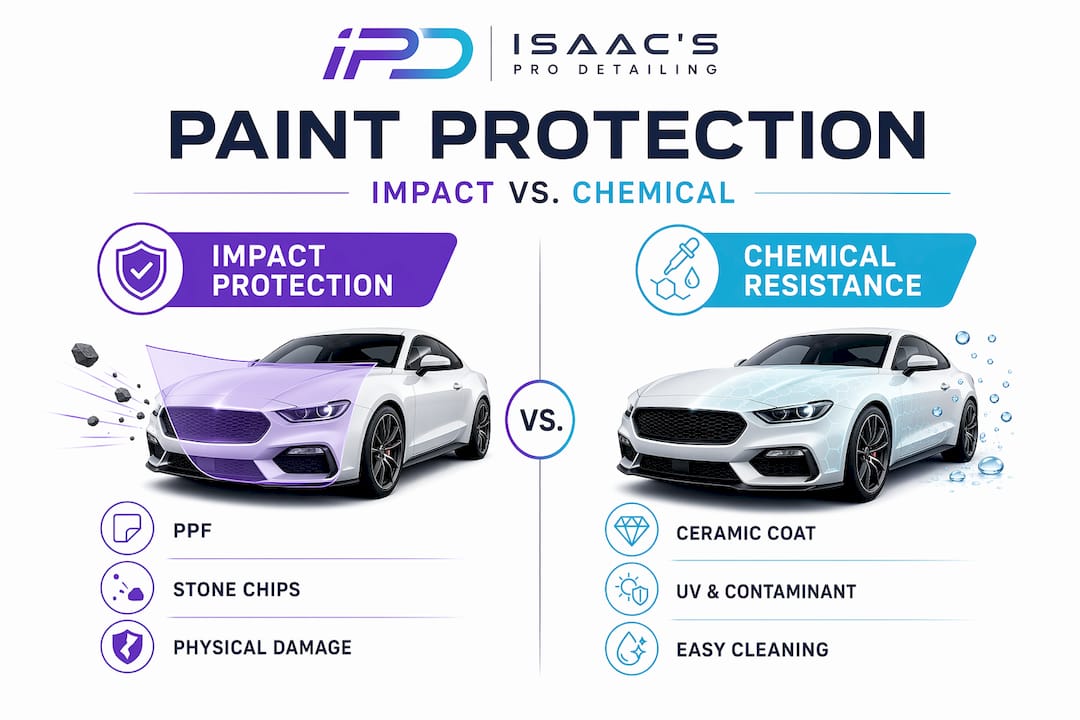
PPF targets physical impact protection, while ceramic coatings target chemical resistance and UV protection. Layering both addresses multiple failure modes for protection that no single product can match.
Think about a typical Sunshine Coast commute: highway driving kicks up stone chips toward your front bumper and bonnet. Then your car sits in a car park under direct sun for eight hours. Then it picks up bird droppings on the way home. You need PPF for the stone chips. You need ceramic for the UV and the acid. Wax handles neither effectively.
| Damage type | PPF | Ceramic coating | Wax |
|---|---|---|---|
| Stone chips | Excellent | No protection | No protection |
| UV fading | Moderate | Excellent | Minimal |
| Bird droppings and acid | Limited | Good | None |
| Water spots | Limited | Excellent | Moderate |
| Minor swirl marks | Self-healing (premium PPF) | Partial | None |
The best ways to protect car exterior typically involve prioritising PPF on the front bumper, bonnet, mirrors, headlights, and front guards, then applying ceramic coating across the full vehicle. This gives you layered defence without the cost of full-wrap PPF. The comprehensive paint protection guide walks through how to structure this approach based on your budget and how you use your vehicle.
A fresh look at car paint protection for busy Sunshine Coast owners
Here’s an opinion worth sitting with: most car owners overpay for protection they don’t understand and underpay for the maintenance that actually makes it work.
Dealer paint protection packages are the classic example. Sold at handover when you’re already exhausted from paperwork, they often include products applied in minutes by someone with minimal training. The importance of regular detailing as an ongoing practice delivers more value than most of these one-time dealer applications, yet it gets far less attention.
The real insight is this: preparation is the product. A ceramic coating applied over contaminated, swirl-marked paint is largely wasted money. That same coating applied over properly decontaminated, polished paint will last years and look exceptional throughout. Two completely different outcomes from the same bottle.
For busy Sunshine Coast owners specifically, the smartest approach is not the most expensive package, but the most appropriate one. PPF where you need physical protection. Ceramic where you need UV and chemical resistance. And a professional paint protection insights service that understands local conditions, preps the surface correctly, and isn’t trying to upsell you on products your car doesn’t need.
The people who get the best results from paint protection are not the ones who spend the most. They’re the ones who make informed choices and maintain what they have.
How professional detailing services ease paint protection for Sunshine Coast owners
Knowing what your paint needs and having time to do something about it are two very different things. That’s where Isaac’s Pro Detailing comes in.

As a fully mobile service operating across the Sunshine Coast, Isaac’s Pro Detailing comes to you at home, at work, or wherever suits your schedule. No dropping the car off, no waiting around. Professional-grade mobile car detailing means proper surface preparation, correct coating application, and ongoing care without the hassle of a traditional detailing shop. Whether you’re looking for a ceramic coating guide consultation or want to explore a full paint protection guide for your vehicle, the team uses premium products matched to our local environment. It’s expert paint protection that fits around your life.
Frequently asked questions
Is paint protection film necessary for daily driven cars?
PPF reduces damage from road debris and minor scratches on high-impact areas like front bumpers, mirrors, and guards, making it a worthwhile investment for any car driven regularly on Queensland roads. Even partial PPF coverage on vulnerable zones delivers meaningful protection without the cost of a full wrap.
Can ceramic coatings prevent all types of scratches?
Ceramic coatings add a hard, thin layer but are not scratch-proof and will not self-heal the way premium PPF does, so they are best understood as UV and chemical protection rather than physical armour.
How often should I get my car detailed to maintain paint protection?
Detailing every 6 to 12 months with professional polishing and protective product application maintains your paint’s condition and extends the life of any coating, at far better value than most dealer packages.
What areas of my car should I prioritise for paint protection?
PPF is typically installed on the front bumper, bonnet, mirrors, headlights, and front guards because these zones take the most punishment from road debris, stone chips, and daily contact damage.