
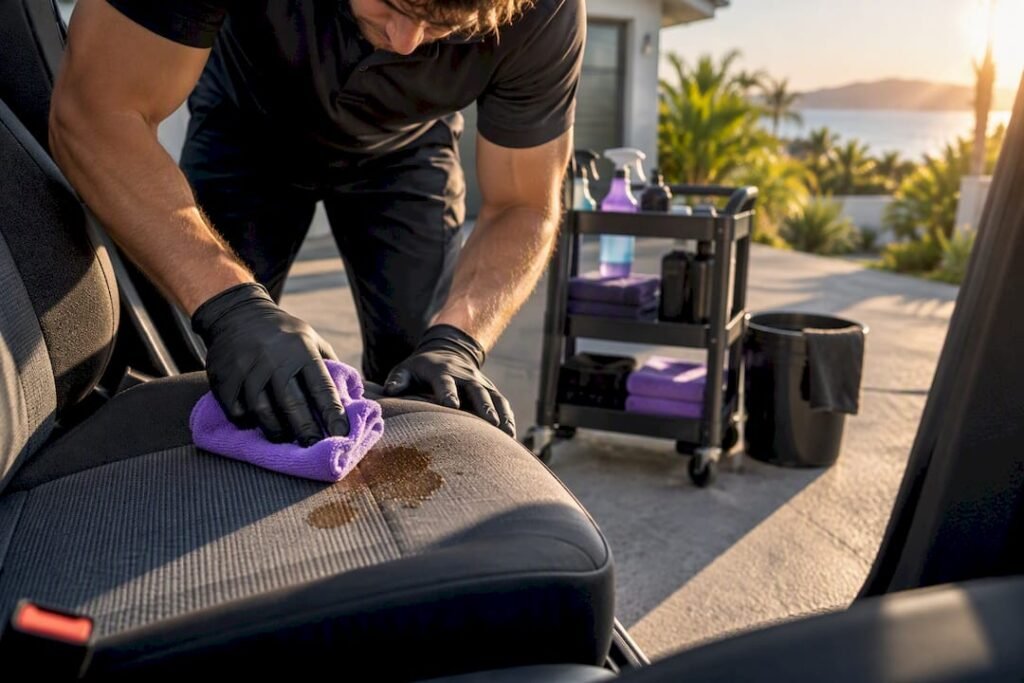
For a fresh spill, remove the solids, blot the excess with a dry microfibre towel, then treat sparingly, working from the outside of the stain toward the centre. Most fresh coffee marks lift out with prompt action. Dried stains are harder: they usually need repeated, controlled treatment rather than one quick fix, and deep or milk-based stains often call for professional extraction.
TL;DR:
- Fresh coffee stains should be treated within 30 minutes by blotting with a dry towel and working from the outside toward the center to prevent spreading.
- Dried stains often require multiple gentle treatments, rehydration, and patience, with full drying between each attempt for best results.
- Use treatment methods specific to the seat material: fabric tolerates mild detergents, leather needs dedicated cleaners, and Alcantara requires gentle foam and caution against alcohol-based cleaners.
- Professional cleaning is recommended if the stain has soaked through to the foam, if odors persist after treatment, or if the material shows signs of damage or dye transfer.
- Avoid using harsh chemicals like bleach, hydrogen peroxide, or WD-40, as they can damage fabric or leather and complicate stain removal.
Table of Contents
- Quick emergency steps for a fresh coffee spill
- Treating a dried or old coffee stain
- Fabric, leather and Alcantara need different rules
- Products and simple home mixes that actually work
- When to get professional help and what it involves
- Common mistakes and quick tips from the field
- How Isaac’s Pro Detailing can help with stubborn stains
- Sources
- FAQ
Quick emergency steps for a fresh coffee spill
The first 30 minutes decide whether a coffee spill becomes a five-minute job or a weekend project. Coffee contains tannins, the same compounds that stain teeth and cotton shirts, and tannins bond to fabric fibres faster the longer they sit. Speed matters more than the product you reach for.
- Pick up any cup, lid or solid debris straight away so you are not grinding grit into the seat.
- Blot the puddle with a dry microfibre towel, pressing straight down rather than rubbing, which just spreads the coffee further into the weave.
- Work from the outside of the wet patch toward the middle so you are not dragging the stain outward as you go.
- Apply a small amount of an upholstery-safe cleaner to a cloth (not directly onto the seat), blot, then lift the moisture with a clean, dry cloth or a small extractor.
- Dry the area fully with a hairdryer on a cool setting or a car air mover, then inspect once it is completely dry before deciding if another pass is needed.
This sequence, remove solids, blot, work outward, apply cleaner sparingly and dry fully, mirrors the tested process CHOICE uses for fresh spills on fabric, including the instruction to patch-test first and repeat rather than saturate.
Pro Tip: Never judge a stain while it is still damp. Wet fabric always looks patchy, and a stain that seems stubborn at the ten-minute mark is often gone once the seat dries.
Treating a dried or old coffee stain
Once coffee dries, the tannins have had time to bind to the fabric fibres, and the sugar and milk that often ride along with it can bind too. That is why an old stain rarely comes out with a single wipe. It needs to be softened, lifted and checked, sometimes several times over.
Start by rehydrating the stain rather than attacking it dry. Lightly mist the area with water or a diluted upholstery cleaner, let it sit for a minute or two, then agitate gently with a soft brush to loosen the bond before you try to lift anything.
- Spray lightly rather than soaking, since a saturated cushion takes far longer to dry and risks mould or a musty smell underneath.
- Agitate with a soft-bristled brush, not a scrubbing pad, to avoid fraying or flattening the fabric weave.
- Blot and extract with a clean towel or a portable spot cleaner rather than rubbing the loosened stain back into the fibres.
- Let the seat dry completely between attempts, since a wet stain and a dry stain can look very different.
Portable spot cleaners help here because they apply cleaning solution and pull moisture and soil back out in the same pass, which limits how wet the cushion gets. They are not a fix for stains that have soaked through to the foam or backing though. CHOICE’s testing shows dried stains typically need more than one treatment cycle to fully lift, and that any assessment of success should wait until the seat has dried fully, since a stain can look improved while wet and reappear once dry.
A tannin stain left to dry for a day or more usually requires multiple treatment cycles before it fully releases, based on CHOICE’s repeat-trial testing method. That figure is worth keeping in mind before you assume one attempt has failed for good.
Two or three careful cycles is a reasonable ceiling. If a stain is still visible after that, chasing it further with more product usually just risks the fabric’s colour or backing, and it is a sign the coffee has soaked deeper than a surface treatment can reach.

Fabric, leather and Alcantara need different rules
Not every seat trim reacts to cleaning the same way, and using a fabric method on leather (or vice versa) is one of the fastest ways to turn a stain into permanent damage. A quick check before you start saves a lot of regret afterward.
- Fabric feels woven or slightly textured, and a drop of water will usually sit on the surface briefly before soaking in.
- Leather feels smooth, slightly cool and has a faint natural grain; it will not soak up water the way fabric does.
- Alcantara (a suede-like microfibre) feels soft and napped, almost velvety, and can shift colour slightly if brushed in one direction.
Fabric seats tolerate the widest range of treatments: mild detergent mixes, foaming upholstery cleaners and portable extractors all work, provided you patch-test first on a hidden section of the seat.
Leather needs a dedicated leather cleaner and conditioner, never a fabric foam, a vinegar solution or a solvent like WD-40, since these strip the finish or dry out the hide over time.
Alcantara wants a gentle foam applied sparingly, with a soft cloth or brush rather than a stiff scrubbing pad, and no alcohol-heavy cleaners, which can leave patchy marks. For stains on leather trims specifically, the same identify-first, treat-gently logic applies as with other tricky stains, such as the approach covered in safe leather and fabric fixes for ink marks.
Stop immediately and call a professional if you see dye transferring onto your cloth, the backing feels wet well after the surface has dried, the material starts lifting or bubbling, or there is a lingering milk-and-sugar smell that cleaning has not shifted.
Products and simple home mixes that actually work
Four categories of product cover almost every coffee stain you will face in a car: automotive upholstery foams, portable wet-and-dry extractors, enzyme-based cleaners for organic spills like milky coffee, and simple mild detergent solutions for light marks.
- Automotive upholstery foams are formulated for fabric seats and generally rinse or blot out cleanly without leaving a sticky residue.
- Portable spot cleaners combine solution and suction, useful for stains that have started to set but have not soaked through.
- Enzyme-based cleaners break down the organic matter in milk or sugar, which is useful when a latte or flat white has spilled rather than a black coffee.
- A mild dish soap solution works as a low-cost first pass on light, fresh marks before you reach for anything stronger.
When you have nothing else on hand, CHOICE’s tested fallback recipe is two tablespoons of dishwashing liquid, three tablespoons of white vinegar and a quarter cup of water. Apply it sparingly with a cloth, never poured directly onto the seat, patch-test on a hidden spot first, and blot rather than scrub. It is a fallback for mild stains, not a universal fix, and it was tested on carpet rather than every automotive fabric.
Some products belong nowhere near a coffee-stained seat. RACQ’s interior-cleaning guidance warns against bleach and hydrogen peroxide, which can strip colour and damage fibres, and against WD-40, which leaves an oily residue that can make a stain worse rather than better. Strong solvents are a similar risk on leather and Alcantara, where they can dull or discolour the finish.
Pro Tip: If a stain covers more than a coin-sized patch or has soaked into the cushion, renting or hiring a proper extraction machine for a day often beats buying a cheap spot cleaner you will use once.
When to get professional help and what it involves
DIY methods handle most fresh spills and plenty of dried ones, but some situations are genuinely outside a home fix. Knowing the difference saves both the seat and your weekend.
- The coffee has soaked through to the foam or you can feel dampness in the cushion well after the surface looks dry.
- A milky or sugary spill has left a smell that treatment has not shifted, which usually means bacteria are working on residue you cannot reach.
- The same ring keeps reappearing after drying, a sign the stain has spread wider under the surface than it looks.
- The seat is leather, Alcantara or another delicate trim where the wrong product can cause permanent damage.
Professional cleaners work from a different starting point: identifying the fibre, dye and backing before choosing a method, which is exactly the sequence set out in national competency standards for cleaning fabric upholstery. That identification step matters because a treatment safe for one fabric construction can discolour or soak into another.
From there, a technician typically pre-spots the stain with a targeted solution, uses low-water or controlled extraction rather than saturating the cushion, and finishes with proper drying equipment and, if needed, deodorisation for anything organic that has soaked in. For a full breakdown of what a professional interior clean covers, see this step-by-step car interior cleaning guide. If the odour is more sour milk than coffee, the same soak-through logic applies, and it is worth reading how to stop milk smell before it sets.
For a booked appointment, expect a short assessment of the fabric and stain, a controlled pre-spot and extraction pass, and full drying before the seat is handed back. Diagnosing the smell’s actual source first, rather than masking it, is also standard practice in odour treatment guidance from the detailing industry.
Common mistakes and quick tips from the field
The same mistakes turn up again and again on stained seats: soaking the fabric instead of blotting, skipping the patch test, reaching for WD-40 or bleach, and scrubbing hard enough to fray the weave. Each one makes the fix harder, not easier.
Keep a small kit in the boot: a microfibre towel, a travel-size upholstery cleaner and a soft brush cover most spills. Extract moisture out rather than rinsing it further in, and always let the seat dry fully before deciding whether it needs another pass.
A stain treated within the first few minutes is a five-minute job. The same stain left overnight can take three attempts and still leave a faint mark.
— isaac’s
How Isaac’s Pro Detailing can help with stubborn stains

When a coffee stain has soaked past what a home kit can lift, or the seat is leather or Alcantara and you would rather not risk it, a mobile detail takes the guesswork out of the job. A professional mobile detailing service comes to your home, workplace or wherever the car is parked, with the equipment and material knowledge to treat the stain properly rather than just cover it up.
- Interior extraction and seat cleaning to lift stains that have soaked into the cushion, not just the surface.
- Fabric Guard treatment, priced from $25 per seat, to make the next spill easier to wipe away before it sets.
- Odour elimination for milk, sugar or coffee residue that has settled into the foam.
A typical appointment starts with an assessment of the fabric or leather, a targeted pre-spot on the stained area, controlled extraction, and full drying before the car is handed back.
You can see the full scope of the interior packages on the Deluxe Detail and Revival Detail page and book a time that suits.
Sources
The stain-removal steps and cautions in this guide draw on CHOICE’s tested method for fresh fabric stains and its carpet stain removal guide with the fallback home recipe. Safety guidance on products to avoid comes from RACQ’s car interior cleaning advice, and the professional identification and cleaning process referenced throughout is based on the national competency unit for cleaning fabric upholstery.
FAQ
How do you get coffee stains out of a fabric car seat?
Remove any solids, blot the spill dry with a microfibre towel, then apply a small amount of upholstery-safe cleaner and work from the outside of the stain inward. Blot or extract the moisture out rather than rubbing, and let the seat dry fully before checking whether another pass is needed, following the tested sequence CHOICE recommends for fabric stains.
Are dried coffee stains permanent?
Dried coffee stains are not necessarily permanent, but they are harder to shift than fresh ones because the tannins have had time to bind to the fibres. CHOICE’s testing indicates dried stains typically need repeated treatment cycles rather than a single wipe, and full drying between attempts before judging the result.
Can old coffee stains be removed from car upholstery?
Old stains can often be removed with rehydration, gentle agitation and repeated extraction, though results depend on the fabric type, backing and whether the coffee has soaked through to the foam. If two or three careful attempts do not shift it, a professional extraction using material-identification led techniques is the next step.
Does WD-40 remove coffee stains from car seats?
No, WD-40 is not suitable for coffee stains and can make the problem worse. RACQ’s interior cleaning guidance warns that oily products like WD-40 can leave a residue that is harder to remove than the original stain.