
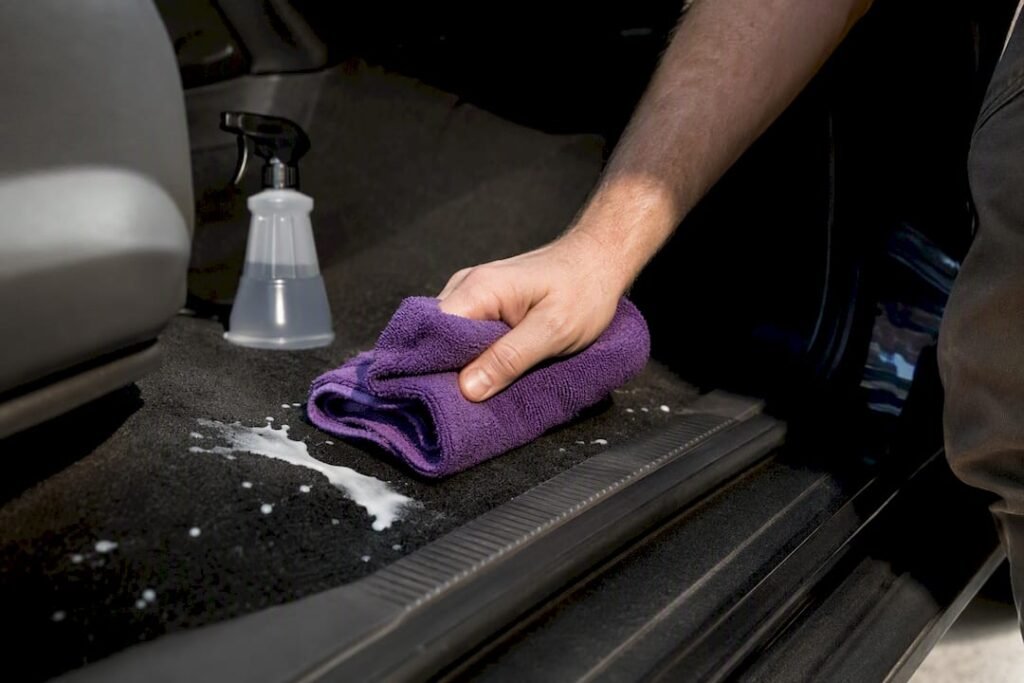
Milk smell comes out of a car in most cases, provided you treat the spill within a few hours rather than letting it sit overnight. The first move matters more than any product you’ll buy: blot and extract the liquid immediately, don’t rub it and don’t reach for a hairdryer. Everything after that, enzyme cleaner, extraction, drying, is just finishing the job that first blot started.
TL;DR:
- Prompt blotting and extraction within the first few hours prevent milk from soaking deep into foam and fabric, reducing the need for professional cleaning.
- Enzyme cleaners are essential for treating set-in sour milk smell, requiring sufficient dwell time and multiple extraction passes for effective removal.
- Using heat or steam on dried milk spills can set proteins into fabric fibers, making odors permanent and necessitating more invasive repairs.
- If the odor persists despite carpet treatment, the air conditioning system likely holds the contamination and may need thorough cleaning or filter replacement.
- Professional removal becomes necessary when milk has soaked into foam or the smell returns after DIY cleaning, especially on older or long-set spills.
Table of Contents
- What to do in the first four hours after a milk spill
- How to deep clean a set-in sour milk smell
- Could the smell be coming from your air conditioning?
- When DIY stops working and a professional needs to step in
- How Isaac’s Pro Detailing tackles a milk smell that won’t budge
- Sources
- FAQ
What to do in the first four hours after a milk spill
The clock starts the moment milk hits fabric. Milk is a protein and sugar solution, and both wick fast into foam padding and carpet underlay if you leave them there. Cool water extraction and prompt blotting are the correct first response, and every hour you delay makes the job harder.
Here’s the order that actually works:
- Open every door, wind down windows if you can, and pull out loose items, floor mats and child seats straight away.
- Blot, don’t rub. Fold a few paper towels or a microfibre cloth into a thick pad, press it onto the spill, and stand or kneel on it for a few seconds. Your body weight does more work than your hand.
- Repeat with fresh dry sections of towel until they come away barely damp.
- Wash removable mats separately and check underneath seats, in seams and around seat tracks. Milk runs further than you’d expect once it hits an angled surface.
- If the spot still feels wet, flush lightly with cool water and blot again. Never use hot water, a hairdryer or the car’s own heater to speed things up.
- Once the area is as dry as you can get it by hand, tip on a generous layer of baking soda and leave it for a few hours before vacuuming it out.
Baking soda earns its place here, but only as a stopgap. It absorbs surface moisture and buffers some smell, but it can’t reach anything that’s already soaked into foam or backing. Treat it as damage control, not a cure.
Pro Tip: Keep a couple of old bath towels and a small spray bottle of water in the boot. Fresh milk is far easier to pull out in the first ten minutes than after it’s had time to spread through the carpet weave.
How to deep clean a set-in sour milk smell
If the smell is still there the next day, you’re no longer dealing with fresh milk. You’re dealing with bacteria that have started breaking down the proteins and sugars, and that’s what produces the sour smell everyone associates with a forgotten sippy cup. Surface cleaning won’t touch it. You need something that digests the residue, not just masks it.
Enzyme cleaners are the right tool here because they break casein and lactose down into fragments that no longer smell, rather than just perfuming over the top of them. But they only work if you give them time.
- Spray the enzyme cleaner generously over the stained area and about an inch beyond the visible mark, since milk spreads further under the surface than it does on top.
- Work it gently into the fibres with a soft brush so it reaches down to the backing, not just the carpet pile.
- Leave it alone. Enzyme cleaners commonly need 10 to 15 minutes of dwell time, sometimes longer on sour spills, and cutting that short is the single biggest reason DIY treatments fail.
- Extract the liquid with a wet/dry vac or a carpet extractor, running overlapping passes until the water coming back out runs close to clear.
- Expect to repeat the whole cycle multiple times on a stain that’s had a few days to set in.
A practical technique worth borrowing from professional detailers: press dry with folded microfibre towels under your own body weight to lift the bulk of the liquid, then apply the enzyme straight after and run overlapping extractor passes until the returned water clears. That sequence, press, enzyme, extract, repeat, does more than any single product on its own.
Skip the steam cleaner, no matter how tempting it looks. Heat sets milk protein permanently into the fabric fibres, which locks the smell in rather than lifting it out. If extraction still leaves the padding damp or the smell persists once everything is dry, the contamination has likely reached the foam or carpet backing underneath, and that’s a job that needs the carpet lifted, not another spray bottle. Isaac’s Pro Detailing’s step-by-step interior cleaning process covers this kind of layered extraction in more detail.
Could the smell be coming from your air conditioning?
If you’ve cleaned the carpet and seats properly but the sour smell still hits you the moment you turn the fan on, the problem probably isn’t the upholstery anymore. It’s the ventilation system.
- Notice whether the smell gets stronger specifically when the air conditioning or fan is running, that’s the clearest sign the evaporator or ductwork is holding onto residue.
- Check and replace the cabin air filter, since a milk splash near the intake can saturate it directly.
- Inspect the air conditioning drain for blockages and look at the vents for any visible residue or discolouration.
- If the smell only shows up with the AC on, the evaporator or filter is usually the source, not the carpet you’ve already treated.
Don’t attempt an ozone treatment on your own to chase this down. Ozone and hydroxyl treatments only affect airborne molecules in a sealed cabin and demand strict safety handling, so they’re not a substitute for physically cleaning a contaminated evaporator. This partner guide on diagnosing the source of car odours walks through the same HVAC checks in more depth if you want to rule it out yourself before calling anyone.
When DIY stops working and a professional needs to step in
Fresh, shallow spills usually respond well to enzyme cleaner and extraction done at home. Expect to repeat the treatment once or twice and give the carpet a full day or two to dry out completely before judging whether it’s worked.
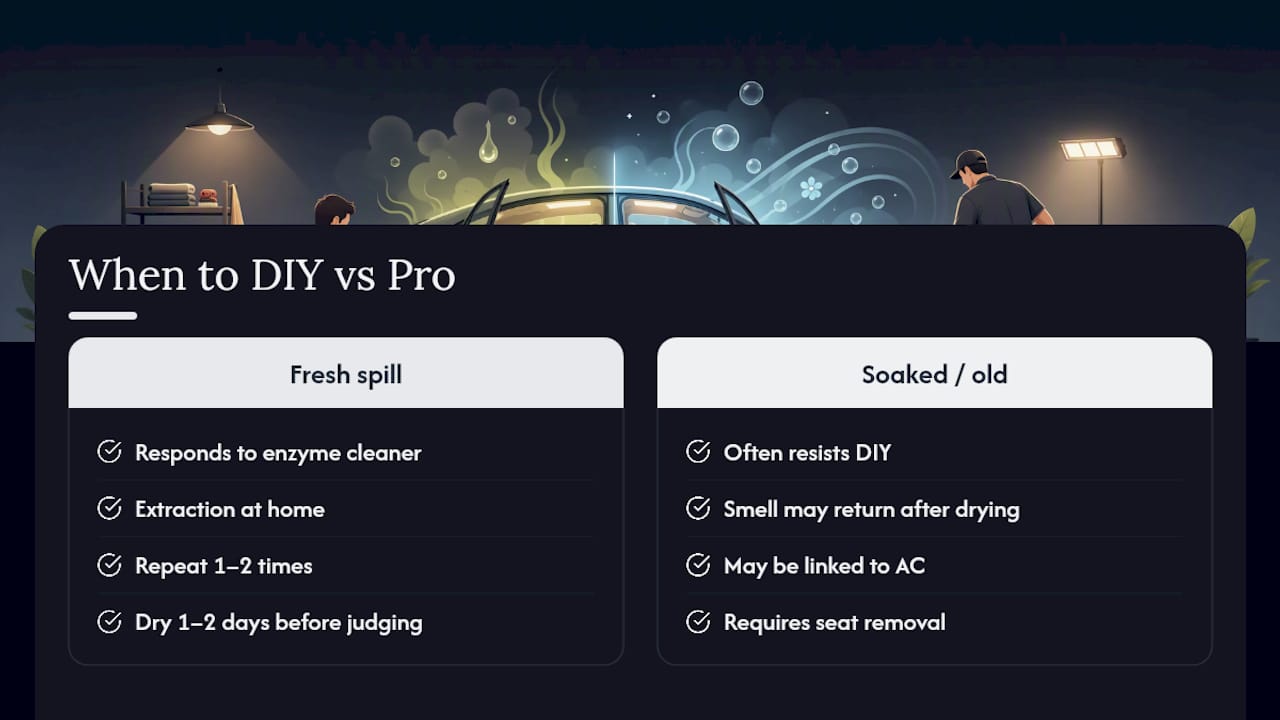
Spills that soaked in overnight, or longer, tell a different story. So does a smell that comes back a day after everything felt dry, or one that’s clearly tied to the air conditioning. At that point you’re usually looking at seat removal, foam flushing or, in the worst cases, foam replacement, work that needs the seat out of the car entirely. A small, fresh spill is cheap to fix within hours; a week-old soak into foam is a proper restoration job, and that gap in cost is the whole argument for acting on day one, not day seven.
Before you book anyone, jot down the spill’s history, what you’ve already tried, which areas got treated, and whether the smell gets worse with the AC running. That saves the detailer time and gets you a more accurate quote.
— isaac’s
How Isaac’s Pro Detailing tackles a milk smell that won’t budge
When the carpet’s been cleaned twice and the smell is still there, you need someone who can get under the surface, not another bottle off the shelf. Isaac’s Pro Detailing is the mobile alternative to booking your car into a workshop and losing it for a day: we come to your home, workplace or wherever suits, and work through interior extraction, seat and foam access, targeted deodorising, and fabric or leather protection on the spot.
At an inspection, we check how deep the contamination has gone, whether it’s reached the foam or backing, and whether the HVAC system is involved before recommending a treatment plan and realistic drying timeframe. Sometimes that’s a thorough extraction and enzyme cycle covered under our Deluxe Detail or Revival Detail packages, priced from $375 to $775 depending on your vehicle and the level of work needed. Other times, particularly with an older or soaked spill, foam removal or seat access genuinely is the only permanent fix, and we’ll tell you that honestly rather than sell you a repeat clean that won’t hold. If your own attempts haven’t shifted the smell, book a mobile inspection and let us look at what’s actually going on underneath.
Sources
For more detail on technique and product use, AllACES covers the full remediation process for spilled milk, while AutoDetailPedia breaks down enzyme cleaner dwell times step by step. Always check your product’s own label for exact instructions before applying it.
- Spilled Milk in Car: Removing the Sour Smell in Australia
- How Do You Get Sour Milk Smell Out of Your Car Interior and Carpet? – AutoDetailPedia
- How to Remove Sour Milk Smell From Your Car | AutoGuru
FAQ
Why does my car smell like sour milk?
Milk left in a car sours because bacteria break down its proteins and sugars once it’s soaked into carpet, foam or seat fabric, producing the sharp odour you notice within a day or two.
How long does milk smell last in a car?
A fresh spill treated with prompt blotting, enzyme cleaner and extraction can be smell free within a day or two once everything dries out fully. A spill left to soak for a week or more can linger for weeks and often needs professional remediation.
What enzyme cleaner should I use to remove milk smell from my car?
Look for an enzyme cleaner labelled for pet or organic stains, since these are formulated to break down proteins and sugars like the ones in milk. Give it the full dwell time on the label, usually 10 to 15 minutes or longer on sour spills, before extracting it.
How do I know if the milk reached the padding or vents?
If the carpet still feels damp after extraction, or the sour smell gets stronger when you run the air conditioning, the contamination has likely reached the foam underneath or the HVAC evaporator, and a professional inspection like the one Isaac’s Pro Detailing offers is the next step.