
TL;DR:
- Contactless car detailing uses high-pressure water jets and chemicals without physical contact to protect sensitive vehicle finishes. It offers quick, eco-friendly maintenance suitable for coated, wrapped, or luxury cars while reducing the risk of swirl marks and micro-scratches. However, heavily soiled vehicles still require manual pre-rinse or hand cleaning for thorough debris removal.
Contactless car detailing is defined as a vehicle cleaning method that uses high-pressure water jets and specialised chemical detergents to remove dirt and grime without any brushes, cloths, or physical contact with the paint surface. Also known in the industry as touchless auto detailing, this approach has grown rapidly as car owners seek safer alternatives to traditional brush-based washes. The process protects sensitive finishes including matte paint, vinyl wraps, and ceramic coatings from the swirl marks and micro-scratches that physical contact causes. This guide covers how the process works, its real advantages, how it compares to other wash types, and when it genuinely delivers results.
How does contactless car detailing work?
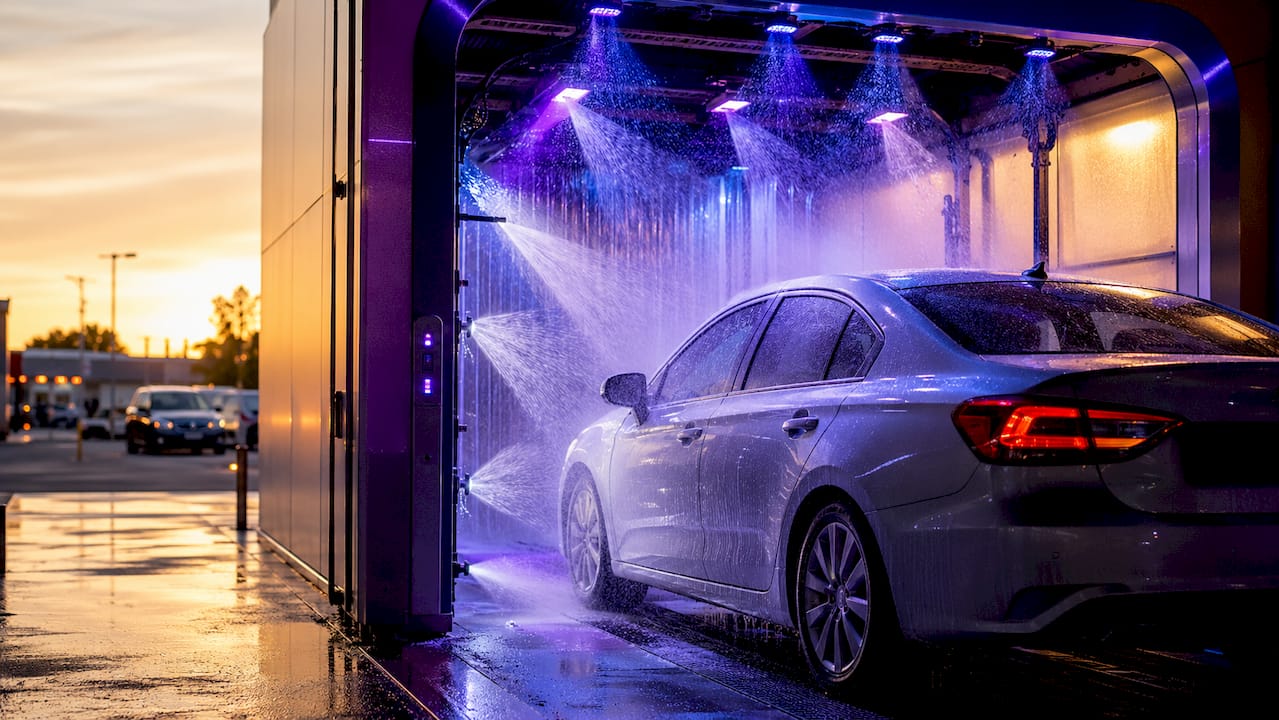
The contactless car cleaning process follows a precise sequence designed to loosen and remove contamination without touching the paint. Each stage builds on the last, and skipping any step reduces the result significantly.
-
Vehicle scanning. Advanced systems use sensors that map vehicle shape with ±1mm positioning accuracy, generating a rapid 3D model to optimise nozzle angles and achieve over 99.7% surface coverage. This means every panel, mirror, and wheel arch receives targeted spray rather than a generic blast.
-
Chemical pre-soak. A specialised alkaline detergent is applied across the entire exterior. This solution penetrates and loosens bonded grime, road film, and organic matter before any water pressure is applied. Allowing the pre-soak to dwell for 60–90 seconds significantly improves the final result.
-
High-pressure rinse. High-pressure water jets, often combined with acidic detergents to neutralise mineral deposits and brake dust, flush the loosened contamination from the surface. The alternating alkaline and acidic agents handle different contaminant types that a single product cannot address.
-
Spot-free final rinse. Purified or deionised water is used for the final rinse to prevent water spots from forming as the vehicle dries. This step is what separates a quality touchless wash from a basic one.
-
Drying cycle. Forced air dryers remove the majority of surface water. Some facilities add a spray wax or sealant at this stage to leave a light protective layer.
A standard automated wash cycle takes between 3 and 5 minutes from entry to exit. That speed makes contactless car wash services practical for busy owners who cannot afford a half-day at a detailing bay.
Pro Tip: Always request a pre-rinse pass before the chemical application if your vehicle has been driven on dirt roads or through heavy mud. Professionals recommend pre-rinsing to dislodge abrasive grit before chemicals are applied, which prevents particles from being dragged across the paint under pressure.
What are the benefits of contactless car detailing?
The case for touchless auto detailing rests on three pillars: paint safety, convenience, and environmental responsibility.
Paint and finish protection
Contactless systems provide a complete elimination of brush-induced swirl marks and micro-scratches. That matters because swirl marks are cumulative. Every friction wash adds fine abrasions that scatter light and dull the finish over time. For owners of vehicles with ceramic coatings, matte paint, or factory vinyl wraps, a single brush wash can cause damage that requires professional correction to fix. Automotive expert David Tracy specifically highlights touchless washes for paint preservation in luxury and classic vehicles, emphasising the role of pH-balanced chemical management in protecting clear coats.
Cost savings over time
Avoiding paint correction services can save hundreds over a vehicle’s lifetime despite similar upfront wash costs. A single-stage paint correction at a professional detailer typically costs several hundred dollars. Choosing touchless washing as your regular maintenance method removes the primary cause of that expense.
Reliability and uptime
Contactless systems have fewer moving parts than brush-based equipment. That lower mechanical complexity leads to better uptime and consistent service, even in harsh conditions where brush systems fail or risk vehicle damage. For 24/7 self-serve facilities, this reliability is a genuine operational advantage.
Environmental footprint
Touchless systems use eco-friendly car care practices by reducing water volume, electricity consumption, and chemical waste compared to traditional washes. Recirculation systems in modern facilities recover and filter rinse water for reuse, cutting total water use per vehicle significantly.
Pro Tip: If your vehicle has a ceramic coating, keep it out of direct sunlight and maintain controlled humidity around 40–60% for 24–48 hours after any wash to allow the coating chemistry to remain stable and fully bonded.
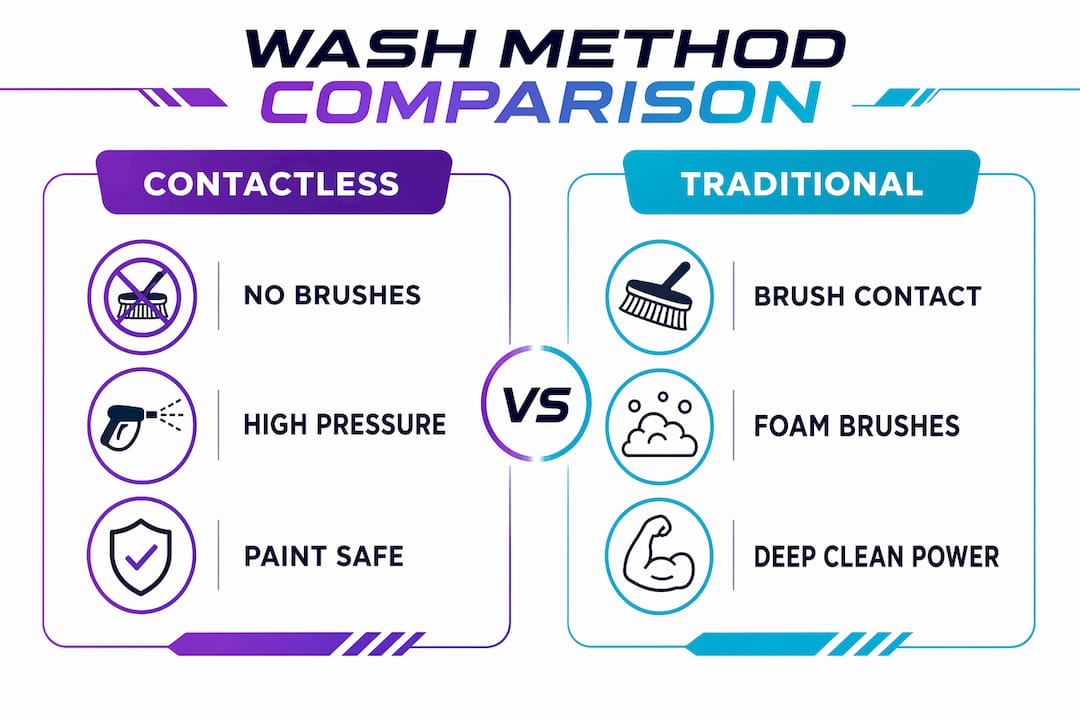
Contactless detailing vs traditional car wash methods
Understanding where touchless washing sits relative to other options helps you choose the right method for each situation.
| Wash method | Physical contact | Paint safety | Cleaning power | Best for |
|---|---|---|---|---|
| Contactless / touchless | None | Excellent | Good for regular grime | Sensitive finishes, maintenance washes |
| Soft cloth automatic | Cloth pads | Moderate | Good | General use, quick cleans |
| Brush automatic | Rotating brushes | Poor | Good | Budget washes, hardy finishes |
| Hand wash (microfibre) | Controlled contact | Excellent | Excellent | Deep cleans, heavy soiling |
| Waterless / rinseless | Cloth contact | Good with care | Moderate | Light dust, water-restricted areas |
The core tradeoff is cleaning thoroughness versus paint safety. Brush-based systems use rotating foam or nylon brushes that carry residual grit from previous vehicles. That grit acts like sandpaper on your clear coat. Soft cloth systems are gentler but still introduce friction. Contactless washing removes friction entirely, which is why it is the preferred method for vehicles with protective coatings and finishes.
The limitation of touchless washing is cleaning power on heavily soiled vehicles. Water pressure alone has limits when it comes to removing embedded mud, caked-on insects, or tar deposits. In those cases, a pre-treatment or hand detailing step is necessary before or after the touchless cycle. For vehicles that are regularly maintained and not exposed to extreme soiling, contactless washing handles the job cleanly and efficiently.
Manual hand detailing remains the gold standard for deep cleaning, paint decontamination, and interior work. The mobile car detailing workflow used by professional detailers typically combines touchless pre-rinse stages with targeted hand work on problem areas, giving you the safety of no-contact cleaning alongside the thoroughness of manual attention.
Is contactless car detailing effective?
Contactless car detailing is highly effective for regular maintenance cleaning on vehicles that are washed frequently. The key word is maintenance. When you wash your car every one to two weeks, contamination does not have time to bond deeply to the paint, and high-pressure chemical washing removes it cleanly.
The method has clear boundaries. Industry experts confirm that touchless washing cannot fully replace manual hand detailing for heavy dirt or complex grime removal. Vehicles that have gone months between washes, or that have been driven through mud, gravel, or coastal salt spray, will need a hand wash or professional detailing session to achieve a genuinely clean result.
Here is where contactless detailing excels:
- Ceramic-coated vehicles. The absence of physical contact protects the coating surface and prevents premature degradation of the hydrophobic layer.
- Matte and satin finishes. These surfaces cannot be polished to remove scratches, so preventing scratches in the first place is the only viable strategy.
- Vinyl-wrapped vehicles. Brushes and cloths can lift wrap edges and cause peeling. Touchless washing avoids this entirely.
- Busy owners on a schedule. A 3–5 minute automated cycle fits into a lunch break or a quick stop between appointments.
- Eco-conscious owners. Reduced water and chemical use aligns with greener car detailing practices on the Sunshine Coast and beyond.
Where you need to supplement contactless washing: tar spots, tree sap, bird dropping etching, and interior cleaning all require hands-on attention. A practical approach is to use touchless washing for weekly or fortnightly maintenance, then book a professional full detail every three to six months to address what the automated system cannot reach.
Key takeaways
Contactless car detailing is the most paint-safe regular wash method available, and it works best as part of a broader maintenance routine that includes periodic professional hand detailing.
| Point | Details |
|---|---|
| Core definition | Touchless auto detailing cleans using high-pressure water and chemicals with zero physical contact. |
| Paint safety advantage | Contactless systems eliminate brush-induced swirl marks, making them ideal for ceramic coatings and sensitive finishes. |
| Cycle speed | A standard automated contactless wash cycle completes in 3–5 minutes, suiting busy owners. |
| Cleaning limitations | Heavy grime and embedded contaminants require supplementary hand detailing for thorough removal. |
| Best use case | Regular maintenance washing on coated, wrapped, or luxury vehicles between professional detail sessions. |
Why I think most car owners are using contactless washing wrong
Most people treat a touchless wash as a set-and-forget solution. They run their car through once a fortnight and assume the job is done. That is not wrong exactly, but it misses the point of what contactless detailing is genuinely good at.
The real value is in what it prevents, not just what it removes. Every time you choose a touchless wash over a brush system, you are making a decision about the long-term condition of your paint. Over two or three years, that decision compounds. Vehicles that have been maintained exclusively with touchless or hand washing consistently show cleaner, sharper paint than those run through brush automatics, even when both are washed at the same frequency.
Where I see owners go wrong is skipping the pre-rinse on a dirty car. If you have driven through a dusty construction zone or along a beach track, running straight into a touchless system without a manual pre-rinse first is risky. The high-pressure jets can drive fine abrasive particles across the paint before the chemical pre-soak has time to lift them. That is the one scenario where touchless washing can cause the very damage it is designed to prevent.
My honest recommendation: use contactless washing as your regular maintenance method, invest in a quality ceramic coating to make each wash more effective, and book a professional detail two to three times a year. That combination gives you paint that looks genuinely good, not just clean.
— isaac’s
Professional mobile detailing on the Sunshine Coast
Isaac’s Pro Detailing brings the quality of a professional detail to your driveway, workplace, or wherever suits you across the Sunshine Coast. The mobile detailing workflow combines touchless pre-rinse techniques with targeted hand work, ceramic coating application, and interior extraction for a result that automated systems alone cannot match.
Whether you drive a daily commuter or a weekend classic, the full wash menu covers everything from maintenance washes to full paint correction and protective coating packages. Transparent pricing, eco-friendly products, and a fully mobile setup mean you get professional results without rearranging your day. Book directly through the Isaac’s Pro Detailing website and have your vehicle looking its best at a time and place that works for you.
FAQ
What is the difference between touchless and contactless car washing?
Touchless and contactless car washing are the same thing. Both terms describe automated cleaning systems that use high-pressure water jets and chemical detergents without any brushes, cloths, or physical contact with the vehicle surface.
Is contactless car detailing safe for ceramic coatings?
Contactless detailing is the recommended wash method for ceramic-coated vehicles. The absence of physical friction protects the hydrophobic coating layer, and pH-balanced detergents used in quality systems will not degrade the coating chemistry.
How often should I use a contactless car wash?
A contactless wash every one to two weeks suits most vehicles as a maintenance routine. Supplement this with a professional hand detail every three to six months to address contaminants that high-pressure washing cannot remove.
Can a contactless wash remove heavy mud or tar?
Water pressure alone has limits when removing embedded mud, tar, or tree sap. Heavily soiled vehicles require a manual pre-rinse or professional hand detailing to dislodge abrasive particles before a touchless cycle is used.
Does contactless car detailing use less water than a traditional wash?
Contactless systems are designed to reduce water, electricity, and chemical consumption compared to traditional brush washes. Modern facilities with water recirculation systems recover and filter rinse water, cutting total water use per vehicle significantly.