

TL;DR:
- Living near the Sunshine Coast exposes wheels to salt, UV rays, and grime, accelerating corrosion and damage. Ceramic coating bonds to wheel surfaces, creating a durable barrier that repels brake dust, prevents corrosion, and makes cleaning easier. Proper application and maintenance can extend wheel protection for up to three years, especially in coastal environments.
Living near the Sunshine Coast means brilliant beaches, salty breezes, and driving conditions that quietly destroy unprotected wheel surfaces. Many car owners rely on a weekly rinse to keep their rims looking sharp, but that habit barely scratches the surface of what coastal conditions can do to exposed metal and alloy. Ceramic coating for wheels is a technology-driven solution that bonds directly to the rim surface, creating a long-lasting barrier against brake dust, salt, UV rays, and grime. This guide breaks down exactly how it works, what you gain, and whether it makes sense for your situation.
Table of Contents
- What is wheel ceramic coating?
- Key benefits of ceramic coating your wheels
- Wheel ceramic coating vs traditional protection: What’s the difference?
- Is wheel ceramic coating worth it for Sunshine Coast drivers?
- How to care for ceramic coated wheels
- What most car owners miss about wheel ceramic coating
- Get professional wheel ceramic coating on the Sunshine Coast
- Frequently asked questions
Key Takeaways
| Point | Details |
|---|---|
| Lasting wheel protection | Ceramic coating forms a tough barrier, shielding rims from salt, brake dust and Sunshine Coast humidity. |
| Easier maintenance | Coated wheels repel grime, making regular cleaning much faster and more effective. |
| Superior to wax | Ceramic outperforms traditional wax and sealants in both durability and defence against coastal conditions. |
| Best with regular care | Maximum performance and appearance comes from combining ceramic coatings with gentle, consistent cleaning routines. |
What is wheel ceramic coating?
Ceramic coating is a liquid polymer that bonds chemically with your wheel’s surface once applied correctly. Unlike traditional wax or spray sealant, which sit on top of the rim and wash away within weeks, ceramic coating fuses with the material itself, creating a semi-permanent protective layer that doesn’t simply wipe off in the rain.
Ceramic coatings use nanotechnology to create a strong, hydrophobic barrier that causes water and contaminants to bead up and roll off rather than soak in. The result is a surface that actively resists what tries to stick to it, including the fine metallic particles that come off your brake pads every time you slow down for a roundabout.
Here’s what wheel ceramic coating delivers as core benefits:
- Brake dust repulsion: The hydrophobic surface stops brake dust bonding to the rim, making it far easier to rinse away.
- Corrosion resistance: Salt and moisture can’t penetrate the protective barrier, reducing the risk of pitting and oxidation.
- UV protection: Queensland’s intense sunlight fades and dulls alloy finishes quickly. Ceramic coating acts as a shield.
- Easier cleaning: Less contaminant adhesion means significantly less scrubbing during every wash.
- Preserved finish: Your rims hold that fresh, showroom gloss for far longer.
The application process involves thorough surface preparation first, including decontamination to remove old wax, iron deposits, and embedded grime. The coating is then applied in thin, even layers and left to cure. Each stage matters enormously.
Pro Tip: Professional application consistently outperforms DIY methods because proper surface prep and controlled curing conditions determine how well the coating bonds. A poorly prepared surface leads to premature failure regardless of product quality.
When you look at how to apply ceramic coating in detail, it becomes obvious that the prep work is where most DIY attempts fall short. Without removing every trace of contamination first, the coating bonds to the dirt rather than the metal.
Key benefits of ceramic coating your wheels
Knowing what ceramic coating is only tells half the story. Understanding what it actually does for your wheels in day-to-day Sunshine Coast driving is where the real value becomes clear.
Ceramic coated wheels stay cleaner and are easier to wash, with significant resistance to UV and salt, meaning that every drive past the esplanade or along the coastal strip causes less cumulative damage than it would on unprotected rims.

Studies show cleaning time for coated wheels can be reduced by up to 50%, which adds up considerably over a year of regular maintenance sessions.
Here’s a direct comparison to put things in perspective:
| Parameter | Uncoated wheels | Ceramic coated wheels |
|---|---|---|
| Brake dust adhesion | High, bonds firmly | Very low, rinses easily |
| Cleaning time per session | 15 to 25 minutes | 7 to 12 minutes |
| Corrosion risk (coastal) | High within 6 to 12 months | Significantly reduced |
| UV fading | Visible within 1 to 2 years | Minimal over 2 to 3 years |
| Appearance longevity | Dulls within months | Maintains gloss long-term |
| Chemical sensitivity | High | Low to moderate |
Beyond the numbers, there’s a texture to the day-to-day experience of owning ceramic coated wheels. You notice it when the spray from a coastal road doesn’t leave a crusty white residue on your rims. You notice it when a quick rinse after a beach run actually leaves the wheels looking clean. You notice it most when you skip a wash for two weeks and your rims still look respectable rather than caked in grey brake dust.
The paint protection guide makes a similar point about painted surfaces: prevention is always cheaper than restoration. The same logic applies to your wheels. A faded, pitted rim costs significantly more to repair or replace than it does to protect from the start.
Wheel ceramic coating vs traditional protection: What’s the difference?
Most car owners reach for wheel wax or a spray sealant because they’re inexpensive and easy to apply. That convenience comes at a genuine cost when you live somewhere as aggressive as the Sunshine Coast coastline.
Here’s how each protection type actually performs:
| Protection type | Durability | Salt/UV resistance | Brake dust resistance | Maintenance frequency | Typical cost |
|---|---|---|---|---|---|
| Carnauba wax | 4 to 8 weeks | Low | Very low | Monthly | Low |
| Spray sealant | 3 to 6 months | Moderate | Low to moderate | Every 3 months | Low to moderate |
| Ceramic coating | 1 to 3 years | High | High | Annually | Moderate to high upfront |
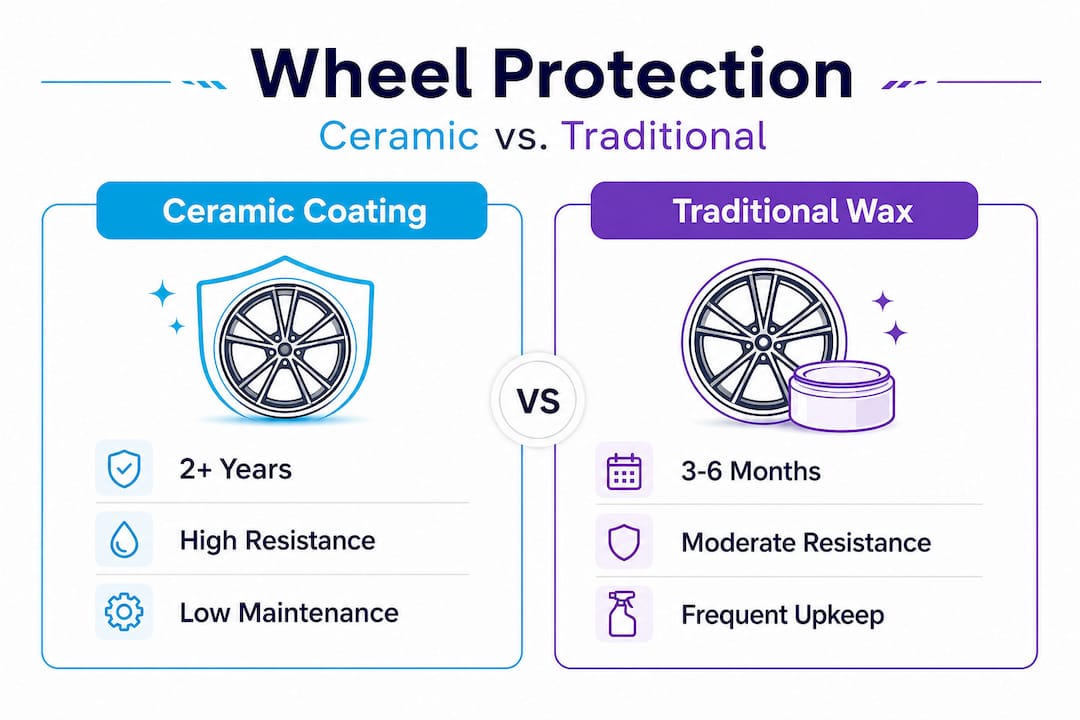
Ceramic coatings offer longer-lasting protection and hydrophobic qualities compared to wax or standard sealants, meaning you’re genuinely comparing different categories of protection rather than just different price points.
Here’s what maintenance actually looks like with each option:
- Waxed wheels: Wash weekly, reapply wax monthly, inspect for fading every few weeks, strip and redo every two to three months.
- Sealant-protected wheels: Wash regularly, reapply sealant every three to four months, watch for brake dust build-up between applications.
- Ceramic coated wheels: Wash with pH-neutral shampoo, rinse thoroughly after beach trips, inspect the coating twice yearly, top up or recoat after one to three years.
The difference in time investment is significant. Waxing your wheels monthly might seem affordable on paper, but the cumulative hours and product costs add up fast.
“In our experience, car owners who switch to ceramic on their wheels almost never go back. The maintenance difference is that noticeable — especially after a long weekend near the beach where a traditional wax would’ve already given up.”
The ceramic vs wax breakdown makes one thing clear: for Sunshine Coast drivers navigating salty air, road spray, and strong UV, wax simply doesn’t have the durability to keep up.
Is wheel ceramic coating worth it for Sunshine Coast drivers?
Let’s address the core question honestly. High humidity and salt mean Sunshine Coast wheels face unique threats, making robust protection critical for anyone who parks near the beach, commutes along coastal roads, or simply lives in the region’s humid salt-air environment.
The real threats your rims face include:
- Rapid oxidation: Salt accelerates corrosion on alloy and steel rims far faster than inland conditions.
- Brake dust etching: Iron particles from brake pads bond to hot rim surfaces and begin etching into the clear coat within hours.
- UV-induced fading: The Queensland sun strips colour and gloss from unprotected surfaces year-round.
- Chemical contamination: Road grime, tyre dressings, and fallout accumulate and bond over time.
The upfront cost of professional ceramic coating for four wheels typically sits between $150 and $400 depending on wheel size and condition. Compare that with the cost of a professional decontamination and polish every few months, or worse, a full rim refurbishment if corrosion takes hold. The maths generally favour coating within 12 to 18 months for anyone who takes regular care of their vehicle.
Environmental benefits are real too. Less frequent cleaning means less water used, fewer chemical products down the drain, and a lower overall environmental footprint across the life of your ownership.
Pro Tip: Combining coastal paint protection on your car’s body panels with ceramic coating on your wheels gives you unified, consistent protection across the whole vehicle. It also simplifies your maintenance routine because every surface responds the same way to washing.
Who benefits most? Here’s a quick checklist:
- Coastal drivers: Anyone regularly within 10 kilometres of the ocean sees the fastest return on investment.
- Commuters: High brake usage means heavy brake dust, making the cleaning time savings immediately noticeable.
- Show or enthusiast owners: Preserving wheel aesthetics is non-negotiable, and ceramic delivers on that.
- Busy professionals: Less time cleaning is a genuine lifestyle benefit.
- Rural drivers: Road dust and gravel fallout are also resisted effectively.
Check out the ceramic coating application steps if you want to understand exactly what the professional process involves before committing.
How to care for ceramic coated wheels
Ceramic coating dramatically reduces how hard you have to work to keep your wheels clean. It doesn’t eliminate maintenance entirely. Even ceramic-coated wheels need gentle care for best results, and using the wrong products can degrade the coating faster than expected.
Here’s a simple weekly and monthly routine to follow:
- After every beach trip or heavy rain: Rinse wheels thoroughly with clean water to flush salt and grit before it dries on the surface.
- Weekly wash: Use a pH-neutral car shampoo diluted appropriately. Apply with a soft, dedicated wheel brush or microfibre mitt. Never use the same mitt you use on painted panels.
- Rinse and inspect: Look for any areas where water no longer beads properly, which signals the coating may be thinning.
- Monthly check: Apply a ceramic maintenance spray to boost hydrophobicity and add a thin sacrificial layer over the base coat.
- Bi-annual inspection: Have a professional inspect the coating and advise whether a top-up coat is needed before full degradation occurs.
Learn more about exterior cleaning for coated wheels to build a complete maintenance habit that protects your investment.
Common mistakes that shorten coating lifespan:
- Using acid-based wheel cleaners, which strip the ceramic layer rapidly
- Scrubbing with abrasive pads or brushes with stiff bristles
- Running through automatic car washes that use harsh chemicals or rotating brushes
- Letting brake dust accumulate for weeks without rinsing
- Applying traditional wax on top of the ceramic coating, which clogs the hydrophobic pores
Pro Tip: Inspect your coating twice a year by watching how water behaves on the rim surface. If water sheets rather than beads, it’s time for a professional top-up before the base coat is compromised.
What most car owners miss about wheel ceramic coating
Here’s something worth saying plainly: most car owners dramatically underestimate how quickly wheel damage starts in a coastal environment. It doesn’t take years of neglect. A single beach weekend, a few hot days of city driving, and some missed rinses can leave visible brake dust etching and early salt spotting on uncoated rims. The degradation is quiet and cumulative.
Ceramic coating buys you time. That’s the honest value. It’s not a “set and forget” miracle that eliminates all wheel care. It’s a powerful amplifier of good habits. A car owner who maintains coated wheels correctly will see spectacular long-term results. A car owner who gets ceramic coating and then ignores their wheels entirely will still see faster degradation than they’d expect, just slower than with no protection at all.
The perspective we’ve developed working with in-depth ceramic insights across dozens of Sunshine Coast vehicles is this: most coating failures come from neglect after application, not from flawed products or poor installation. Owners who understand that the coating needs a maintenance mindset behind it get dramatically better results than those who treat it as permanent armour.
Looking ahead, the industry is evolving. Self-healing ceramic formulations and graphene-infused coatings are already arriving in the professional detailing space, promising even longer lifespans and improved scratch resistance. But right now, today, a correctly applied and properly maintained ceramic coating remains the most practical, cost-effective wheel protection available to Sunshine Coast drivers.
Get professional wheel ceramic coating on the Sunshine Coast
After understanding the full picture, the next step is straightforward: find a professional who can deliver consistent, durable results without you having to spend a weekend doing it yourself.
At Isaac’s Pro Detailing, we bring the service directly to you. Whether you’re at home, at work, or taking a break near the water, our fully mobile setup means your wheels get professionally prepared and coated without disrupting your day. We use proven ceramic products suited to Queensland’s conditions, and our work is backed by real results you can see immediately. Explore our ceramic coating services to find the right package for your vehicle, check out how professional detailing contributes to lasting car value, or browse our complete full detailing menu to combine wheel coating with a full exterior and interior refresh.
Frequently asked questions
How long does wheel ceramic coating last?
With proper maintenance, professional ceramic coatings can last one to three years on wheels, even in the harsh coastal conditions common across the Sunshine Coast region.
Can I apply ceramic coating to wheels myself?
DIY kits exist, but professional application ensures maximum durability and even coverage, particularly important for complex multi-spoke wheel designs where even coverage is difficult to achieve by hand.
Will ceramic coating make cleaning my wheels easier?
Yes, absolutely. Ceramic coated wheels repel brake dust and dirt effectively, cutting down the time and effort needed during every wash session.
Does ceramic coating prevent all wheel damage?
Ceramic coating greatly reduces risk from UV exposure, salt corrosion, and brake dust etching, but it offers chemical and UV resistance rather than impact protection, meaning rock chips and curb rash can still occur.