
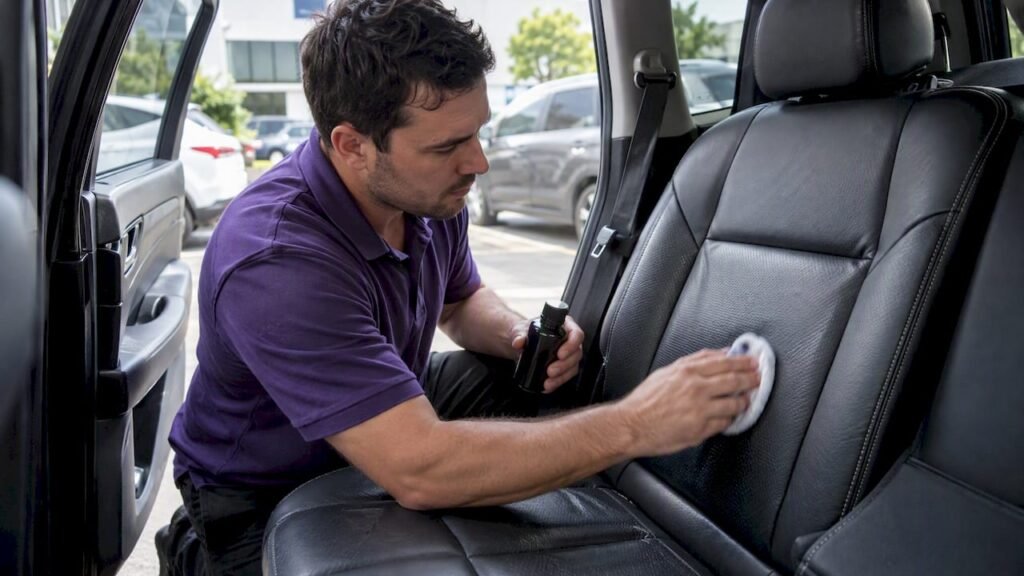
The best sun protection for leather seats is a layered one. Keep direct sun off the leather, clean it regularly, and put a UV-blocking barrier on it, either a protectant you reapply often or a ceramic coating made for leather. A conditioner on its own won’t do the job. Below we cover what each option does, what to do about sunscreen and other contamination, and what it costs to have it done on site on the Sunshine Coast.
TL;DR
- Conditioner keeps leather supple but does not block UV, so you need a dedicated UV protectant or a leather ceramic coating as well.
- A regular protectant needs reapplying every 30 to 45 days, while a ceramic coating made for leather is a longer-lasting barrier.
- Wipe sunscreen off while it is still wet. Left for days in heat, it bonds to the seat’s clear coat.
- Shade and a sunshade are still the most effective passive defence, whatever you apply.
- We apply a leather ceramic coating for $50 per seat, mobile, at your home, work or the beach.
Table of Contents
- Why Sunshine Coast sun is hard on leather
- Conditioner is not sun protection
- Your options, compared
- Sunscreen: the hidden enemy of light leather
- What protection can’t do
- A practical routine for Sunshine Coast owners
- Our view: protect early, keep it simple
- What leather protection costs with us
- Choosing between DIY and a professional
- FAQ
- Sources
Why Sunshine Coast sun is hard on leather
A car parked at the beach car park, the school gate or an unshaded office lot spends hours in direct UV and heat. Sunlight exposure is a primary cause of premature ageing in leather interiors. The damage is gradual: the surface dries, colour fades, and the seat starts to feel stiff before you see a crack.
Most modern car seats are not raw, absorbent leather. They carry a polyurethane clear coat, and that top layer is what you are really protecting. Bowden’s Own makes the point that the vast majority of modern car leather is coated, unlike older uncoated aniline hides that soaked up oils and traditional conditioners. That matters for what you buy. Heavy oils and waxy dressings do little for a coated seat, and they can leave a greasy film that attracts dust.
Lighter leather, such as tan, beige and grey, shows contamination and wear more obviously. Dark leather gets hotter. Neither is safe from the sun.
Conditioner is not sun protection
This is the most common mix-up we hear. Conditioner and UV protection are different jobs.
- Conditioner replaces or maintains the natural oils that keep leather flexible.
- UV protectant puts a barrier on the surface that absorbs or blocks ultraviolet light.
Leather care specialists are clear that conditioner is not a substitute for UV protection. In a hot climate they suggest combining regular conditioning with a dedicated UV-blocking protectant or a ceramic coating. Some products do both, but check the label for an actual UV claim rather than assuming.
For a coated modern seat, a pH-balanced cleaner followed by a quality protectant is usually the better routine than piling on conditioner.
Your options, compared
| Option | What it does | Upkeep | Best for |
|---|---|---|---|
| Shade and sunshade | Cuts UV and heat reaching the seat | Use every time you park | Everyone, as the baseline |
| Seat covers | Physically shield the leather | Remove and clean covers | Work utes, dog and kid-heavy cars |
| Leather protectant (DIY) | Adds a surface UV barrier | Every 30 to 45 days | Owners happy with a regular routine |
| Ceramic coating for leather | Forms a clear, sacrificial barrier against UV and stains | Regular gentle cleaning | Owners who want set-and-maintain protection |
Shade and sunshades
Parking in shade or using a windscreen sunshade is described as the most effective passive defence against drying and discolouration. It costs almost nothing and it works with every other option on the list. If you can only do one thing, do this.

Protectants
A good protectant is cheap and effective if you stay on top of it. The catch is the schedule. Manufacturers’ guidance puts reapplication at roughly every 30 to 45 days, and in a Sunshine Coast summer people tend to forget by month two. A protectant you skip is not protecting anything.
Ceramic coatings for leather
These are made specifically for automotive leather. Product makers describe them as a ceramic coating formulated for automotive leather that sits on the surface without changing the look or feel of the seat, and that repels liquids. The idea is a sacrificial layer: the coating takes the wear, not your clear coat. Compared with a traditional conditioner, that barrier is designed to last longer and to resist both UV and staining.

A coating is not a force field. We cover its limits below.
Sunscreen: the hidden enemy of light leather
On the coast, sunscreen on seats is a given. It comes off arms, legs and kids’ hands and lands on the bolsters and door trims. The trouble is chemical: ingredients such as titanium dioxide and polyethylene glycol can bond to the leather’s clear coat if left. In heat that can happen in days.
What to do, in order
- Act fast. Fresh marks, within about 24 hours, usually lift with a gentle leather-specific cleaner while still wet.
- Dab, don’t scrub. BMW’s care guidance for high-end leather says never rub a stain, because rubbing drives it deeper into the grain. Lift with a microfibre cloth.
- Step up gently for older marks. A pH-neutral, citrus-based cleaner and a soft brush is the next move before any mechanical cleaning.
- Avoid the magic eraser. Melamine foam works by sanding off a microscopic layer of the top coat. Treat it as an absolute last resort, and only with a leather-safe cleaner as lubricant.
Our own write-ups go deeper on this: sunscreen fixes without scrubbing and the related guide on sunscreen stains on car paint.
A coating helps here too. With a barrier in place, sunscreen sits on top rather than in the finish, so it wipes off more easily. It still needs to come off promptly.
What protection can’t do
Protected is not the same as indestructible. Premium interior treatment warranties, BMW’s included, say bird droppings, tree resin, industrial fallout and traffic film must be cleaned off within 24 hours to avoid corrosive damage that even a protected surface can’t withstand long term.
For leather, the everyday equivalents are sunscreen, sweat, coffee, pet hair oils and denim dye. A coating buys you time and easier cleaning. It doesn’t replace wiping up. If you tend to have a coffee run in the car, our 30 minute coffee stain fix is worth a read.
A practical routine for Sunshine Coast owners
Weekly, 5 minutes
- Wipe seats with a dry or barely damp microfibre, paying attention to bolsters and the seat base where sunscreen and sweat collect.
- Use a sunshade whenever you park outside.
Monthly
- Clean with a pH-balanced leather cleaner, soft brush on perforated or grained areas.
- If you rely on a protectant, this is the 30 to 45 day window to reapply.
After a beach day or road trip
- Check seats and trim for sunscreen. Dab off anything fresh straight away.
Once or twice a year
- Have the interior properly cleaned and inspected. Our interior cleaning guide walks through the process, and the leather protection tutorial covers a quick at-home workflow.
If cracking is already starting, read how to stop leather seat cracking first. Protection prevents damage; it does not fill existing cracks.
Our view: protect early, keep it simple
We work on leather seats across the Sunshine Coast every week, in driveways, office car parks and near the beach. Here is what we would tell a friend.
Start before the leather looks tired. Protection on healthy seats is far easier than trying to fix dried-out, faded ones. The best time is when the car is new to you, or right after a proper interior detail.
Clean first, always. Sealing in sunscreen residue or body oils under a coating is a waste. Our process is to clean the leather thoroughly, then protect. That is why we like pairing leather work with an interior detail.
Choose a routine you will actually keep. A protectant every 30 to 45 days works if you are disciplined. If you would rather not think about it, a leather ceramic coating is the lower-effort route, with regular gentle cleaning to follow.
Don’t ask protection to do everything. Shade, a sunshade and quick wipe-ups matter as much as any product.
Mobile suits this job. Leather work needs the car out of the weather and the seats cool. We come to you, so you do not give up half a day at a workshop, and we use eco-friendly products where we can. Families with pets and kids often get the most from it, because the seats take the most punishment.
— isaac’s
What leather protection costs with us
Here are our published prices for seat-level protection:
| Service | Price |
|---|---|
| Leather ceramic coating | $50 per seat |
| Fabric Guard (for cloth seats) | $25 per seat |
Both are listed on our special services page. So a five-seat car with a leather ceramic coating on every seat comes to $250 at the per-seat rate. Cloth-trimmed cars or mixed interiors can use Fabric Guard on the fabric seats.
If you want more than the seats done, the leather work sits well alongside a full detail:
- Deluxe Detail and Revival Detail: $375 to $575 and $575 to $775 respectively, depending on the vehicle.
- Ultimate Protection Package: $1,500 to $2,200.
- The “Holy Grail” detail: $600 to $1,000.
The range in each package reflects vehicle size and condition. If your car has an odour problem, we also offer odour elimination and ozone deodorisation, but we do not publish a price for those, so please ask for a quote. The same goes for ceramic coating on paint and cut and polish, which are quoted individually.
Wondering how a coating on paint relates to one on seats? Our article on UV rays and ceramic coating on the Sunshine Coast covers the exterior side.
Ready to book?
Tell us the car and the seat count and we will confirm the price and a time. We come to your home, workplace or wherever the car is parked. Start at our special services page or head to isaacprodetailing.com.au.
Choosing between DIY and a professional
DIY protectant is a fair choice if your seats are in good shape, you enjoy the routine and you will keep to the schedule. A few cautions:
- Test any new product on a hidden spot first, such as the side of the seat base.
- Use a microfibre applicator and thin coats. Thick layers go streaky.
- Skip heavy oils on coated leather.
- Check that the product states UV protection, not only conditioning.
A professional makes more sense when the leather is light-coloured and unforgiving, when you have kids or pets, when you are keeping the car long term, or when you want the seats cleaned properly beforehand. Cleaning is where most of the quality of the result is decided.
FAQ
How do I protect light leather car seats?
Clean them regularly, because dye transfer, sunscreen and body oils show most on light leather. Then add a UV-blocking protectant or a leather ceramic coating, and wipe spills and sunscreen while still wet. Shade and a sunshade reduce the load on top of that.
How often should I reapply leather protectant?
Product guidance suggests every 30 to 45 days to keep the UV barrier effective. Hot summer months and heavy use lean towards the shorter end. A ceramic coating for leather does not follow that schedule, but it still needs regular gentle cleaning.
Can I fix sun-damaged leather with protection?
Protection prevents further damage but does not reverse cracking or fading that has already happened. Early dryness can improve with proper cleaning and care. Deep cracks or worn colour need repair by a leather restoration specialist, and a coating only helps afterwards.
How much does leather seat protection cost on the Sunshine Coast?
We charge $50 per seat for a leather ceramic coating, so a five-seat car is $250 at that rate. Fabric seats can have Fabric Guard at $25 per seat. Bigger detail packages that include interior work start at $375.
How do I remove sunscreen from leather seats?
Dab fresh sunscreen off straight away with a microfibre and a gentle leather cleaner. For older marks, use a pH-neutral citrus-based cleaner and a soft brush. Avoid abrasive tools, and see Bowden’s Own guide for the escalation steps.
Sources
- How to Care for Leather Car Seats: Tips for Long-Lasting Shine
- How to clean sunscreen from leather seats and trims, Bowden’s Own
- How to Clean Leather Car Interiors, Bowden’s Own
- Leather coating product information, Gyeon Australia