
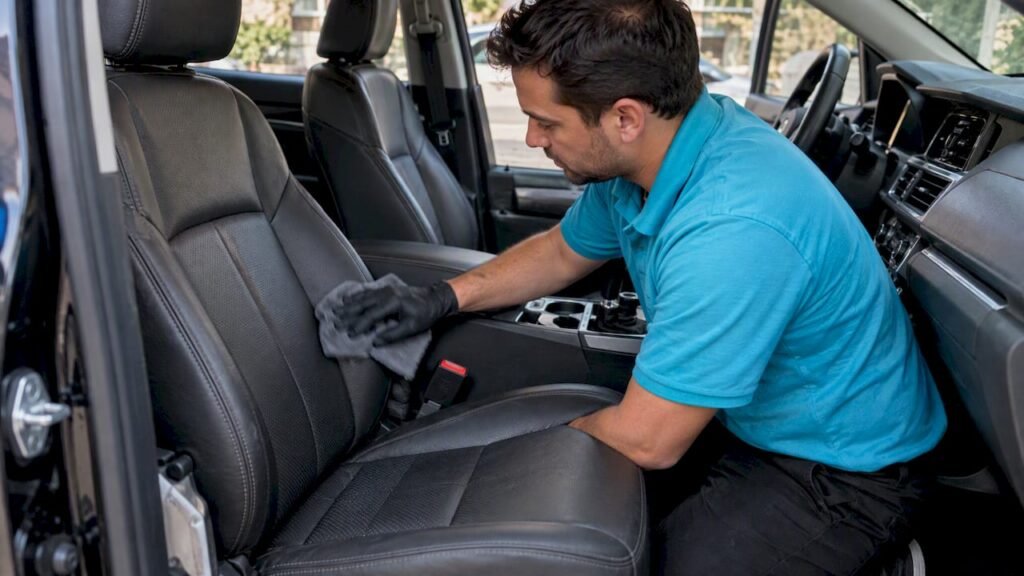
A conditioner feeds the leather. A coating shields its surface. For most modern cars, the seats have a pigmented, factory-sealed finish. A conditioner struggles to soak into that finish, and a ceramic leather coating suits it better. Older or unfinished leather (aniline, open-pore) is the exception, and it needs a different approach. Getting this wrong costs money either way, so it pays to identify your leather before you buy anything.
Below, we explain what each product does, how long each lasts, how to tell which leather you have, and when a coating is worth paying for. We’re a mobile detailer on the Sunshine Coast, so we also cover what UV, humidity and salt air mean for your seats.
TL;DR
- Conditioner hydrates the hide and typically needs re-applying every 3 to 6 months. Ceramic coating forms a bonded surface shield that can last up to 12 months or longer, according to a leather coating manufacturer’s guidance.
- Most modern car leather has a pigmented protective finish, so conditioners often can’t penetrate it and can leave a greasy film.
- Coatings are aimed at dirt, liquids and dye transfer (think denim on pale seats) without changing the feel of the leather.
- Vinyl, PU and faux leather aren’t porous hides, so they need UV protection, not “nourishing”.
- Prep decides the result. Body oils, sunscreen and old silicone conditioners stop a coating bonding.
Table of Contents
- What a conditioner does
- What a ceramic leather coating does
- Why modern car leather changes the answer
- Leather type matters more than the product
- What about vinyl, PU and faux leather?
- Coating vs conditioner: side-by-side
- What the Sunshine Coast climate adds
- Prep decides whether a coating works
- Products to avoid on car seats
- Our perspective: coating first, conditioner only when the leather asks for it
- What a leather coating costs with us
- When to choose which
- FAQ
- Sources
What a conditioner does
A conditioner is a moisturiser. Real leather is a natural material that loses moisture over time, and a good conditioner is designed to penetrate, lubricate and keep the hide supple. On open leather types, that’s useful work.
The catch is the word penetrate. A conditioner can only do its job if it can get into the leather. Hold that thought, because it’s the whole reason this comparison exists.
Conditioning also sits in a sequence. Cleaning removes what the leather doesn’t need, and conditioning follows once the contamination is gone. Skipping the clean means you seal grime in.
What a ceramic leather coating does
A leather ceramic coating works the opposite way. Instead of soaking in, it bonds to the surface finish and forms a thin, durable layer. Manufacturer guidance describes these coatings as designed to repel dirt, liquids and dye transfer, without changing the look or feel of the upholstery.

That last point surprises people. A coated seat doesn’t feel plasticky or slick. It feels like your seat, only it wipes clean more easily and resists staining from things like denim, sweat and spilled coffee.
A coating is not a moisturiser, though. It doesn’t “feed” anything. It protects what’s already there.
Why modern car leather changes the answer
Most people assume all leather needs regular conditioning. That’s a common misconception. Care guidance from an Australian leather supplier points out that many modern leathers carry a pigmented protective coating that stops traditional oils and creams from penetrating. Put conditioner on those surfaces and it can sit there as a sticky, greasy residue that attracts dirt and can even speed up wear.
In practice, here’s what we see on the Sunshine Coast: a seat that has been “conditioned” with a heavy cream, then gone shiny, tacky and dusty within weeks. The cream never went anywhere. It just sat on the finish and collected sand, sunscreen and skin oil.
For these seats, professionals tend to prefer ceramic coatings because they bond to the finish rather than trying to soak through it. The result is a non-greasy barrier against dye transfer and UV damage.
Leather type matters more than the product
The same Australian guide makes a point worth repeating: the leather type counts for more than the brand on the bottle. A generic conditioner on aniline or open-pore leather can cause permanent staining or darkening. Failing to coat pigmented automotive leather leaves it exposed to friction and dye transfer.
| Seat material | What it is | Conditioner? | Coating? |
|---|---|---|---|
| Pigmented (coated) leather | Most modern cars. Sealed, coloured surface layer | Often ineffective, can leave residue | Usually the better fit |
| Aniline or open-pore leather | Natural, absorbent, little or no surface finish | Only with a suitable product, test first | Only if the product is designed for it |
| PU, vinyl, faux leather | Synthetic polymer, not a porous hide | Not needed | UV and surface protection suited |
| Perforated or heavily finished leather | Surface sealed or holes that can clog | Risk of clogging or residue | Applied carefully, thin layers |
The perforated row comes from our own experience of applying products, not from a published standard. Treat it as a reason to ask before you act.
A quick way to identify your leather
This isn’t a lab test, just a sensible first check:
- Check the owner’s manual or ask the dealer or manufacturer what the upholstery is. Many cars have a mix of leather and synthetic on the same seat.
- Look at the surface. A sealed, uniform, slightly satin finish usually means pigmented leather.
- Try a product on a hidden spot, such as under the seat or the lower rear edge, before treating the whole seat.
- If you’re unsure, don’t guess. Ask a detailer, particularly on a luxury or older vehicle where a wrong product can mark the seat for good.
What about vinyl, PU and faux leather?
Many utes, work vehicles and some family cars use vinyl or PU on bolsters, door cards or whole seats. These materials don’t need hydration, because they aren’t porous animal hide. Colourlock Australia notes that what they do need is surface protection from UV bleaching, brittleness and cracking, with clean-and-protect cycles every 6 to 12 months.
So if you’ve been rubbing conditioner into a vinyl dashboard or a faux leather seat and wondering why it still cracks, that’s why. The conditioner was the wrong tool.
Coating vs conditioner: side-by-side
| Conditioner | Ceramic leather coating | |
|---|---|---|
| Main job | Hydrate and keep supple | Shield the surface |
| How it works | Soaks into the hide | Bonds to the finish |
| Typical life | Re-apply every 3 to 6 months | Up to 12 months or longer |
| Feel | Can feel soft or greasy if overdone | Feels unchanged |
| Best on | Open or unfinished natural leather | Modern pigmented leather |
| Dye transfer | Little protection | Designed to resist it |
| Upfront effort | Quick DIY job | Needs thorough prep, often professional |
Lifespans come from manufacturer guidance and depend on use. A family car with kids and a dog in the back will wear through protection faster than a weekend car garaged in Maroochydore.
What the Sunshine Coast climate adds
Seats here take a beating: strong UV through the glass, heat inside a parked car, sunscreen on bare legs, wet swimmers and sandy towels after the beach. Sunscreen is a particular problem. It stains and degrades protective finishes, which is why we wrote a separate piece on sunscreen stains in car interiors.

A coating helps with exactly these problems. It gives spills and sunscreen less chance to grab the surface, and it makes routine wiping quicker. If cracking worries you, our guide on stopping leather seat cracking covers the habits that matter most.
Prep decides whether a coating works
The most common reason coatings fail is not the product. It’s what was underneath. Body oils, sunscreen and previous silicone-based conditioners all stop a coating bonding properly, which leads to patchy results or early failure. Coating manufacturers stress a deep clean, often followed by a dedicated prep agent, as the most critical step.

That’s also the awkward truth for anyone who has been using a heavy conditioner for years. Residue from past products has to come off before a coating goes on. A coating over a layer of old cream won’t hold.
If you want to see how the process looks end to end, our leather protection tutorial and guide to protecting car leather walk through it.
Products to avoid on car seats
Industry guidance warns against household items on car upholstery: saddle soap, detergents and DIY oils. These are often made for heavy-duty farm or equine leather and can alter pH or leave residues that damage the finish and stitching of delicate seats. Olive oil, kitchen sprays and baby wipes belong on that list too, since they’re also not designed for automotive finishes.
Stick to products formulated for vehicle interiors. If you do want to look at purpose-made options, a specialist range of ceramic-infused car care products for interior and exterior cleaning and protection is a sensible place to start, rather than anything from the kitchen or the laundry.
Our perspective: coating first, conditioner only when the leather asks for it
We do mobile detailing across the Sunshine Coast, and the seat question comes up constantly. Our view is simple.
If your car is a recent model with pigmented leather, a properly prepped ceramic coating is the better long-term choice than a conditioner routine. It protects against the things that actually damage these seats: UV, friction, dye transfer and spilled sunscreen. It doesn’t leave a film that picks up dirt.
If your seats are unfinished or absorbent, conditioning has its place, but only after you’ve identified the leather and tested a hidden spot. We would rather tell you that than sell you a coating you don’t need.
We don’t cut corners on prep. Cleaning is the job, and the coating is the last 10 per cent. That’s why we do it at your home, workplace or wherever the car is parked, with eco-friendly products, and why we treat leather type as the first question, not the last.
— isaac’s
What a leather coating costs with us
We publish prices so you can plan. Our leather ceramic coating is $50 AUD per seat. If some seats are fabric (a third row, say), our Fabric Guard is $25 AUD per seat on the same page.
If you’d like leather protection as part of a bigger job, the Ultimate Protection Package is $1500 to $2200 AUD, depending on the vehicle. Our Deluxe and Revival details ($375 to $575 AUD and $575 to $775 AUD) give you the deep interior clean that any coating needs before it goes on. For paint, see our ceramic coating service.
Want seats sorted without taking time off work? Book a mobile detail and tell us your car’s make, model and seat material.
When to choose which
Choose a ceramic coating if:
- Your car has modern pigmented leather.
- You have kids, pets, or regular passengers in jeans.
- You want seats that wipe clean and stay looking original.
- You’d rather do one thorough treatment than re-apply every few months.
Choose a conditioner if:
- You’ve confirmed your leather is open-pore, aniline or otherwise unfinished, and the product maker says it’s suitable.
- You’re maintaining older, dried-out hide and have tested a hidden spot.
Choose a UV protector if:
- The surface is vinyl, PU or faux leather.
For wider context, see why leather protection matters and how to maintain a vehicle interior like a pro.
FAQ
Can I use a conditioner and a coating on the same seats?
Yes, but in the right order and not at the same time. Conditioner residue, particularly from silicone-based products, can stop a coating bonding, so the seats need a thorough deep clean first. Once coated, you generally don’t need a conditioner on pigmented leather, since it can’t penetrate the finish anyway.
Does ceramic coating change how leather feels?
It shouldn’t. Leather coating manufacturers say their products don’t change the look or feel of the upholstery. A good coating leaves the seat feeling like your seat, not slick or tacky.
How often should I redo a leather coating or conditioner?
Conditioners typically need re-applying every 3 to 6 months, while professional ceramic leather coatings can last up to 12 months or longer, depending on use. Heavy use, strong sun and sunscreen shorten both. Regular gentle cleaning with an automotive-safe product helps either one last.
What should I use on vinyl or faux leather seats?
A protector designed for synthetic materials, not a nourishing conditioner. These surfaces aren’t porous hides, so the aim is guarding against UV bleaching and cracking. Manufacturers suggest a clean-and-protect cycle every 6 to 12 months.
Is household soap or oil a safe substitute for conditioner?
No. Saddle soap, detergents and DIY oils can alter pH or leave residues that harm the finish and stitching on car seats. Use products made for automotive interiors, and test a hidden spot first.