
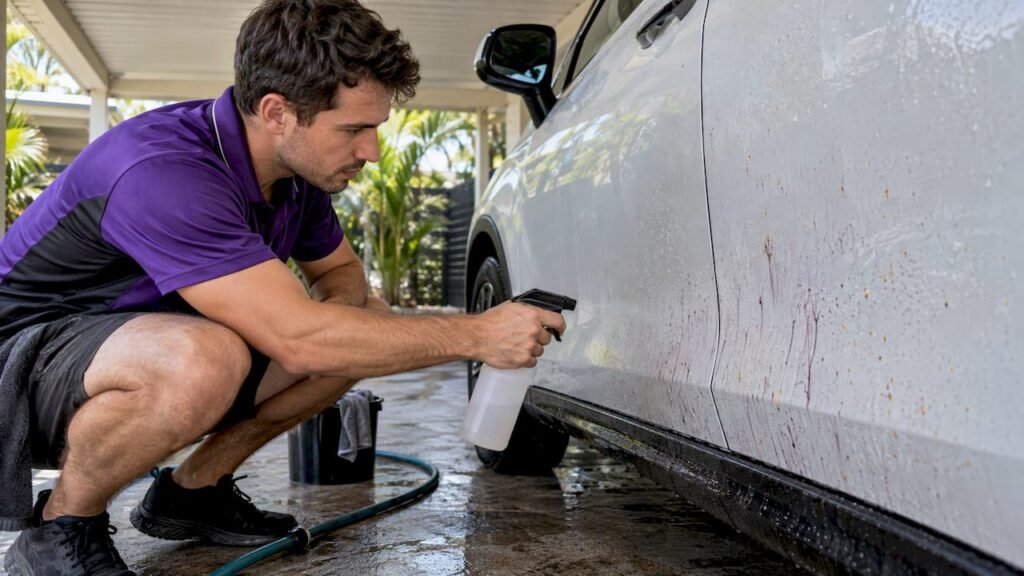
Iron fallout is removable with a reactive iron remover when you use it properly, and it is one of the few paint contaminants with a built-in visual confirmation that the product is working. Before reaching for a chemical, wash the car, let the panels cool in the shade, and test a small area first. Check the Safety Data Sheet and wear basic protective gear before you spray anything on the paint.
TL;DR:
- Read the Safety Data Sheet, wear gloves resistant to chemicals, eye protection, and enclosed footwear, and work in a ventilated, shaded area with cool panels.
- Test a small, inconspicuous area, then treat one cool panel at a time for 3 to 6 minutes and rinse before the product dries.
- Choose pH neutral removers for coated paint; acidic formulas may tackle heavy rust faster but carry greater risk of etching paint, trim, and wheels.
- Book a professional for widespread contamination or existing ceramic coatings; persistent orange staining after two treatment passes may require light machine correction.
- Do not polish or coat until clean, dry paint feels smooth; repeat iron removal roughly every 3 to 6 months, depending on exposure.
Table of Contents
- How to identify iron fallout and when it matters
- Safety and regulatory basics: PPE and reading the SDS
- How iron removers work, product types and in-market examples
- The step-by-step safe removal workflow
- Aftercare: polishing, sealants and when to coat
- Isaac’s recommended workflow and when to book a pro
- DIY versus professional decontamination
- Get your paint properly prepped before it’s protected
- FAQ
- Sources
How to identify iron fallout and when it matters
Iron fallout shows up as tiny orange or rust-coloured specks embedded in the clear coat, often clustered on horizontal surfaces, door edges and lower panels. Run your palm over a freshly washed panel and you will usually feel a gritty, sandpaper-like texture before you see anything unusual. That roughness is the first sign that contaminants have bonded to the paint rather than sitting loosely on top.
Most of this contamination comes from brake dust, rail dust from train lines, and airborne industrial particles that land on the car and oxidise. Once a reactive iron remover is applied, the specks often bleed visible purple or violet run-off, confirming the diagnosis on the spot.
- Orange or brown specks that feel rough rather than smooth to the touch
- Gritty texture across the paint even after a thorough wash
- Purple or violet streaking once a reactive product is sprayed on
- Contamination concentrated on bonnets, boots and lower door panels
Skipping this check before polishing or coating is a common mistake. Buffing over embedded iron particles drags them across the clear coat and causes fine scratching, and coating over unresolved iron contaminants traps the problem under a layer that is far harder to remove later.
Safety and regulatory basics: PPE and reading the SDS
Reactive iron removers are mild compared with many automotive chemicals, but they are still classified hazardous substances and deserve the same respect as any workshop product. WorkSafe Queensland advises that anyone handling hazardous chemicals should consult the product’s Safety Data Sheet and wear the PPE it specifies, which for iron removers typically means chemical-resistant gloves and eye protection.
- Put on chemical-resistant gloves, safety glasses or goggles, and enclosed footwear before opening the bottle.
- Work in a shaded, ventilated area rather than an enclosed garage with the door shut.
- Read the SDS first aid, storage and disposal sections before you start, not after a spill.
- Keep panels cool and never let the product dry on the surface; agitate or rinse within the stated dwell window.
- Store concentrate bottles upright, away from direct sunlight, and transport them securely to avoid leaks.
The Safety Data Sheet exists for a reason: a national training unit for vehicle paint care requires cleaning and polishing to follow manufacturer directions and workplace OHS methods, which in practice means checking the SDS before every new chemical you introduce to a paint care routine.
How iron removers work, product types and in-market examples

Reactive iron removers work through a visible chemical reaction: the active ingredient, usually a thioglycolate compound, bonds with embedded iron particles and turns the liquid purple or violet as it dissolves them. That colour change is a genuine functional cue, not a marketing gimmick. No colour change on a contaminated panel usually means the product has dried out or the surface was never actually affected by iron fallout.
Products split broadly into pH-neutral or acid-free formulas and older acid-based ones. Acidic iron removers cut through heavy rust and scale fast but carry higher risk of etching clear coat, trim and alloy wheels, and they demand more care and experience to use safely. pH-neutral formulas react more gently, which makes them the preferred choice for coated paint and wheels where protecting the existing ceramic or sealant layer matters.
- CARPRO IronX Cherry is an acid-free, pH-balanced iron remover that turns purple-red as it dissolves fallout, with a recommended 3 to 5 minute dwell and safe use on coated paint and wheels when applied correctly.
- Koch Chemie RRR is a pH-neutral reactive rust remover sold in Australia that turns violet on contact with iron and suits a 3 to 6 minute dwell on paint, glass and wheels.
- Deluxe Detail’s iron fallout remover is sold in 1 L and 5 L bottles, turns purple as it reacts, and recommends a 3 to 5 minute dwell on cool panels followed by a clay bar pass for full decontamination.
All three avoid unsealed bare metal and polished aluminium, where the reaction can cause discolouration or staining rather than clean removal. Test a small, inconspicuous patch first regardless of which product you choose, and mist a little water over dark paint to make the purple run-off easier to see. Buyers ordering the 5 L Deluxe Detail bottle should also check freight notices, since larger volumes of reactive chemicals often attract dangerous-goods shipping rules within Australia.
The step-by-step safe removal workflow
Getting the order right matters more than the brand you choose. Rushing straight to a clay bar without a chemical pass first just drags grit across the paint, and spraying iron remover onto a hot bonnet in direct sun flash-dries the product before it can work.
- Wash first. Use a two-bucket contact wash with a pH-neutral shampoo to strip off loose dirt, then rinse thoroughly so the iron remover is working on bonded contamination only, not general grime.
- Move into shade and let panels cool. Surface temperature affects dwell time significantly; a hot panel causes the product to evaporate before it can react.
- Test a small area. Spray a 30 by 30 centimetre patch, watch for the purple or violet bleed, and confirm the product is compatible with any existing coating before treating the whole car.
- Apply evenly across one panel at a time. Work panel by panel rather than coating the entire car at once, so no section sits beyond its dwell window.
- Dwell for 3 to 6 minutes, agitating lightly with a soft wash mitt on heavily contaminated spots such as lower doors and wheel arches.
- Rinse thoroughly with a hose or pressure washer before the product dries, checking that run-off has gone from purple back to clear water.
- Feel the surface again. If it is still gritty, repeat the treatment on that section rather than moving straight to clay.
- Clay the paint using a clay bar or mitt with a dedicated lubricant to lift any contamination the chemical pass did not fully dissolve.
- Inspect under good light before polishing, protecting or coating, confirming the surface feels glass-smooth across bonnet, doors and boot.
Pro Tip:Mist a fine spray of water over the panel after applying iron remover on dark paint; it makes the purple reaction far easier to spot against black or navy finishes.
Persistent orange staining after two treatment passes usually means the contamination has sat for a long time and etched slightly into the clear coat, which chemical removal alone will not fix. At that point, light machine correction is the next step, not a stronger acid. If you notice the paint has gone dull, developed fine white marks, or the contamination covers the whole car rather than isolated panels, that is a reasonable point to stop and book professional decontamination rather than risk the clear coat with repeated DIY passes. The same wash-first, dwell, rinse logic applies to wheels, where brake dust bonds in much the same way as paint fallout.
Aftercare: polishing, sealants and when to coat
Decontamination has to happen before polishing or coating, never after. Buffing over embedded iron particles drags them across the clear coat and causes fine scratches, and sealing or coating over unresolved contamination locks the problem in place under a layer that is genuinely difficult to remove without cutting back the protection first.
- Run a fingertip test across a clean, dry panel: if it still feels gritty, the surface is not ready for polish or protection.
- Light surface marring usually only needs a finishing polish, while deeper scratches or oxidation call for a cutting compound and machine correction first.
- A sealant is often enough for paint in good condition that just needs a protective top-up between details.
- Ceramic coating works best over paint that has been fully decontaminated, corrected where needed and wiped down with a panel-prep solution.
- Reapply iron removal treatment roughly every 3 to 6 months depending on how much brake dust and road grime the car is exposed to, since fallout accumulates continuously, not just once.
Getting this sequence wrong is one of the most common reasons a coating fails early or paint looks hazy under direct sun within weeks of a detail.
Isaac’s recommended workflow and when to book a pro
When we work on a car with visible fallout, the process follows the same logic outlined above: wash, cool the panels, treat with a pH-appropriate iron remover, dwell, rinse, then clay before any polish or protection goes on. We pay close attention to dwell time on darker paint and on wheels, where brake dust tends to bond harder than fallout on bodywork.
- We treat DIY as reasonable for light, isolated fallout on paint with no existing coating.
- We suggest booking a mobile service when contamination is heavy, covers the whole car, or sits under an existing ceramic coating that needs careful handling.
- Our detailing packages include exterior decontamination and paint prep ahead of any cut and polish work.
- Our Ultimate Protection Package builds iron removal and surface prep into the process before ceramic coating goes on.
For wheels specifically, the same dwell-and-rinse principle applies, and brake dust often responds to a similar wheel-safe decontamination approach using shorter dwell times.
DIY versus professional decontamination
DIY iron removal makes sense for a car with light, isolated specks and no existing coating to protect, a reasonable afternoon job with the right product and basic PPE. Where it gets riskier is heavy, whole-car contamination, paint that already carries a ceramic coating, or a finish that has sat untreated for years and may already be etched. A professional brings test-spotting experience across different paint systems, correct disposal of spent chemical run-off, and the judgement to know when a panel needs machine correction rather than another chemical pass. That difference matters most right before a coating goes on, since any contamination trapped underneath becomes far harder to fix once the coating cures.
— isaac’s
Get your paint properly prepped before it’s protected
If the gritty feel on your paint has you reaching for a bottle of iron remover, we can take that job off your hands with the same wash, treat, clay and inspect process outlined above, done at your home, workplace or wherever suits on the Sunshine Coast.
- Our Deluxe Detail and Revival Detail packages both include exterior decontamination and paint prep as standard.
- The Ultimate Protection Package adds full iron removal and surface correction ahead of ceramic coating application.
- Our mobile service means no driving to a workshop and no waiting around, as we bring the gear and the chemical know-how to you.
Brake dust on wheels follows the same bonding pattern as fallout on paint, and for wheel-specific dwell times and agitation technique, Diamondbrite’s brake dust removal guide is a useful reference if you are tackling wheels yourself between details.
Book a Deluxe Detail or Revival Detail and we will handle the decontamination, correction and protection in one visit.
FAQ
Is IRON OUT safe on cars?
IRON OUT is formulated as a household and industrial rust stain remover, not a dedicated automotive iron fallout product, and it is not designed with clear coat safety in mind. Purpose-built automotive iron removers such as CARPRO IronX Cherry or Koch Chemie RRR are formulated specifically for paint, glass and wheels and carry documented dwell times for that use.
What is the best fallout remover for cars?
There is no single best option. It depends on whether your paint is coated or bare: pH-neutral formulas like Koch Chemie RRR or CARPRO IronX Cherry suit coated paint, while heavier acid-based products suit uncoated panels with stubborn rust but need more careful handling.
What is the best iron decontamination spray for cars?
Reactive sprays that turn purple or violet on contact, such as CARPRO IronX Cherry, Koch Chemie RRR or Deluxe Detail’s iron fallout remover, give the clearest visual confirmation that they are working. All three recommend a 3 to 6 minute dwell on cool, shaded panels.
How can I remove iron contamination from my car paint?
Wash the car, move it into shade, and apply a reactive iron remover to one cool panel at a time, letting it dwell for 3 to 6 minutes before rinsing thoroughly. Follow with a clay bar pass to lift any remaining bonded particles, then inspect the surface by feel before polishing or applying any protection.
Sources
- Worksafe
- Koch Chemie Reactive Rust Remover (RRR) — CarCareProducts
- CARPRO IronX Cherry Iron Remover | Waxit
- Training