
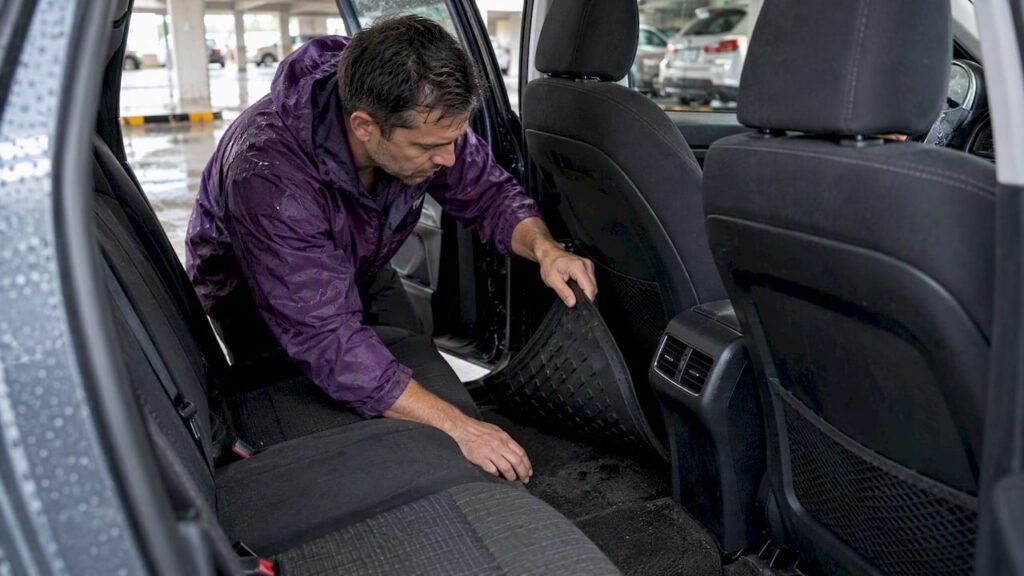
A musty smell after rain almost always means trapped moisture is feeding mould or bacterial growth somewhere in your carpets, underlay or HVAC system. Ventilate and dry the cabin first, then track down the wet spot. If the smell lingers once everything feels dry, or anything stayed wet beyond a short period, it’s time to book professional extraction.
TL;DR:
- Check seals, sunroof drains, boot wells, lifted carpet, and HVAC vents; damp underlay or seat foam can retain water after visible surfaces feel dry.
- Within the first 48 hours, remove wet fabrics, ventilate the cabin, and extract soaked carpet; towels alone cannot remove moisture trapped in underlay.
- If carpet or upholstery remains wet beyond 48 hours, arrange professional extraction; HVAC cleaning also needs care because disturbing contaminated parts can spread spores.
- Sneezing, coughing, wheezing, or eye and throat irritation that eases after leaving the car can point to exposure; seek medical advice for persistent symptoms.
- Deep flooding is different: do not start the engine, and arrange a mechanical inspection before driving because water can cause hydraulic lock and engine damage.
Table of Contents
- Where water gets in and where it hides
- Can mould in a car make you sick?
- How to find the source of a musty smell in your car
- What to do in the first 48 hours after your car gets wet
- When drying isn’t enough: deep cleaning and professional remediation
- How to stop musty smells coming back after rain
- Why most musty car smells are a moisture problem, not a one-off
- How we help when a musty smell won’t shift
- FAQ
- Sources
Where water gets in and where it hides
Rain rarely soaks a cabin evenly. It usually finds one weak point and pools there, often somewhere you won’t notice until the smell shows up days later.
The most common entry points are door and window seals that have perished or gone stiff, blocked sunroof drains and scuppers, boot seals that no longer compress properly, and seams around the floor pan where water creeps in under wet floor mats. Once moisture gets past these points, it settles into carpet, underlay and seat foam, materials that hold water far longer than they look like they do.

Your HVAC system is a second, less obvious source. The evaporator coil sits behind the dash and collects condensation every time you run the air conditioning. A clogged drain tube stops that condensation draining away properly, so it sits on the coil and in the housing, and the cabin air filter downstream can become a damp trap for dust, pollen and skin cells that microbes feed on.
Common culprits include:
- Door, window and boot seals that have hardened or cracked, letting rain seep in slowly over time.
- Blocked sunroof drains that overflow into the headliner or down the A-pillars.
- Wet floor mats and underlay that trap moisture against the carpet backing for days.
- A clogged AC drain tube that leaves condensation sitting in the evaporator housing.
- A saturated cabin air filter that holds moisture and organic debris near the vents.
This is also why the smell can seem to come and go rather than sitting there constantly. Research on air conditioning systems shows evaporator coils with hydrophilic coatings can host microbial growth and release short bursts of odour-causing compounds, known as pulse releases, whenever temperature and humidity shift, which explains why the smell often hits hardest right as you switch the AC on or off, then fades for a while before returning with the next humidity swing.
Can mould in a car make you sick?
Breathing in mould spores inside a closed, damp cabin is more than unpleasant. It can trigger a real physical reaction, particularly on longer drives where you’re sealed in with recirculated air.
The symptoms to watch for are fairly predictable: sneezing, a persistent cough, wheezing, and irritation around the eyes, nose, throat or skin. None of these are dramatic on their own, but they tend to ease noticeably once you’re out of the vehicle, which is a useful clue that the car itself is the trigger rather than a cold or seasonal allergy.
Mould exposure in damp indoor environments, including vehicle interiors, can worsen symptoms for people with asthma, allergies or weakened immune systems, according to guidance on mould risk after water damage. Children, older adults and anyone with a respiratory condition are more sensitive to these effects and generally feel them sooner.
If anyone who regularly rides in the car has ongoing or worsening respiratory symptoms, it’s worth mentioning the musty smell to a doctor, especially if symptoms consistently improve away from the vehicle. On the remediation side, state health guidance treats a persistent musty odour as a genuine warning sign in its own right, not something to wait out, since it often means mould is established somewhere you can’t see.
How to find the source of a musty smell in your car
You don’t need specialist equipment to narrow down where the smell is coming from. A methodical walk-through will get you most of the way there.
- Check the outside first. Run your fingers along door, window and boot seals, feeling for stiffness, cracking or gaps where water could get through.
- Map the smell inside. Sit in each seat with the windows up and note where the odour is strongest, footwells, boot, or around the vents.
- Lift the floor mats. Peel back carpet at the edges where it meets the door sills and check the underlay beneath for dampness or discolouration.
- Inspect the boot well and spare wheel area. These low points collect water that’s entered through boot seals or rear light housings.
- Remove seat bases where you can. Water often pools underneath the seat and soaks into the foam without ever reaching the visible carpet.
- Test the HVAC system. Smell directly at the vents with the fan running on fresh air, then again on recirculate, to see whether the odour is stronger from the AC itself.
- Find the AC drain outlet, usually a small tube underneath the car near the firewall, and check it isn’t blocked or dripping inside instead of outside.
Pro Tip: Run the AC on its coldest setting for five minutes with the windows down before you start sniffing around. It forces condensation through the system and makes a blocked drain or mouldy coil far easier to smell.
If you’ve worked through every step and still can’t find the source, or if you suspect water got in behind trim panels or under the dash where you can’t see, that’s a sign you need a moisture meter or a professional assessment rather than more guesswork.
What to do in the first 48 hours after your car gets wet
The first two days after a wet interior are the window that matters most. Act quickly and you can often avoid the smell taking hold at all.
Start by opening every door and window and parking somewhere dry and sunny if you can. Airflow does more work in this period than almost anything else. Pull out any wet floor mats, seat covers or loose fabric items and dry or launder them separately rather than leaving them damp inside the cabin where they’ll keep releasing moisture into the air.
For carpet and upholstery that are properly wet rather than just damp, towels alone won’t cut it. A wet/dry vacuum or proper extraction pulls far more moisture out of carpet and underlay than blotting does, and it’s worth doing before you place any desiccant packs or silica gel in the footwells to soak up what’s left in the air. Running the heater on a dry setting, or the AC’s dedicated dry mode if your car has one, helps bring cabin humidity down faster than ventilation alone.
- Ventilate fully with doors and windows open, parked in sun where the weather allows.
- Remove and separately dry wet mats, seat covers and anything fabric that isn’t fixed in place.
- Extract rather than blot, using a wet/dry vac where water has properly soaked in.
- Place desiccants in footwells once the bulk of the moisture is out.
- Avoid masking sprays and air fresheners, which hide the smell without addressing the moisture causing it.
Pro Tip: Crack the windows a few centimetres overnight rather than sealing the car up completely. A small amount of airflow stops condensation building up on the inside of the glass while the cabin finishes drying.
If the water ingress was significant, think flooding rather than a leaking seal, document it with photos and don’t start the engine. Deep water can cause hydraulic lock and serious engine damage, so flood-affected vehicles need a mechanical inspection before they’re driven again.
When drying isn’t enough: deep cleaning and professional remediation
Surface cleaning handles light dampness, but once moisture has worked its way into carpet backing, underlay or seat foam, wiping the top layer does very little. These materials are porous, and porous materials hold onto moisture in layers a cloth or vacuum simply can’t reach.
This is where the 48-hour rule matters most. Items that have stayed wet for more than 48 hours are at meaningful risk of significant mould growth, and WorkSafe guidance on managing mould recommends professional remediation for HVAC systems in particular, since disturbing contaminated components during cleaning can spread spores through the cabin rather than removing them. The same guidance is clear that mould can’t be eliminated outright. The realistic goal is controlling moisture and drying things out fast enough that mould never gets a foothold.
Professional remediation for a musty car interior typically includes:
- Hot-water extraction for carpet and seats, pulling bound moisture out of the underlay rather than just the visible surface.
- Evaporator coil and AC drain cleaning, clearing blockages and treating microbial growth directly at the source.
- Targeted disinfection of affected panels and trim, paired with industrial-strength drying equipment rather than household fans.
- Ozone deodorisation, used to break down odour at a molecular level once the moisture source has been dealt with.
Guidance for professional mould remediation also stresses distinguishing porous from non-porous materials, since scrubbing alone leaves moisture trapped in fabric and foam, while industrial extraction paired with dehumidification is what actually prevents regrowth.
If your interior has been properly flooded rather than just dampened, safety comes before cleaning. Don’t start the engine, since deep water ingress can cause hydraulic lock, and get a mechanical inspection alongside any interior remediation. For anything short of full flooding, our flooded car interior cleanup guide and our piece on wet carpet car smell both walk through what fast, proper extraction looks like in practice. For small, isolated mould spots that haven’t spread, our guide to cleaning small patches of mould in car carpet covers what you can safely tackle yourself and where the limits are.
How to stop musty smells coming back after rain
Preventing a musty smell is far less work than removing one, and most of it comes down to a handful of habits you repeat after every wet trip or soaking.
- Clear drainage points regularly, including sunroof drains and door drains, so water has somewhere to go instead of pooling inside panels.
- Replace your cabin air filter on schedule, since a saturated filter holds onto moisture and organic matter long after the rest of the cabin has dried.
- Never leave wet gear inside the car, whether that’s a damp towel, wet shoes or sports kit, since they keep adding moisture to the air long after you’ve parked.
- Run the AC regularly, even in cooler weather, to keep the evaporator coil cycling rather than sitting damp and unused.
- Lift floor mats to dry properly after any wet drive, rather than leaving them down to trap moisture against the carpet.
- Book a periodic interior check during humid seasons, catching early signs of damp before they turn into an established smell.
A simple rule of thumb: every time your car gets properly wet, whether from rain, a beach trip or a spilled drink, treat the next 48 hours as a mini version of the immediate-action steps above. It’s a small habit that heads off most musty-smell problems before they start.
Why most musty car smells are a moisture problem, not a one-off
The conventional wisdom treats a musty car smell as a cleaning problem: spray something, wipe something, move on. In practice it’s almost always a drying problem that cleaning alone won’t fix, because the moisture causing the smell is usually sitting somewhere a cloth can’t reach.
What catches most people out is the intermittent nature of the smell. It fades for a week, comes back after the next rainy drive, and each time it feels like a fresh issue rather than the same underlying damp spot getting worse. That pattern is exactly what you’d expect from a clogged AC drain or a seal that lets in water only in heavier rain, not a sign that the smell is random or that air fresheners simply aren’t working hard enough.
The other thing worth saying plainly: surface-level home remedies have a ceiling. Baking soda and open windows handle light dampness well, but once water has sat in underlay or seat foam for more than a couple of days, you’re no longer dealing with a smell you can out-clean. You’re dealing with moisture that needs proper extraction and drying equipment to actually leave the material. Recognising that difference early saves a lot of wasted effort spraying scent over a problem that’s still growing underneath it.
— isaac’s
How we help when a musty smell won’t shift
When the smell has survived your best drying effort, or when water sat in the carpet longer than it should have, the practical answer isn’t more air freshener. It’s getting the moisture out properly, with equipment and methods a home clean can’t match.

We offer mobile service to your location, which is especially convenient when your car smells too bad to want to drive it to a workshop. Our mobile setup means extraction, HVAC cleaning and odour elimination can happen at your chosen location, without requiring an extra trip to a workshop.
For a musty smell tied to wet carpet or seats, our Deluxe Detail and Revival Detail packages include the interior extraction and odour work needed to properly dry and treat affected materials, not just mask them. Where the smell keeps returning after cleaning, our Ultimate Protection Package adds longer-term interior protection, and our Fabric Guard and leather ceramic coating services help upholstery resist future moisture rather than soaking it straight back up.
To get a quote, it helps to tell us when the water event happened, roughly how long anything stayed wet, and whether anyone in the car has noticed symptoms like sneezing or irritation. A few photos of the affected area speed things up considerably. From there we can tell you whether a standard detail will clear the smell or whether it needs the fuller extraction and treatment process.
- Share the timeline: when it got wet and how long it stayed that way.
- Send photos: of the carpet, seats or any visible damp patches.
- Note any symptoms: anyone in the car reacting to the smell helps us prioritise.
- Ask about the right package: a Deluxe Detail suits a recent, minor soaking; deeper or recurring dampness usually needs more.
Book an inspection or request a quote and we’ll work out the fastest way to get your car dry, clean and smelling normal again.
This article is general information, not a substitute for advice from a qualified doctor. Consult a qualified healthcare professional about your own circumstances before acting on anything here.
FAQ
When it rains, my car stinks. What’s actually going on?
The smell is almost always trapped moisture feeding mould or bacteria somewhere in your carpet, underlay or HVAC system, not something wrong with the rain itself. Check seals, floor mats and the AC drain first, and if the smell persists after drying everything out, that points to moisture sitting somewhere you can’t easily reach.
Does petrichor smell good or bad?
Petrichor is the earthy scent released when rain falls on dry ground, and most people find it pleasant rather than unpleasant. It’s a different smell entirely from a musty car odour, which comes from mould or bacteria growing on damp materials rather than from rain itself.
Will a mildew smell in my car eventually go away on its own?
A mildew smell generally won’t clear up by itself if the moisture source hasn’t been dealt with, since the odour-causing growth keeps producing it as long as conditions stay damp. Drying the area thoroughly and removing the moisture source is what resolves it, not time or ventilation alone.
Does a sour milk smell in a car go away by itself?
A sour milk smell can fade somewhat with thorough cleaning and airing out, but residue trapped in carpet fibres or seat foam often keeps producing odour until it’s properly extracted. If the smell lingers after a few days of ventilation and surface cleaning, treat it the same way as a musty smell and check for moisture or spillage that’s soaked into the padding beneath.
How long can wet car carpet sit before it’s a real mould risk?
Items that stay wet for more than 48 hours face a meaningfully higher risk of significant mould growth, based on WorkSafe guidance on managing mould. If carpet or underlay has been wet beyond a couple of days, professional extraction is a safer bet than continued home drying.
Sources
- Managing mould | WorkSafe Queensland
- Mould risk after water damage | Water Damage Rescue
- Beyond the odor: targeting the root cause of air conditioning VOC pulse release | QUT ePrints