

A mobile detail uses far less water than a driveway hose wash, and a well-run visit does not depend on your tap at all. Most of the water goes on wheels, wheel wells and floor mats, and the rest of the job relies on controlled methods such as pressure washers, steam and waterless products. The part that matters most to you as the owner is where the wash water ends up, because in Australia it should never run into the stormwater drain.
This guide covers how much water a detail uses, where it comes from, which methods keep it low, and what to sort out before the detailer arrives on the Sunshine Coast.
TL;DR
- A small sedan can be washed with about 20 litres using a pressure washer, and larger 4WDs or vans may need 30 litres or more.
- A typical home driveway wash can use up to 100 litres or more if the hose runs freely, so a mobile visit is usually the lighter option.
- Mobile rigs commonly carry their own tank, so you rarely need to supply water, but you do need a sensible place to park and work.
- In every state, wash water carrying detergent or grime must stay out of the stormwater drain.
- Rinseless, steam and waterless methods cut water further, and suit light to moderate dirt best.
Table of Contents
- How much water does a mobile detail use?
- Where does the water come from?
- Methods that cut water use further
- Wastewater and runoff: the rule that matters most
- What to check before you book a mobile detail
- Why mobile detailing is the lighter option
- Our perspective
- Our packages and what they cover
- FAQ
- Sources
How much water does a mobile detail use?
Less than most people expect. An Australian car care brand’s water-restrictions guide reports that 20 litres was enough to wash a small sedan with a pressure washer flowing at around 6 L/min. It adds that bigger 4WDs or vans, or a higher-flow machine at 8.6 L/min, may need 30 litres or more.
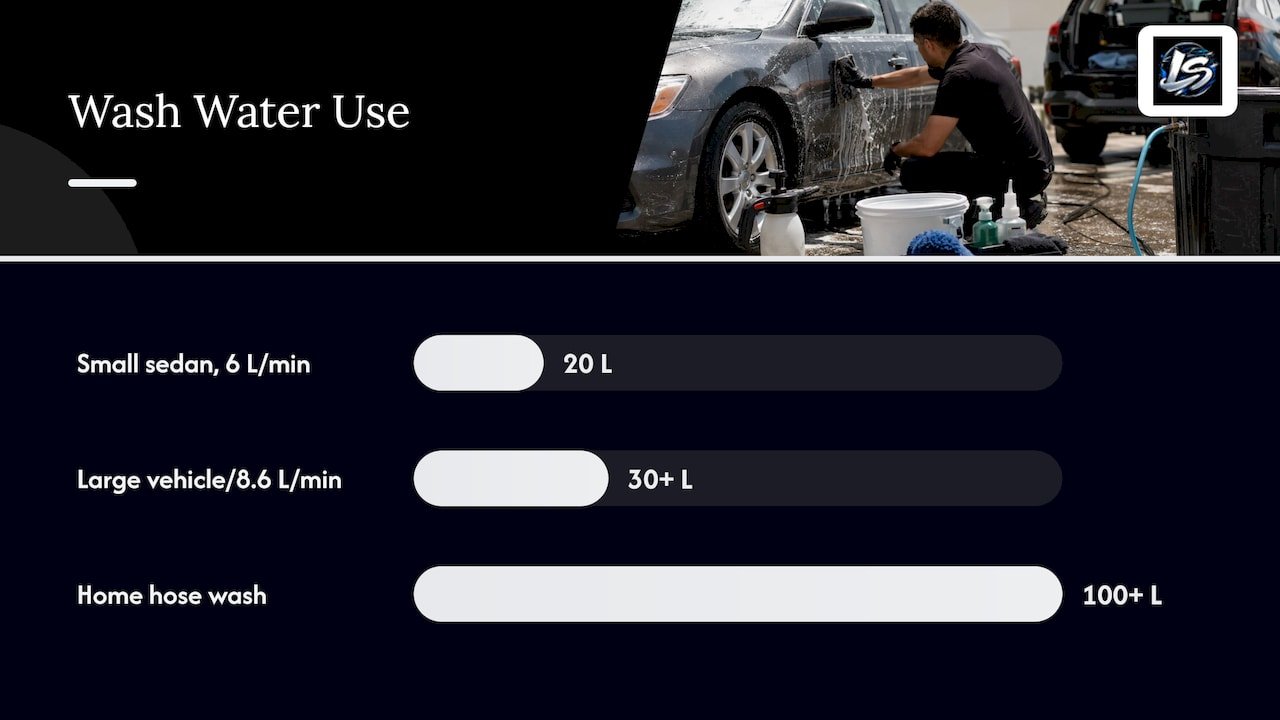
Compare that with the driveway. The Australian Car Wash Association figure, as reported in industry material, is that a typical home driveway wash can use up to 100 litres or more if the hose is left running. The gap comes from control. A pressure washer or a bucket with a measured rinse puts water only where it does work. An open hose runs the whole time you are fetching a sponge.
A full detail is more than a wash, though. Here is where the litres actually go on a typical vehicle:
| Stage | Water demand | Why |
|---|---|---|
| Wheels and wheel wells | Highest | Brake dust and road grime need flushing, and arches are large |
| Floor mats and carpets | High | Rinsing out mats and extraction machines use clean water |
| Pre-rinse of paint | Moderate | Loosens sand and dust before any contact |
| Contact wash | Low | A bucket or rinseless solution does most of the work |
| Final rinse | Low to moderate | Depends on whether you use a spot-free method |
| Polishing, coating, interior trim | Almost none | Product-based work, wiped off rather than rinsed |
That last row is why a protection-focused job such as a ceramic coating or a cut and polish is mostly dry work. The paint is washed and decontaminated first, then the coating or polish goes on with applicators and towels.
Why vehicle size and condition change the number
A hatchback with light dust and a ute coming off a beach track are different jobs. Sand and mud need more rinsing before anything touches the paint, because dragging grit across the surface is how swirl marks start. Salt air on the coast adds to this: the underbody and wheel arches collect it, which is why we offer a Professional Mobile Underbody Wash at $50 as an add-on.
Where does the water come from?
Usually from the detailer’s own vehicle. Mobile detailing is built around being self-contained, and a typical rig carries a tank. One Australian business-planning resource puts the usual size at 200 to 400 litres, which fits in a ute or trailer. At 20 to 30 litres for a wash, that is plenty for a wash-focused visit, and the rest of the volume covers rinsing mats and wheel arches.
Trade reporting on Australian mobile networks has described vans carrying their own tanks, so operators did not need to find a customer’s tap. That is the standard expectation of the category: you should not need to hand over a hose or leave the tap running.
Some detailers still ask to top up from a customer’s tap when a job runs long. It is a small request, and the cost is trivial. If you are on tank water or in a unit complex where the tap is shared, mention it when you book so the setup is planned rather than improvised.
Methods that cut water use further
The water figure is not fixed. The method decides it.
Pressure washing with a measured flow
A low-flow pressure washer is the workhorse. Because the flow rate is known, usage is predictable: a few minutes of rinsing equals a known number of litres. This is the method behind the 20 to 30 litre figures above.
Rinseless and waterless washing
A rinseless wash uses a bucket of solution and microfibre towels, with no hose rinse afterwards. A waterless wash uses a spray lubricant and a towel on lightly dusty paint. Australian waterless-product makers claim that conventional washing can waste up to 100 litres per wash, and that their products remove that usage entirely.

The honest limit is dirt level. Industry guidance describes rinseless methods as best suited to light-to-moderate dirt and suggests a conventional, higher-volume pre-clean for mud-heavy vehicles. That is simply good paintwork practice: the heavier the soil, the more you want to flush before you touch. We explain where waterless fits in our guides to what a waterless car wash is and the role of waterless wash between full details.
Steam cleaning
Steam suits interiors, door shuts, engine bays and stubborn grime. One Australian steam-equipment supplier describes machines producing steam at up to 180°C with almost no water left on the floor and no need for a water connection or drainage. Steam also appears in regulator guidance: Western Australia recommends, where practicable, high-pressure jetting, mechanical scrubbing or steam cleaning in place of chemical solvents to remove grime.
Product choice matters as much as volume
Low water use is only half the story. What is in the water matters too. South Australia’s EPA recommends biodegradable, phosphate-free soap for home washing, and the same principle applies to a mobile visit. Our approach to eco-friendly products is covered in the eco-friendly approach to car detailing.
Wastewater and runoff: the rule that matters most
Volume is the smaller issue. The bigger one is where the water goes. Stormwater drains lead to creeks and the ocean untreated, so anything that runs into the gutter, soap, oil, brake dust, goes straight into local waterways.
The rules are state-based, but they all point the same way:
- Queensland (including the Sunshine Coast): Ipswich City Council advises that home car washing should happen on grassed areas that do not drain to stormwater, with no wash water flowing into gutters, drains or waterways. Check your own council’s pollution page for local wording.
- New South Wales: the EPA states that washing a car where the water drains to the stormwater system is an offence, and that oil, grease and other pollutants must not enter stormwater drains.
- South Australia: the EPA says no washwater containing cleaning agents or toxic pollutants should be discharged directly to stormwater. Home washes should be done on grass, gravel or over a spill-safe mat.
- Western Australia: liquid waste must not enter stormwater soakage pits, gullies or drains. Captured wash-down liquid should be treated, reused or recycled, or sent through approved separation before sewer discharge, or stored for approved disposal.
- ACT: the automotive code expects washing in a designated area with runoff contained, and wastewater sent to sewer only with utility approval.
SA Water’s 2026 guideline also notes that wastewater from high-strength detergent or solvent degreasing may need off-site treatment or disposal rather than ordinary discharge controls. In plain terms: a heavy degrease job is not rinsed down a driveway.
These are the state rules, not a Queensland checklist, so they show the direction of regulation rather than the exact law at your address. What it means in practice is simple. A good mobile detail keeps water low, uses gentle products, and works on a surface where runoff does not reach the gutter.
What to check before you book a mobile detail
A few minutes of planning makes the visit smoother and keeps your property compliant.
- Look at where your driveway drains. Stand there when it rains, or run a bucket of water and watch. If it flows to the street gutter, the visit is better done on grass, a gravel patch or a flatter spot that does not.
- Think about shade and surface. Shade helps products behave and stops water drying into spots. A garage apron, carport or shaded side of the house often works well.
- Tell the detailer about your water. Tank water, shared taps in a unit block and body corporate rules can all affect the setup. Mention them when you book.
- Check body corporate or workplace rules. Apartment buildings and office car parks sometimes restrict washing. Ask the manager before the day, particularly for work or beachside locations.
- Flag the condition of the vehicle. Mud, heavy sand and pet mess change how much rinsing is needed. Tell us up front so the right method is planned.
- Check for drain covers and low spots. Keep the work area clear of pooling water, and keep chemicals and towels off the ground near drains.
- Consider water restrictions. Some regions have restrictions on hose use. A controlled-flow mobile setup tends to suit them better than a driveway wash.
If you work from home and need a car done during the day, or you want it done at the beach car park near your favourite swim spot, the same logic holds: pick a spot that is flat, clear of drains and allowed.
Why mobile detailing is the lighter option
A mobile detail replaces three things people often do at home: the open-hose rinse, the dumped bucket and the half-used chemical bottle. It puts them into one controlled process, with measured water, appropriate products and no leftover wash water in your gutter.
It also saves the other resource, your time. We cover this in our piece on mobile detailing benefits for time and water, and the full process is laid out in our best practices for mobile car detailing on the Sunshine Coast.
Our perspective
Water is the first question most owners ask us, and it is a fair one. They want to know the job will not flood the driveway or send suds down the street.
Our view is that good detailing is mostly technique, not volume. The big visual gains come from decontamination, correction and protection: iron removal, cut and polish, ceramic or graphene coatings, leather and fabric protection. None of those need a hose running. Once paint is protected, it washes more easily and needs less water for the rest of its life.
That is why we put protection at the centre of what we offer, and why we use eco-friendly products across our work. We bring the service to your home, workplace or a spot near the beach so that you are not driving to a wash bay or running a hose at home. We would rather do the job once, properly, with the right method for how dirty the vehicle is.
If you are not sure what suits your car, tell us how it is used. Beach runs, kids, pets and long commutes all point to different packages.
isaac’s
Our packages and what they cover
If you want the water-light approach without managing it yourself, this is what we offer, with prices as published on our site:
- Deluxe Detail: $375 to $575, depending on vehicle size.
- Revival Detail: $575 to $775, for vehicles that need more restoration.
- Ultimate Protection Package: $1,500 to $2,200, an all-inclusive protection package.
- Fabric Guard at $25 per seat and leather ceramic coating at $50 per seat.
- Cut and polish and ceramic coating, quoted to your vehicle.
We come to you across the Sunshine Coast, so the detail happens where the car already is.
To book, start on our detail packages page or go through our main site and tell us where the car will be and how dirty it is. If you want longer-lasting results, our guide to ceramic coating lifespan explains how coated paint is washed and maintained.
FAQ
Do I need to provide water for a mobile detail?
Usually not. Mobile detailers commonly carry their own tank, and Australian trade reporting on mobile networks describes vans carrying their own water. Mention it when booking if you are on tank water or a shared tap, so the setup is planned properly.
How many litres does it take to wash a car?
With a pressure washer, about 20 litres can wash a small sedan, and larger 4WDs or vans may need 30 litres or more. A driveway hose wash can use up to 100 litres or more if the hose is left running.
Is it legal to wash a car on my driveway?
It depends on where the water goes. Regulators across Australia say wash water with detergent or pollutants must not enter stormwater drains, and NSW treats it as an offence. Washing over grass or gravel that does not drain to the street is the commonly advised approach. Check your own council’s rules.
Can a waterless wash replace a full detail?
No. Waterless and rinseless methods suit light to moderate dirt and work well for maintenance between details. Heavily soiled vehicles need a conventional pre-clean, and jobs like polishing, coating and interior extraction are separate processes.
Does ceramic coating reduce how much water I use later?
A coated surface is easier to clean, so washes can be quicker and gentler. How much you save depends on the vehicle, how it is used and how it is maintained.
Sources
- Bowden’s Own water-restrictions guide, exterior set-up
- DayRoute mobile car detailing business plan for Australia
- Business View Oceania on mobile car detailing networks
- WOSH Australia, About
- How to Start a Mobile Detailing Business
- KKE Wash Systems Australia, car steam cleaners
- WA Government, Mobile mechanical servicing and cleaning
- EPA South Australia, Stormwater Management for Wash Bays
- Ipswich City Council, Water Pollution
- NSW EPA, Smash repair industry
- ACT Environment Protection (Automotive) code
- SA Water, Vehicle Washing guideline