
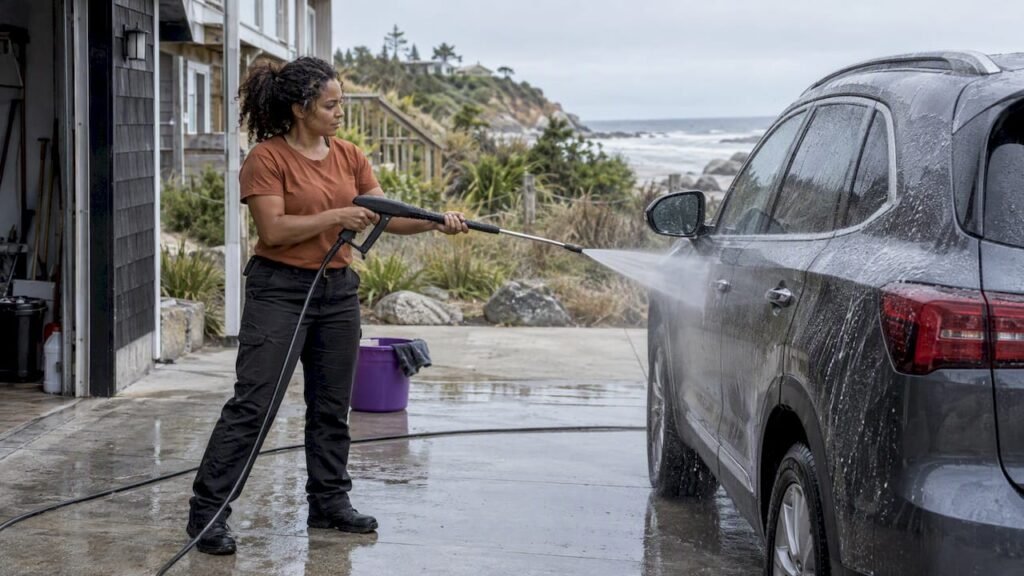
Neither wins on its own. A pressure washer is the best tool for removing loose grit, salt and mud before you touch the paint, and a hand wash is the best way to remove the film that is left. Paint damage mostly comes from dragging dirt across the surface, so the safest routine uses both, in that order, on a lawn rather than a hard driveway.
Below, we compare the two methods on paint safety, coatings, water use and cost. We also cover where each one goes wrong and when it makes more sense to book a professional.
TL;DR
- Use a pressure washer (or a thorough hose rinse) first to lift grit, then hand wash with a clean mitt. That pairing is gentler than either method alone.
- Most swirl marks come from dirty sponges, worn brushes and soiled buckets, not from the pressure washer itself.
- Washing on a hard driveway sends suds and contaminants into the stormwater system. Wash on grass, or use a mobile service that manages its own wastewater.
- A hand wash with a pH-friendly shampoo is kinder to waxes, sealants and ceramic coatings than repeated aggressive blasting.
- If your paint is already swirled, or you want a coating, a detail will do more than any wash method.
Table of Contents
- The short answer: pressure wash first, hand wash second
- Pressure washing: strengths and risks
- Hand washing: strengths and risks
- Side-by-side comparison
- What about automatic and touchless washes?
- The environmental side: where the water goes
- How often should you wash?
- A safe home routine, step by step
- Our perspective: the wash isn’t the real problem
- When a professional detail beats any wash
- Our mobile detailing options on the Sunshine Coast
- Choosing your method: a quick decision guide
- FAQ
- Sources
The short answer: pressure wash first, hand wash second
People search “pressure wash vs hand wash” as if they must pick one. In practice they do different jobs.
A pressure washer moves a lot of water at speed. It is excellent at knocking off sand, mud, bird droppings that have softened and the salty film that builds up on coastal cars. It does this without touching the paint, which is its main advantage.
A hand wash is the contact step. A soapy mitt lifts the bonded traffic film that water alone leaves behind. It lets you see and feel the paint, spot chips and check the edges of panels.
Skip the first step and your mitt picks up grit and drags it across the clear coat. Skip the second and the car looks clean but carries a thin layer of road film that dulls the finish and sheds water badly. The RACV makes the same point about technique: rinse the car thoroughly before any physical contact, and use a two-bucket method, one bucket for soap and one for rinsing the mitt.

Pressure washing: strengths and risks
What it does well
- Removes loose abrasive dirt before contact, which is the biggest single step in protecting paint.
- Cleans wheel arches, sills and the underside, where a mitt can’t easily reach.
- Works fast. A rinse that would take twenty minutes with a hose takes a few.
- Pairs well with a foam pre-soak, which loosens grime so there is less to scrub.
Where it goes wrong
Pressure itself is rarely the problem on healthy paint. Problems start with how it is used:
- Holding the nozzle too close. A narrow jet at close range can lift flaking clear coat, damage stone chips and force water past worn seals. Car makers publish their own minimum distances in owner’s manuals, so check yours.
- Aiming at weak spots. Peeling paint, loose trim, aftermarket decals, wrap edges and paint protection film edges are all vulnerable. A jet can get under an edge and lift it.
- Treating it as the whole wash. Pressure alone won’t remove road film, so owners often go back over the same area and wear down wax or sealant.
- Forcing water into places it shouldn’t go. Door seals, engine bays and electrical connectors on older vehicles don’t like a close, hard jet. Follow your handbook.
If you own a car with a ceramic coating, fresh paint or PPF, keep the pressure moderate and the nozzle wide, and read the care instructions your installer gave you.
Hand washing: strengths and risks
What it does well
- Removes the film pressure alone leaves behind.
- Gives you control: you can spend extra time on bug splatter at the front or tar behind the wheels.
- Is gentle on coatings when done with a suitable shampoo. A fresh wax or sealant lasts longer under a mild hand wash than under harsh, repeated treatment.
- Lets you inspect the paint for chips, rust spots and new scratches.
Where it goes wrong
The RACV notes that dirty sponges, worn brushes and a soiled bucket drag grit across the paint, and that fine swirl marks and light scratches are generally caused during washing and drying. That fits what we see on cars: a hand wash done badly can be harder on paint than a good pressure rinse.
The usual culprits:
- One bucket, so the mitt is reloaded with grit on every dip.
- A kitchen sponge or old rag instead of a microfibre wash mitt.
- Washing in direct sun, so soap dries on the panel.
- Dry-wiping with a dirty or rough towel.
- Dropping the mitt and carrying on.
A mitt that hits the ground goes in the wash pile, not back on the car.
Side-by-side comparison
| Factor | Pressure wash only | Hand wash only | Pressure rinse, then hand wash |
|---|---|---|---|
| Removes loose grit | Very well | Poorly, and risks scratching | Very well |
| Removes road film | Poorly | Well | Well |
| Scratch risk on paint | Low if used at a sensible distance | Moderate to high with poor technique | Lowest of the three |
| Effect on wax, sealant, coating | Can strip weaker products if overused | Gentle with a suitable shampoo | Gentle |
| Time | Fast | Slow | Moderate |
| Reaches wheel arches and underside | Yes | Partly | Yes |
The third column is the one we recommend for owners who wash at home.
What about automatic and touchless washes?
It helps to know the third option, because it often comes up in the same search. Automatic washes with rotating brushes are, according to the RACV, a major contributor to swirl marks. Touchless systems avoid the brushes, so they are generally the safer choice, but they can struggle with stubborn road film. That often leaves a thin haze that a follow-up hand wash or a good sealant handles better.
If you want a compact tool that does both jobs at a small scale, a 2-in-1 wash brush with jet spray lets you rinse and agitate in one pass. Use soft bristles only on a car that has been rinsed first, and keep the brush clean.

The environmental side: where the water goes
This is where the two methods differ most in the real world, and it matters more on the Sunshine Coast than most owners assume, because our driveways drain towards creeks, canals and beaches.
The Australian Car Wash Association says uncontrolled residential washing is a significant source of stormwater pollution, and that commercial car washes direct their runoff to the sewer for treatment. Sunshine Coast Council’s smart car washing guidance explains that washing on a hard driveway sends soapy suds and contaminants straight into the stormwater system and on to waterways and beaches. Heavy metals and tyre particles are among what gets carried off. South Australia’s EPA gives the same advice for high-pressure cleaning: keep waste water out of the stormwater system.
A pressure washer makes this worse in one respect: it moves more dirt, faster, and sprays it further. So if you use one at home:
- Park on grass or gravel where water can soak in, not on concrete or pavers that slope to the street.
- Brush or blow loose dirt off first where you can.
- Use a mild, biodegradable shampoo and as little as you need.
- Never hose suds into the gutter.
The ACWA also reports a typical commercial wash uses about the same water as one load of laundry. Backyard washing with a running hose typically uses more, so a bucket and a trigger nozzle are better than an open hose.
We’ve written about this in more detail in our guide to eco-friendly car care and a home detailing workflow that cuts harmful runoff.
How often should you wash?
The RACQ suggests washing at least once a fortnight to protect paint from dust and debris. The RACV’s paint-protection advice goes further and suggests washing once a week to remove contaminants that can lead to paint corrosion. Near the coast, with salt air, pollen and bird droppings, weekly is a sensible target if you have the time.
Between full washes, a waterless method can handle light dust without a hose. Our notes on the role of waterless wash between full details explain when it works and when it just rubs dust around.
A safe home routine, step by step
- Pick the spot and time. Shade, cool panels, and a patch of lawn rather than a sloped driveway.
- Rinse from the top down. Use the pressure washer on a wide fan (or a hose) and work around the car, spending extra time on lower panels, wheel arches and the front bumper.
- Foam or pre-soak if you have it. Let it sit briefly (not drying) so it loosens the film.
- Wash with two buckets. Soap in one, clean rinse water in the other. Rinse the mitt after each panel and start at the roof, finishing with the dirtiest lower sections.
- Wheels last, with separate tools. Brake dust is abrasive and should never touch your paint mitt.
- Rinse again. Sheet water over the panels to carry soap away.
- Dry gently. Use a clean, plush microfibre towel and blot or glide, never scrub.
For a deeper look at the steps, see our exterior car cleaning best practices.
Our perspective: the wash isn’t the real problem
We detail cars on the Sunshine Coast, at people’s homes, workplaces and even beaches, so we see the results of both methods every week.
Here is what we’d tell a friend. The pressure washer is not the villain, and the hand wash is not automatically the hero. The cars that come to us with the worst swirl marks have usually been washed with one dirty bucket, a gritty sponge or a brush-based automatic wash. The cars with the best paint have usually been rinsed properly and washed with clean tools by someone patient.
We also see how many owners have a ceramic coating or sealant and then undo some of the benefit with an aggressive wash or harsh chemicals. If you have paid for protection, treat the wash as maintenance of that protection. Our guide to keeping a ceramic coating lasting longer covers how.
The other thing we’d say is that a home wash can only remove dirt. It can’t fix swirl marks, oxidation or etched bird droppings, and a mitt won’t deliver a coating. That is detailing work, and it is easier to do properly with the right lighting, products and a controlled process. Our article on why you might skip DIY car cleaning goes into when that trade-off makes sense. And our own mobile approach is built around the same principles: rinse thoroughly, contact the paint as little as possible, use clean tools and eco-friendly products, and keep the wastewater off the street.
— isaac’s
When a professional detail beats any wash
Washing, whichever way you do it, maintains. It doesn’t restore. Consider booking a detail when:
- You can see swirl marks in sunlight. Washing can’t remove them; polishing can. See how we remove swirl marks while preserving the clear coat.
- Water no longer beads and the paint feels rough even after washing.
- The car is new and you want protection from day one. Here is how to protect a new car in 6 to 8 weeks.
- You want to cut down on washing time. A coated car is easier to clean, whichever method you use.
- The interior is as tired as the exterior, especially with kids or pets.
Not sure whether you need polishing or just wax? Our 50x50mm test is a simple way to decide.
Our mobile detailing options on the Sunshine Coast
We come to you, so you don’t need to find a spot on the lawn or deal with runoff. Published prices on our site are:
| Service | Price |
|---|---|
| Deluxe Detail | $375 to $575 |
| Revival Detail | $575 to $775 |
| Graphene spray sealant coating package | $339 to $739 |
| The “holy Grail” detail | $600 to $1,000 |
| Ultimate Protection Package | $1,500 to $2,200 |
| Professional Mobile Underbody Wash | $50 |
Prices vary with vehicle size and the package. Our cut and polish and ceramic coating services don’t have a published price, so ask us for a quote.
If your main worry is salt and grit under the car, the underbody wash is the cheapest place to start. The RACV recommends professional underbody cleaning with high-pressure equipment about once per season to help prevent rust in drainage holes and exposed metal, which is exactly the job a home pressure washer does badly. You can see what’s included on our special services page.
Choosing your method: a quick decision guide
- You have a lawn, ten minutes of patience and a clean mitt: pressure rinse, then two-bucket hand wash.
- You live in a unit with only a hard drive or street parking: use a waterless product for light dust, and book a mobile service or a trade-waste car wash for heavy dirt.
- You have a coating or PPF: gentle rinse, hand wash with a suitable shampoo, and follow the installer’s care guide.
- Your car is already swirled or dull: skip another home wash experiment and book a polish.
- You drive a lot on dirt roads or the beach: rinse the underside soon after, and have it professionally cleaned every season.
FAQ
Is it better to pressure wash or hand wash a car?
Use both. A pressure rinse removes the loose grit that causes scratches, and a hand wash with a clean mitt removes the film that remains. Doing only one leaves either a dull film or a higher risk of swirl marks.
Can a pressure washer damage car paint?
It can if the nozzle is too close, the jet is too narrow or the paint is already flaking or chipped. Keep to your manufacturer’s minimum distance, use a wide fan and stay away from peeling paint, trim edges and PPF or wrap edges. On healthy paint at a sensible distance, a pressure rinse is generally gentler than scrubbing off dry dirt.
Is it legal to wash my car on the driveway on the Sunshine Coast?
We aren’t aware of a blanket ban, but the council explains that washing on hard surfaces sends contaminants into the stormwater system and on to waterways. It recommends washing on grass or gravel. Check the council’s current guidance for specifics, since rules differ between councils and states.
How often should I wash my car?
The RACQ suggests at least once a fortnight, and the RACV suggests once a week for best paint protection. Wash sooner after bird droppings, bugs, salt spray or a beach trip.
Will washing damage my ceramic coating?
A gentle rinse and hand wash with a suitable shampoo is the usual way to maintain a coating. Harsh chemicals and abrasive tools shorten its life. Follow the care guide from your installer, and see our ceramic coating care guide.
Sources
- How to wash, clean, and detail your car, RACV
- How to remove swirl marks from your car, RACV
- How to protect car paint: wax and coatings explained, RACV
- Top tips for looking after your first car, RACQ
- The Environment, Australian Car Wash Association
- Around the home, EPA South Australia
- Smart car washing, Sunshine Coast Council