
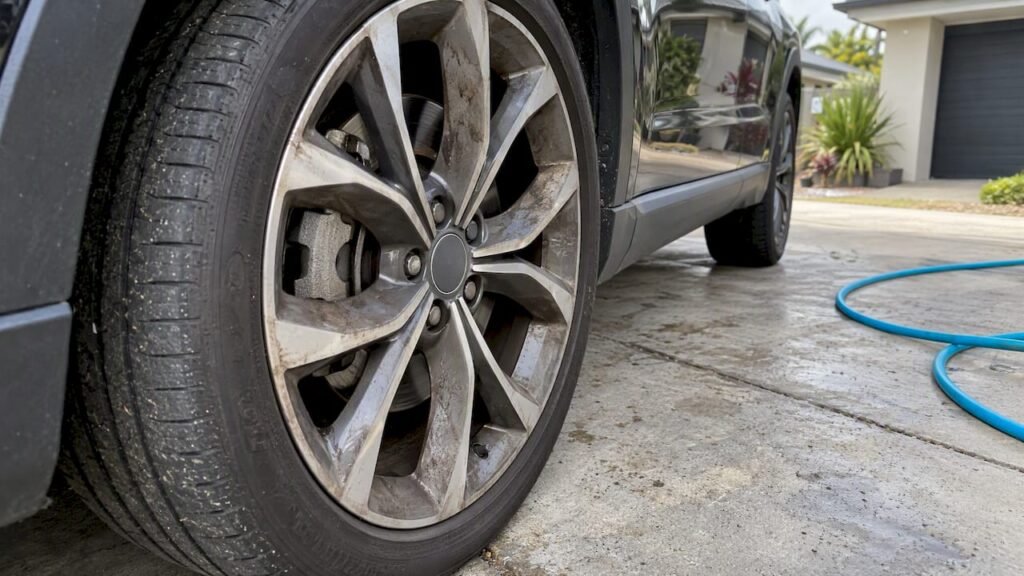
The most effective brake dust protection is a dedicated wheel coating (a wheel sealant or a professional ceramic coating) applied to a perfectly clean, decontaminated rim, then kept up with regular wet washing. The coating does not stop the dust forming. It stops the dust gripping, so a rinse and a gentle wash lift it off. Low-dust brake pads reduce how much lands on the wheel in the first place, and the two together make the biggest difference.
Below we cover where the dust comes from, what each type of protection really does, how long it lasts, the mistakes that ruin it, and when it is worth having a professional do it at your home or workplace.
TL;DR
- Brake dust is fine metallic debris from the pads and discs. Hot and left to sit, it bakes onto the rim and becomes hard to remove.
- A wheel-specific sealant or ceramic coating gives dust a slick, heat-resistant surface to sit on, so it rinses off far more easily. It is not maintenance-free.
- Prep decides the result. A coating applied over leftover iron, grease or old product fails early.
- Wash wheels wet and often, with a pH-appropriate cleaner. Never blow dust off with compressed air or dry-brush it.
- Low-dust pads cut the supply, but only where they suit your vehicle and driving.
Table of Contents
- Where brake dust comes from, and why it sticks
- What actually protects a wheel from brake dust
- Sealant, coating or wax: a quick comparison
- Prep is where coatings win or fail
- How to wash coated wheels without undoing the work
- Safety: wet-wipe only, and keep brake fluid off the finish
- Do dust shields and wheel covers help?
- What we do about it on the Sunshine Coast
- Getting wheel protection done for you
- How to decide: a short checklist
- FAQ
- Sources
Where brake dust comes from, and why it sticks
Every time you brake, the pad rubs against the disc. That friction wears both surfaces and sheds particles. A review of brake wear particle emissions describes brake dust as a major source of non-exhaust traffic particles, often 11 to 21% of traffic-related PM10, with iron, copper, barium and antimony among the key components.
The iron is the part you notice. Fine iron particles land on a wheel that is already hot from braking, and they embed in the surface. Add Sunshine Coast humidity, salt air near the beaches and the odd afternoon storm, and the particles start to rust and stain. Left alone for weeks, they can etch into clear coat, polished alloy and some painted finishes.
That is why a wheel that looks fine on Saturday has a brown-black film by the following weekend. It is also why prevention beats scrubbing: every aggressive clean you avoid is less wear on the wheel’s finish.
What actually protects a wheel from brake dust
There are four layers of defence. They stack, and none of them is magic.
1. Low-dust brake pads
Pad material changes how much dust you produce and how dark it is. Ceramic and low-dust formulations are sold for many popular models (retailers list them by vehicle, for example low-dust ceramic pads for the Nissan X-Trail). They are worth asking your mechanic about at the next pad change, but only where they suit your car, load and driving. Towing or spirited driving may call for a different compound, so take the advice of the person fitting them.
2. Wax and general sealants
A paint wax or general paint sealant on a wheel is better than nothing, but wheels are the hottest, dirtiest surface on the car. Ordinary waxes soften and break down under brake heat. Products made for wheels are formulated for that temperature cycle, which is why enthusiasts keep recommending sealants over waxes for rims.
3. Dedicated wheel sealants
A wheel sealant is a quick DIY option: clean, decontaminate, apply, buff. It typically lasts weeks to a few months. It suits owners who enjoy the ritual and do not mind reapplying.
4. Ceramic wheel coatings
A ceramic wheel coating forms a hard, heat-resistant, water-repelling layer on the rim. Dust cannot bond as strongly, so cleaning needs mostly water and a gentle cleaner. Wheel-specific products are engineered for the extreme heat cycles wheels see, and manufacturers such as Gyeon describe their wheel coating as suitable for painted, powder coated, anodised and polished rims. Real-world life is typically 12 to 24 months depending on product, application and care.
For a deeper look at types and care, see our guide on what wheel coating is and how to look after it.
Sealant, coating or wax: a quick comparison
| Wax | Wheel sealant | Ceramic wheel coating | |
|---|---|---|---|
| Heat tolerance | Low | Moderate to good | High, made for wheel temperatures |
| Typical durability | Days to weeks | Weeks to months | Around 12 to 24 months with care |
| Application | Easy | Easy to moderate | Needs full prep, best done professionally |
| Dust release | Mild | Good | Best of the three |
| Upfront cost | Lowest | Low | Highest |
If you want to see how the same trade-off plays out on paint, our piece on ceramic coating versus wax for Australian car owners goes through it in detail.
Prep is where coatings win or fail
The single most common reason a wheel coating disappoints is poor preparation. A coating is not a gloss spray. The rim has to be washed, chemically decontaminated for embedded iron, and degreased so the surface is oil-free before anything is applied. Manufacturer guidance for wheel coatings describes a dedicated prep step for exactly this reason.

Skip it and the coating bonds to contamination rather than the wheel. It fails early, can leave a tacky residue, and that residue can hold dust more readily than bare metal would. The same logic applies to iron: our guide to safe iron fallout removal explains why this step comes before any protection goes on, and why iron contaminants matter on paint applies equally to rims.
A sensible professional sequence for wheels looks like this:
- Rinse and wash the face, spokes and barrel to remove loose dust.
- Chemically remove embedded iron and brake dust.
- Clean the barrel, lip and around the lug nut seats.
- Remove any old sealant and wipe the surface oil-free.
- Inspect for kerb damage, pitting or corrosion that needs attention first.
- Apply the coating in thin, even layers and let it cure as the maker specifies.
Curing matters. Keep the wheels dry and away from harsh chemicals for the period the product requires.
How to wash coated wheels without undoing the work
A coating makes cleaning faster, not unnecessary. Many owners assume it is maintenance-free. Detailing guidance is consistent that gentle, regular upkeep is still needed to clear embedded iron over time so the coating keeps performing, which the product guidance from Gyeon also notes.
A routine that works for most daily drivers:
- Weekly or fortnightly: rinse the wheels first, then wash with a quality pH-neutral or low-pH wheel cleaner and a soft brush. Rinse thoroughly.
- Every few months: use an iron remover to dissolve embedded particles, then rinse well.
- Avoid: strong acid or strongly alkaline wheel cleaners on a coated wheel, as retailers of ceramic wheel coatings such as Waxit point to high-temperature wheel coatings being designed to make wheels rinse clean easily, and harsh chemistry works against that.
- Ignore miracle products. Consumer group CHOICE has warned against relying on miracle cleaning products. A simple multipurpose or dedicated wheel cleaner does the job.
We have also written a practical two to four week routine to stop dust sticking and a guide to wiping brake dust off in minutes if your wheels are already built up.
Safety: wet-wipe only, and keep brake fluid off the finish
Two cautions belong right where you start work.
Never blow the dust off or dry-scrub it. Brake friction material in older vehicles may contain asbestos. The national Asbestos Product Guide notes that asbestos brake linings were used in Australia before the mid-1990s, and asbestos safety guidance for motor vehicle workshops says many vehicles built before 2003 can still carry asbestos-containing components. That matters most if you own an older or imported vehicle or a historic car. Use plenty of water and wipe wet so the debris stays contained. If you are unsure about the brakes on an older vehicle, ask a mechanic before cleaning around them.
Treat brake fluid as a paint hazard. If you see fluid on a wheel or paintwork, do not wipe or rub it. RACQ advises flushing it with plenty of water straight away, and notes that brake fluid is corrosive to paint and clear coat. A leak is also a brake fault, so have a mechanic inspect the car before you drive it.

Do dust shields and wheel covers help?
The search results are full of dust shields and hub covers. These are fitted behind or over the wheel face, mostly for trucks, trailers or steel wheels. For a modern passenger car or SUV with alloy wheels they are rarely a sensible answer. They can trap heat, change the look of the car, and are unrelated to how your brakes ventilate. If your goal is a clean alloy wheel, pad choice plus a coating and a good wash habit deal with the problem without modifying anything.
What we do about it on the Sunshine Coast
We are a fully mobile detailer, so we do the decontamination and coating at your home, workplace or wherever you can park in shade. We see the same pattern all the time: owners who have tried a spray product over dirty wheels, and then wonder why the dust is stuck harder than before.
Our point of view is simple, and it is the one we would give a friend:
- Prep over product. The best coating on a poorly prepared wheel is a bad coating. We spend the time on decontamination because it decides how long the finish lasts.
- Match protection to how you drive. A weekend car with low-dust pads and a sealant may not need a full coating. A daily commuter in stop-start traffic, or a family car parked outdoors near the coast, gets the most from one.
- Be honest about maintenance. Coatings make wheels easier to clean. They do not eliminate washing, and we tell customers exactly what to use and what to avoid.
- Gentle chemistry. We use eco-friendly products where they do the job, and we avoid harsh acids on finishes that will not tolerate them.
Mobile work means no drop-off, no waiting around, and the wheels are cured and cared for in a clean setting. It also means we can see the car in your daily environment and advise accordingly.
— isaac’s
Getting wheel protection done for you
If you would rather have it done properly once, our ceramic coating service covers paint, wheels and leather, applied by us at your location. Ceramic coating has no published price, so ask us for a quote based on your vehicle and wheels. We explain what influences the figure in our article on wheel ceramic coating cost.
If you want wheel protection as part of a bigger job, our published packages are:
- Deluxe Detail and Revival Detail: 375 to 575 AUD and 575 to 775 AUD respectively, depending on vehicle size.
- Graphene spray sealant coating package: 339 to 739 AUD.
- Ultimate Protection Package: 1500 to 2200 AUD.
Tell us when you book that wheels are your priority and we will confirm what is included for your vehicle. If you are weighing options, our ceramic coating guide for Sunshine Coast owners and ceramic coating lifespan advice explain what to expect afterwards.
How to decide: a short checklist
- Is the brake dust only a nuisance, or is it staining? Staining or pitting means the wheel needs correction before protection.
- How long do you keep the car? Longer ownership favours a coating.
- How often will you wash the wheels? If rarely, protection matters more, as it reduces how much damage builds between washes.
- Are you about to change pads? Ask about low-dust options then.
- Do you want to DIY? A wheel sealant is fine, as long as you do the prep.
- Is the car older or imported? Wet-wipe only, and ask a mechanic about the brake components.
The combination that gives most owners the best result for the effort is a properly prepped coating, a fortnightly gentle wash, and a periodic iron treatment.
FAQ
What is the black dust on my wheel rims?
It is brake dust: a mix of worn pad material and iron from the brake discs, thrown onto the wheel as you brake. Because it lands on hot metal, it can bond to the surface and stain if left for weeks.
Does ceramic coating stop brake dust completely?
No. Dust still forms and still lands on the wheel. A coating makes it grip less, so it rinses and wipes off much more easily, and it needs gentle washing and occasional iron removal to keep performing.
How long does wheel protection last?
A wheel sealant generally lasts weeks to a few months. Professional ceramic wheel coatings are typically reported at 12 to 24 months, depending on the product, the prep and how you wash the wheels.
Can I use any wheel cleaner on coated wheels?
Stick to a pH-appropriate or low-pH wheel cleaner or a quality multipurpose cleaner. Strong acid or strongly alkaline cleaners can strip the coating and leave the wheel exposed, so check with your installer before using anything aggressive.
Is it safe to blow brake dust off with an air gun?
No. Blowing or dry-brushing sends fine particles into the air, and older or imported vehicles may have friction material containing hazardous substances. Rinse and wipe wet instead.
Sources
- Brake wear particle emissions: a review (PMC)
- Gyeon Australia, Q² Rim EVO wheel coating
- Waxit, Nv WHEEL ceramic wheel coating
- CHOICE, eco cleaning products you should and shouldn’t buy
- RACQ, What is brake fluid?
- Asbestos Product Guide, automotive brake shoes and linings
- Asbestos.sa.gov.au, motor vehicle workshop guidance
- Pedders, Akebono ceramic low dust brake pads