
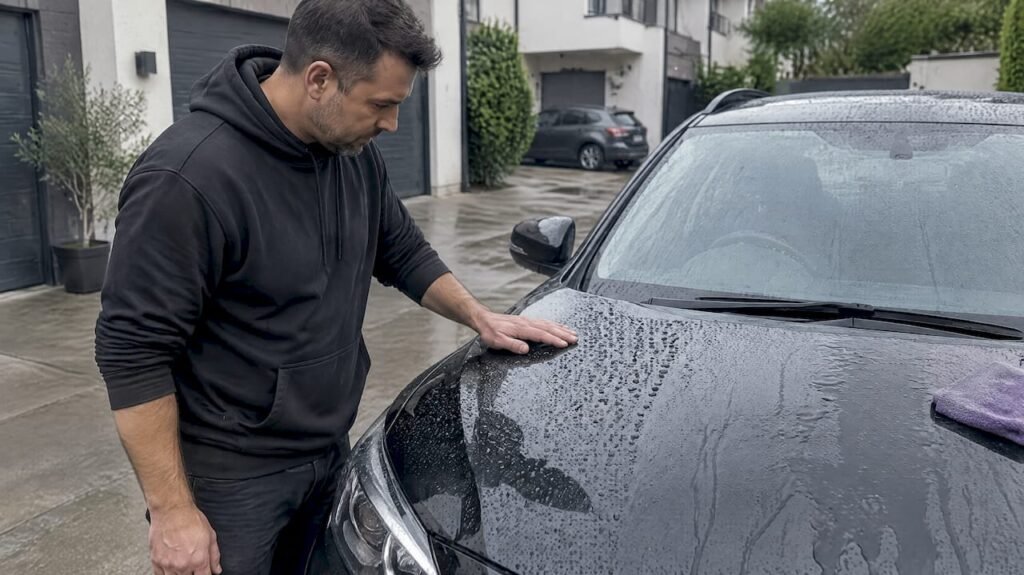
If you want low-effort, long-lasting protection, a professional ceramic coating is the better fit. If you want low-cost shine and don’t mind frequent top-ups, wax still does the job well. The right answer depends on your budget, how often you’ll realistically maintain the car, and how long you want the protection to last, which we break down below alongside a decision checklist.
TL;DR:
- Professional ceramic coatings typically last 2 to 5 or more years, while wax needs frequent reapplication every few months depending on exposure.
- Both protect against UV fading and chemical stains, but coatings generally perform better against bug acid and bird droppings, while wax offers a warmer gloss.
- Applying a ceramic coating requires extensive surface preparation, including washing, decontamination, polishing, and proper curing, unlike wax which needs minimal prep.
- Coatings are more cost-effective over time for owners who prefer low-maintenance routines, whereas wax remains cheaper upfront but incurs ongoing expenses.
- Environmental and safety considerations include solvent use for both products, but coatings benefit from fewer reapplications, reducing waste over the vehicle’s lifespan.
Table of Contents
- Ceramic coating vs wax: the main differences at a glance
- Durability and protection: what each actually delivers
- Cost and value: how to compare ongoing costs
- Application and preparation: steps required for reliable results
- Maintenance and longevity management: wash routines and boosts
- Disadvantages and risks to consider
- Which is right for you: match owner profiles to the best option
- Isaac’s Pro Detailing: practical workflow and evidence-based tips
- Environmental impact and safety considerations of ceramic coating vs wax
- Common myths and misconceptions about ceramic coating and wax
- How weather and climate affect the performance of ceramic coatings and wax
- Author perspective: practical advice from a mobile detailer
- How Isaac’s Pro Detailing can help with professional ceramic coatings
- FAQ
- Sources
Ceramic coating vs wax: the main differences at a glance
The two options solve the same problem (protecting your paint and keeping it glossy) in very different ways. Ceramic coating forms a semi-permanent bond with the clear coat, while wax sits on the surface as a sacrificial layer that wears off with washing, sun and road grime.
- Durability: professional ceramic coatings commonly last 2 to 5 or more years, while wax typically lasts weeks to a few months depending on exposure.
- Protection: both resist UV fading and light chemical staining, but neither stops stone chips or deep scratches, and coatings generally hold up better against bird droppings and bug acid.
- Appearance: wax gives a warm, deep gloss that many owners prefer visually, while ceramic coating produces a harder, glassier shine with stronger water beading.
- Cost: wax is cheap upfront but adds up with repeated buying and application, while a professional coating costs more initially but spreads that cost over several years.
- Effort: wax is simple enough for most owners to apply at home, while a lasting coating depends on proper paint preparation and is usually best left to an installer.
Matching the product to your own habits, rather than chasing the most expensive option, is what experts recommend when owners ask which is “better.”
Durability and protection: what each actually delivers
A professional ceramic coating typically holds up for 2 to 5 or more years, though the exact figure depends heavily on the product, the quality of the prep work, and how the car is parked and washed. Wax, by comparison, breaks down within weeks to a few months once exposed to sun, rain and regular washing, which is why hobbyists treat it as a routine they enjoy rather than a set-and-forget solution.

Both layers resist UV fading and light chemical staining, and both improve water beading, but neither is a substitute for mechanical protection like paint protection film against stone chips or scratches. Dealer “paint protection” add-ons are sometimes just basic sealants marketed as lifetime coatings, so it pays to judge any coating by the product specification and the installer’s reputation rather than by the marketing claim attached to it.
Cost and value: how to compare ongoing costs
Comparing sticker prices alone is misleading because wax and ceramic coating sit on completely different cost curves. A tin of wax might cost very little per application, but reapplying it every couple of months over several years adds up in both dollars and your own time. A professional coating costs more upfront but is designed to last years without repeat purchases.
- Entry-level spray ceramic products can deliver noticeable beading and gloss for hobbyist budgets when the paint is well prepared beforehand.
- Professional coatings carry a higher one-off cost but remove the recurring expense of buying and applying wax every few months.
- Factor in the cost of paint correction: a coating applied over swirl marks locks in those imperfections, so skipping prep to save money often costs more later.
- Consider your own time as a cost: wax requires repeat weekend sessions, while a coating is largely hands-off once cured.
Application and preparation: steps required for reliable results
Reliable results start before any product touches the paint. A thorough professional sequence generally looks like this:
- Wash the car to remove loose dirt and grime.
- Decontaminate the surface chemically to strip tar, iron particles and old sealants.
- Clay bar the paint to lift bonded contaminants the wash missed.
- Polish or correct the paint to remove swirl marks and restore clarity.
- Inspect the surface under good light before committing to coating.
- Apply the coating in controlled conditions and allow it to cure fully.
Wax skips most of this: a clean, dry surface is usually enough, which is why it remains the simpler DIY option. The risk with coatings is that trapped contaminants or incomplete polishing under the coating can cause uneven finish or premature failure, and skipping prep steps is one of the most common reasons an installer’s warranty gets voided.
Maintenance and longevity management: wash routines and boosts
Coated and waxed cars both benefit from gentle, pH-neutral washing, but their maintenance rhythms differ. For waxed cars, garaged vehicles can often go a few months between washes, while cars parked outside regularly need waxing roughly every 2 to 3 months to keep protection intact. Ceramic-coated cars can generally go longer between full maintenance treatments, but still need regular washing to prevent grime building up on top of the coating.
Watch how water behaves on the paint: tight beading that sheets off quickly is a sign the layer is still active, while flat, spread-out water suggests it’s time for a top-up spray sealant or a fresh wax coat. Our guide to extending ceramic coating lifespan covers inspection habits in more detail, and boosting beading every few months with a dedicated maintenance spray is a widely recommended habit for coated vehicles.
Pro Tip: Run your hand lightly over the bonnet after a wash; if it feels gritty rather than glassy smooth, the surface needs decontaminating before any touch-up product will bond properly.
Disadvantages and risks to consider
Neither option is risk-free, and the marketing around both can overstate what they actually do.
- “Lifetime” claims on dealer paint protection packages often describe an aftermarket-grade sealant rather than a premium ceramic coating, so read the fine print on what’s actually being applied.
- Excessive polishing before coating, or a poorly executed application, can thin the clear coat or leave an uneven finish that’s hard to fix.
- Wax’s main downside is simply frequency: it needs reapplying every couple of months to stay effective, which suits hobbyists but frustrates busy owners.
- Ceramic coatings are harder to repair if damaged in one spot, and some branded coatings have drawn complaints about poor longevity and warranty support.
Which is right for you: match owner profiles to the best option
Matching the product to how you actually use and store your car matters more than chasing the “best” option on paper.
- Daily commuter, street-parked: prioritise UV and chemical resistance with lower ongoing effort. A professional coating or durable spray sealant suits this better than frequent waxing.
- Weekend hobbyist who enjoys the ritual: a quality wax, reapplied every couple of months, delivers satisfying gloss without a large upfront outlay.
- High-exposure owner (coastal air, harsh sun, long commutes): a professional coating with proper prep offers the most consistent protection against sustained UV and salt exposure.
- Show or concours car: combine paint correction with a premium coating or boosted wax routine, since appearance and surface condition are inspected closely.
| Owner profile | Best match | Why |
|---|---|---|
| Daily commuter | Ceramic coating or spray sealant | Low ongoing effort, consistent protection |
| Weekend hobbyist | Wax | Enjoys the process, lower upfront cost |
| High-exposure owner | Professional ceramic coating | Stronger UV and chemical resistance over time |
| Show car | Coating plus correction | Appearance and surface condition under scrutiny |
Before booking anything, check your budget, how much time you can realistically commit to upkeep, and whether the installer can explain their prep process and warranty terms clearly.
Isaac’s Pro Detailing: practical workflow and evidence-based tips
A reliable coating outcome depends on the sequence behind it, not just the product applied. Our process runs inspection, wash, decontamination, clay bar, correction and then coating, in that order, because skipping any step shortens the life of what goes on top.
- Correct paint correction before coating removes the swirl marks and light scratches that would otherwise be sealed in permanently.
- Proper decontamination prevents trapped contaminants from causing uneven bonding or premature coating failure.
- Following manufacturer cure times protects both the finish and any warranty attached to the application.
For readers who want the full breakdown, our step-by-step ceramic coating guide and our guide to extending coating lifespan cover each stage in more depth.
Environmental impact and safety considerations of ceramic coating vs wax
Both products raise different environmental and safety questions worth weighing before you choose. Traditional carnauba waxes are generally petroleum or solvent-based blends, and many release fumes during application that are best handled in a ventilated space. Ceramic coatings often use solvent carriers too, and professional-grade products typically require gloves, eye protection and good airflow during curing because of the chemical bonding process involved.
From a waste perspective, wax’s shorter lifespan means more packaging, more product used over a car’s lifetime and more frequent runoff when washing off old layers before reapplying. A coating applied once and maintained for years reduces that cycle of repeat purchases and reapplication, which can mean less product use overall across the life of the vehicle.
Washing habits matter for both. Run-off from driveway washing, whether it’s old wax or coating maintenance spray, can carry chemicals into stormwater drains, so using biodegradable wash products and washing on grass or at a bay with proper drainage is the safer habit regardless of which protection you use. Eco-friendly, water-based formulations exist for both wax and ceramic maintenance sprays, and choosing this reduces the chemical load without sacrificing results.

Neither option poses a meaningful risk to your health in normal use once cured, but always follow the specific product’s safety data sheet, particularly around ventilation during application and disposal of any used cloths or applicator pads.
Common myths and misconceptions about ceramic coating and wax
The biggest myth is that ceramic coating makes a car scratch-proof. It doesn’t: coatings add a hard, sacrificial layer that resists light swirling and chemical etching, but a determined key scratch or a stone chip will still reach the clear coat underneath.
Another common misunderstanding is that “lifetime” paint protection means exactly that. As flagged by consumer research, many dealer-sold packages are aftermarket sealants rebranded with lifetime language, and the real lifespan depends on the actual product used and how well it was applied, not the marketing term on the invoice.
There’s also a persistent idea that wax is outdated and coatings have made it irrelevant. That’s not accurate: high-quality wax still produces excellent gloss and satisfaction for owners who enjoy the maintenance routine, even though it doesn’t match a coating’s durability.
Finally, some owners assume coating and wax are mutually exclusive. In practice, a light wax or spray sealant can be layered over a cured ceramic coating to boost gloss and beading without damaging the underlying layer, as long as the product is compatible and applied correctly.
How weather and climate affect the performance of ceramic coatings and wax
Heat, humidity and sun exposure all influence how long either product lasts. Intense, sustained UV exposure accelerates the breakdown of both wax and coating layers over time, though ceramic coatings generally hold their resistance for longer under the same conditions. Cars parked outdoors in direct sun for most of the day will need more frequent attention than garaged vehicles, regardless of which protection is used.
Humidity and coastal air bring their own challenges. Salt exposure near the coast accelerates chemical etching and corrosion risk on unprotected paint, and frequent rinsing becomes important to stop salt residue sitting on the surface. A well-cured ceramic coating generally copes better with this cycle of salt exposure and washing than wax, which breaks down faster once exposed to repeated moisture and temperature swings.
Temperature at the time of application also matters. Waxing in direct sun or on a hot bonnet causes the product to dry too quickly and streak, so applying it in the shade in smaller sections gives a more even result. Ceramic coating application is even more sensitive to temperature and humidity during curing, which is one reason professional installation in a controlled environment produces more consistent results than a driveway application on a hot afternoon.
Cold climates introduce a different issue: wax can thicken and become harder to spread evenly in low temperatures, while a cured ceramic coating is largely unaffected by cold once it has fully bonded. If your car spends most of its life outdoors through hot summers or salty coastal air, that climate exposure alone is a strong argument for the added durability a coating offers over repeated waxing.
Author perspective: practical advice from a mobile detailer
Honestly, the “best” protection is the one you’ll actually keep up with. We see plenty of cars where an expensive coating was wasted because nobody topped up the wash routine, and just as many where a simple wax, reapplied religiously, kept paint looking sharp for years. We use a mobile setup and eco-friendly products to make either path easier to maintain, wherever your car happens to be parked. Use the checklist above, then ask a professional for advice specific to your vehicle.
— isaac’s
How Isaac’s Pro Detailing can help with professional ceramic coatings
If a coating looks like the better fit for your routine, the full process can be handled by professionals, from paint correction through to certified application, ensuring proper preparation.
- Our ceramic coating service covers paint, wheels and leather with workshop-grade products applied at your location.
- Cut and polish removes swirl marks and light scratches before coating, so the finish underneath is actually worth protecting.
- Our Ultimate Protection Package bundles correction and coating into one all-inclusive service with no hidden extras.
Many providers back their work with satisfaction guarantees and explain their preparation process upfront, recommending the right level of protection based on your vehicle’s use.
FAQ
Is ceramic coating really better than wax?
Neither is universally “better”: a coating typically lasts years and needs little upkeep, while wax is cheaper and simpler but needs reapplying every couple of months. The right choice depends on your maintenance habits, storage and budget rather than one product being objectively superior.
What are the disadvantages of ceramic coating?
Ceramic coating costs more upfront than wax, requires thorough paint correction beforehand to avoid sealing in scratches, and is harder to repair if damaged in one spot. Some branded coatings have also drawn complaints about shorter-than-expected longevity and unclear warranty support.
Should I ceramic coat my car or wax it?
Choose a coating if you want low-effort protection that lasts years and you’re willing to pay more upfront. Choose wax if you enjoy regular upkeep, want a lower-cost option, or just want to try a product before committing to professional application.
Can I wax my car even if it has ceramic coating?
Yes, a light wax or spray sealant can be layered over a cured coating to add extra gloss and beading without harming the coating underneath. Just confirm the product is compatible with ceramic coatings and allow the coating to cure fully before applying anything on top.
Sources
- Useless extras revealed
- Ceramic coating vs wax — what’s best for you and your car
- Productreview
- Car maintenance: cleaning your vehicle