
TL;DR:
- Waterless wash is an effective maintenance tool for lightly soiled, protected vehicles, saving time and conserving water. It relies on high-lubricity polymers to lift dust and fingerprints without rinsing but is unsuitable for gritty or heavily contaminated surfaces. Proper technique and timing are crucial to avoid paint damage and ensure safe, eco-friendly vehicle care.
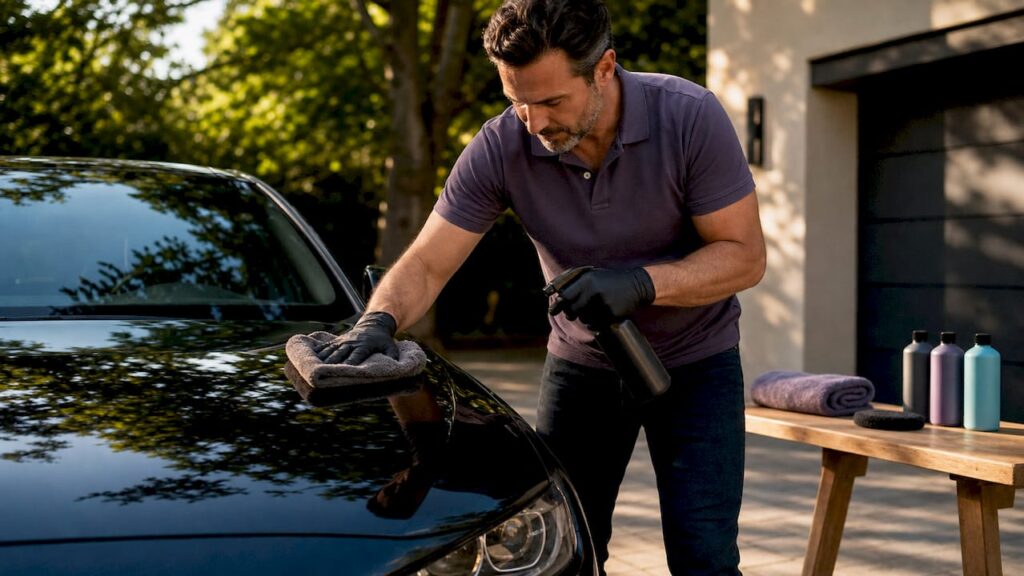
Waterless wash earns its place in any detailing routine by doing one specific job well: safely removing light surface contamination between full washes, in roughly 15 minutes compared to an hour for a traditional wash. It is a spray-on, wipe-off method built around high-lubricity polymers that lift dust, fingerprints, pollen, and fresh bird droppings off paint without a drop of rinse water. Used correctly, it keeps a vehicle’s finish sharp between detail sessions. Used incorrectly, it can grind grit into clear coat and create swirl marks that may require machine polishing to fix.
What is waterless wash and how does it fit between detailing steps?
Waterless wash is a ready-to-use spray containing lubricating polymers and surfactants that encapsulate light surface particles, allowing a microfibre towel to lift them cleanly away. The formula creates a slippery barrier between the dirt and the paint so the towel floats contamination off rather than dragging it across the clear coat.
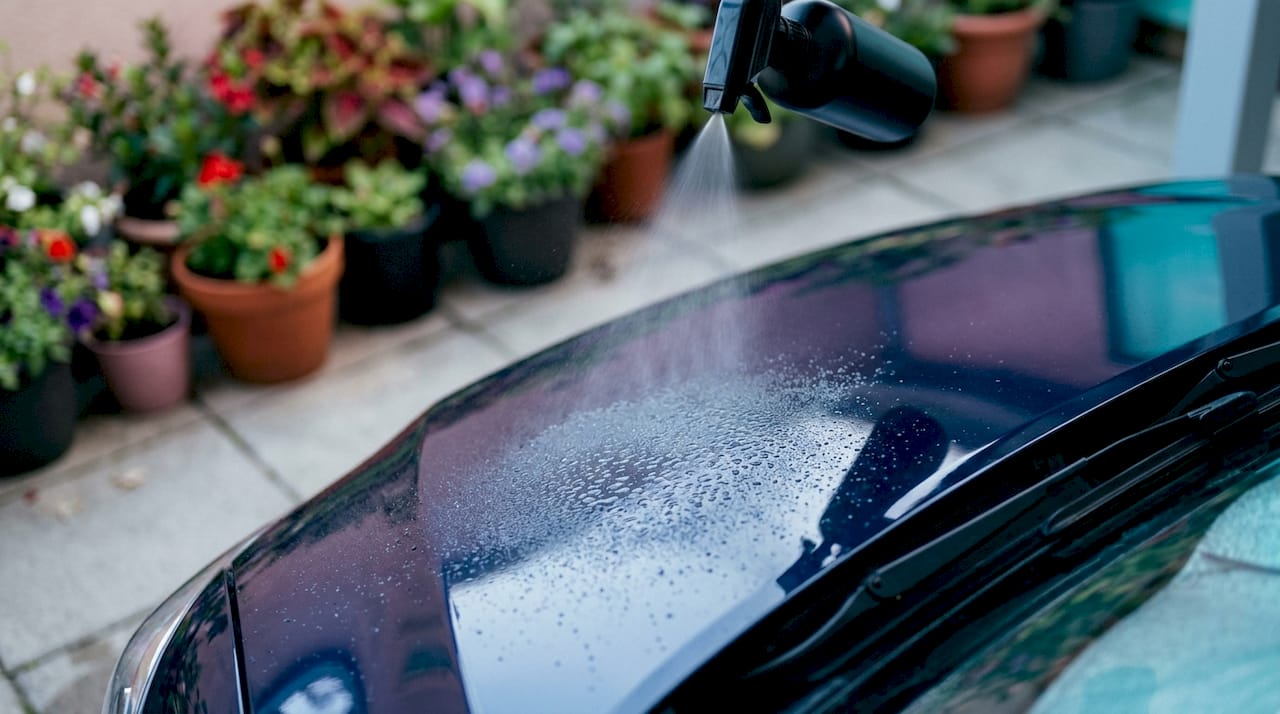
Its role between detailing steps is maintenance, not deep cleaning. A full detail addresses bonded contamination, paint correction, and protection layers. Waterless wash handles the light accumulation that builds up in the days or weeks between those sessions, things like garage dust, pollen film, and door-handle fingerprints.
Key characteristics that define the method:
-
Spray-on, wipe-off with no rinsing required
-
High-lubricity polymer formula that encapsulates and lifts light particles
-
Suitable for light dust, fingerprints, pollen, and fresh bird droppings only
-
Takes roughly 15 minutes per vehicle versus 60 minutes for a traditional wash
-
Not appropriate for mud, road salt, grit, or any contamination that feels rough to the touch
The critical qualifier is contamination level. If the surface feels gritty when you run a bagged finger across it, waterless wash is the wrong tool.
When should you use waterless wash on your vehicle?
Timing and conditions determine whether waterless wash protects your paint or damages it. The method works best in a narrow set of circumstances, and knowing where those boundaries sit saves you from an expensive paint correction job.
Ideal situations for waterless wash:
- Garage-kept or showroom vehicles with a fine film of dust from sitting overnight or for a few days
- Quick touch-ups before a car show or event when the vehicle is otherwise clean
- Spot treatment for a single bird dropping, fingerprint cluster, or pollen patch on an otherwise clean panel
- Apartment dwellers or anyone without hose access who needs a fast maintenance clean
- Mid-week refresh on a vehicle that will receive a full wash on the weekend
Situations to avoid:
- Visible road film, mud, or salt residue
- Paint that feels rough or gritty to the touch
- Hot paint in direct sun, where the product evaporates before it can lubricate
- Unprotected paint with no wax, sealant, or ceramic coating as a buffer
- Any panel with stuck-on contamination like tar, rail dust, or hard water spots
For daily drivers, treat waterless wash as an emergency touch-up method rather than a primary wash routine. Darker paint colours show swirl marks more readily, so the contamination threshold is even lower on black or dark grey vehicles.
Pro Tip: Before you start, run a clean finger in a thin sandwich bag across the panel. If it glides smoothly, waterless wash is fine. If it catches or feels rough, reach for a rinseless wash or a full hose-down instead.
How do waterless wash, rinseless wash, and detail spray actually differ?
These three products are regularly confused, and the confusion causes real paint damage. Each has a distinct chemical composition, a different dirt-load capacity, and a different technique requirement.
| Factor | Waterless wash | Rinseless wash | Detail spray |
|---|---|---|---|
| Chemical composition | High-molecular-weight polymers and silane/siloxane film-formers | Water-soluble surfactants and low-molecular-weight polymers | Gloss enhancers, light surfactants, wax or polymer boosters |
| Typical use cases | Light dust, fingerprints, garage-kept vehicles, spot treatment | Light to moderate road film, daily drivers, apartment maintenance | Final wipe-down, gloss boost, removing light smudges on clean paint |
| Surface suitability | Lightly soiled, protected paint only | Moderately soiled, protected or unprotected paint | Already-clean paint needing a shine refresh |
| Safety for paint | High risk if used on gritty surfaces; safe on lightly dusty paint | Lower risk due to greater lubrication; safer on slightly dirtier paint | Lowest cleaning power; not suitable for actual dirt removal |
| Technique differences | Spray one panel, wipe with six-sided microfibre towel, buff dry | Mix concentrate in a bucket, wash panel by panel with soaked towel or mitt | Mist lightly, wipe with clean microfibre, no buffing required |
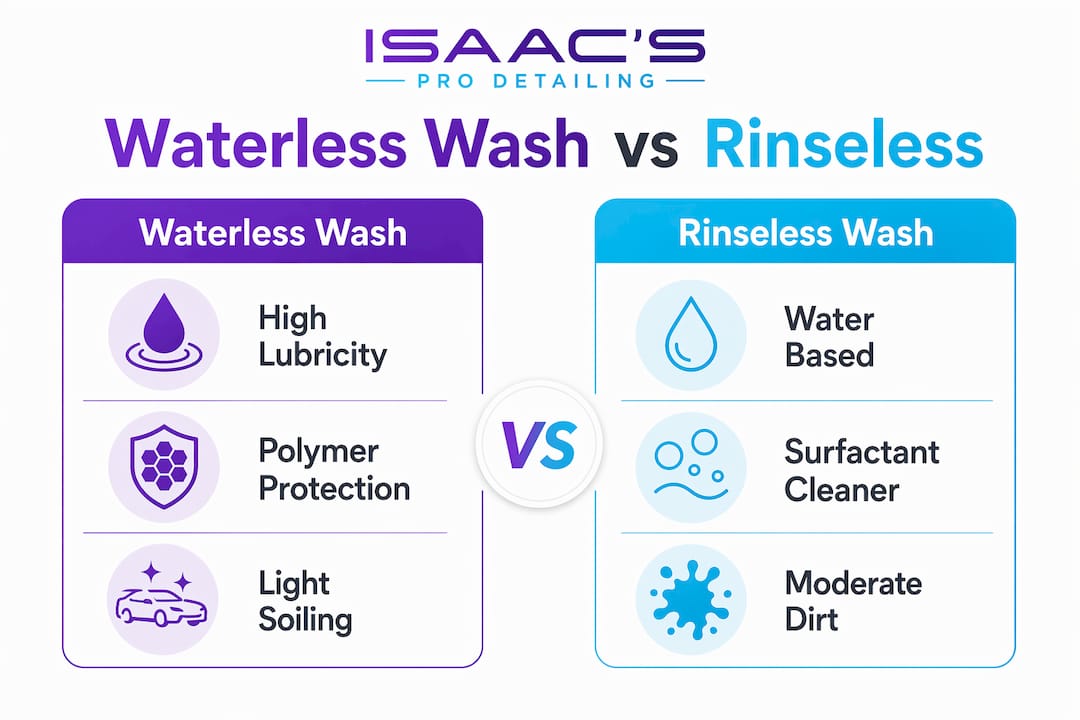
Waterless wash uses high-lubricity polymers for protection, whereas rinseless wash relies on water-soluble surfactants and a bucket to lift moderate road film. Detail spray sits at the other end entirely: it focuses on gloss and light dust removal rather than soil lifting, and it carries far less cleaning power than either waterless or rinseless formulas.
Waterless wash also deposits a thin protective layer via high-molecular-weight polymers and silane film-formers, while rinseless wash leaves minimal residue. That protective film is useful for maintenance, but it can affect how subsequent products bond to the paint, so factor it into your detailing sequence.
The practical takeaway: if the car is dusty and garage-kept, waterless wash is the fastest option. If it has been driven in light rain or sat outside for a week, rinseless wash gives you more lubrication and a safer result. If the paint is already clean and you just want gloss, detail spray is all you need.
How to apply waterless wash properly between detailing steps
Technique is everything with waterless wash vs soft washing. The chemistry can only do so much; the towel is the part touching your paint, and how you manage it determines whether you finish with a clean car or a scratched one.
Before you start:
- Park in shade or indoors. Direct sun causes the product to evaporate before it lubricates.
- Gather at least six to eight clean, plush microfibre towels. One towel per panel is not excessive.
- Check the paint with a bagged finger. Proceed only if the surface feels smooth.
Application steps:
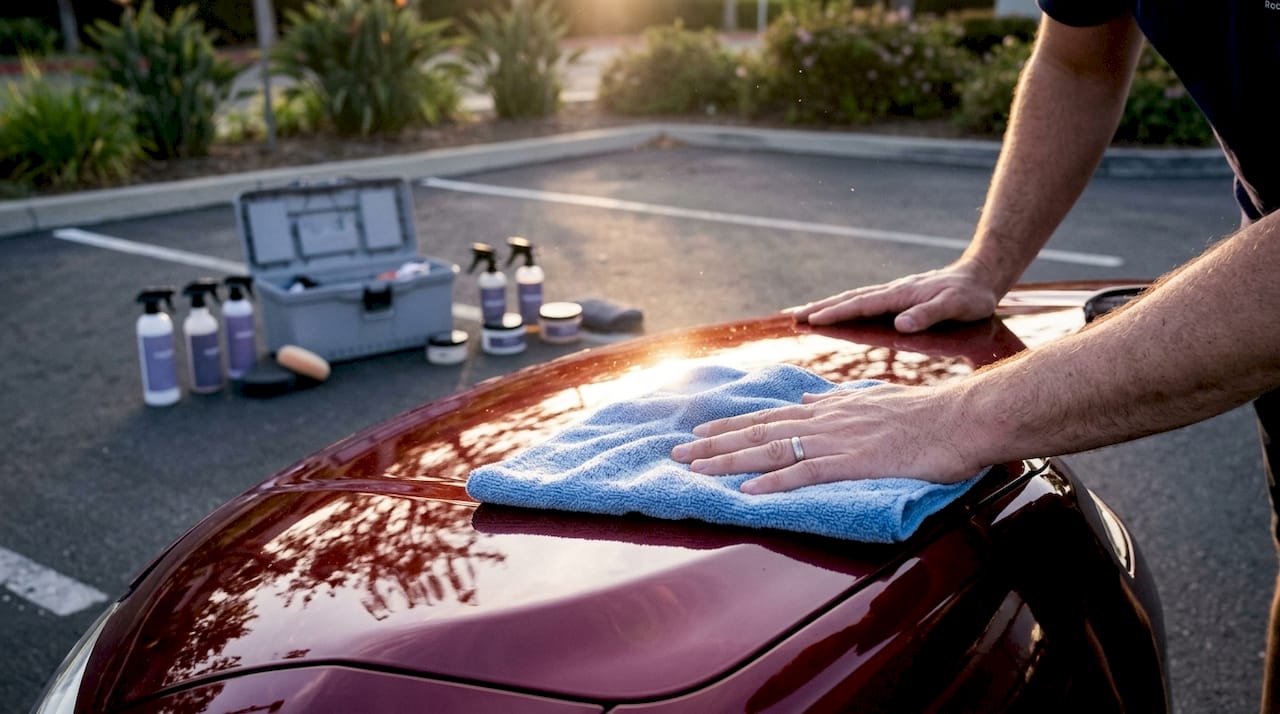
- Spray the product generously onto one panel at a time. Spray some directly onto the towel as well to boost lubrication from the first stroke.
- Fold the microfibre towel into quarters to create six usable sides.
- Using light pressure, wipe in straight lines rather than circular motions. Straight passes reduce the chance of creating swirl marks.
- After each pass, fold to a clean towel face. The six-sided towel method is the professional standard: spray, wipe with successive clean sides, and buff before haze sets.
- Use a second clean towel to buff the panel dry before moving to the next section.
- Work from the roof down, finishing with the lower panels where contamination is heaviest.
Common errors to avoid:
- Using a single towel for the whole vehicle. Once a towel side picks up grit, it becomes abrasive.
- Applying too little product. Insufficient lubrication is the primary cause of waterless-wash scratches.
- Scrubbing or using circular pressure. Light, straight strokes only.
- Working on hot or dirty panels without checking contamination level first.
Pro Tip: Keep a dedicated bag in your boot with a spray bottle of waterless wash and four to six fresh microfibre towels. That way a quick touch-up before a meeting or event takes five minutes and costs nothing in paint damage.
Expert insights and the Australian context for waterless wash
Professional detailers are consistent on one point: waterless wash misused on dirtier surfaces causes swirl marks that require machine polishing to correct. The product is not a shortcut for a dirty car. It is a precision tool for a clean one.
CeramicCoating.com summarises the professional consensus clearly:
Adam’s Polishes, along with other professional-grade brands, instructs users to pre-rinse or use a contact wash if mud, sand, or heavy soil is present. The chemistry of how surfactants lift and suspend soil is why waterless wash over heavily soiled paint will scratch. That is a physics limit on how much grit a thin polymer film can suspend, not a product failure.
Australian-specific considerations:
- The Sunshine Coast and broader Queensland climate brings heavy pollen seasons, coastal salt air, and intense UV. Pollen and salt film both fall within waterless wash territory when fresh, but salt that has dried and bonded to paint needs a proper rinse first.
- Water restrictions apply across many Australian councils during drought periods. Waterless wash aligns directly with eco-friendly car cleaning requirements under those restrictions, using zero rinse water per wash.
- Vehicles with ceramic coatings benefit most from waterless wash between details. The hydrophobic surface means contamination sits on top rather than bonding to the paint, which reduces the risk profile considerably and makes the method safer on coated vehicles than on bare clear coat.
- Red dust contamination common in inland and outback areas is abrasive and often gritty. Waterless wash is not appropriate for red dust; a rinseless or traditional wash is the correct choice.
The car detailing workflow that produces the least harmful runoff typically incorporates waterless wash for light maintenance days, reserving rinseless or traditional methods for heavier soil loads. That approach cuts water use substantially across a full year of maintenance.
Key takeaways
Waterless wash is a safe, effective maintenance tool between full detail sessions when used strictly on lightly soiled, protected paint with proper microfibre technique.
| Point | Details |
|---|---|
| Light contamination only | Waterless wash is safe for dust, fingerprints, and fresh pollen; never use it on gritty, muddy, or salt-crusted paint. |
| Towel management is critical | Use at least six to eight clean microfibre towels per vehicle and rotate to a fresh side after every pass. |
| Water conservation benefit | Waterless wash uses zero rinse water, making it well-suited to Australian water restrictions and eco-conscious car care. |
| Not a full wash substitute | Heavily soiled daily drivers need a rinseless or traditional wash; waterless wash is a maintenance method, not a deep clean. |
| Isaac’s Pro Detailing | Isaac’s Pro Detailing incorporates waterless wash into its mobile detailing workflow for Sunshine Coast clients, using it as a precision maintenance step between full detail sessions. |
Waterless wash in practice: an honest professional view
The detailing industry has a tendency to oversell waterless wash as a universal convenience product, and that framing does real damage to people’s paint. The honest position is narrower and more useful: waterless wash is one of the best tools available for a specific job, and a genuinely poor choice for anything outside that job.
What gets overlooked in most guides is the relationship between paint protection and waterless wash safety. A vehicle with a quality ceramic coating is a fundamentally different candidate for waterless wash than bare, unprotected clear coat. The coating creates a sacrificial layer that contamination sits on top of rather than bonding to, which gives you meaningful margin for error. On unprotected paint, that margin disappears almost entirely. The technique has to be perfect, the contamination has to be genuinely light, and even then the risk is higher than most product marketing acknowledges.
The environmental argument for waterless wash in Australia is real and worth taking seriously. Water restrictions, drought cycles, and the genuine cost of running a hose for 45 minutes every week add up. Incorporating waterless wash on light-contamination days as part of a broader eco-friendly detailing approach makes practical sense, not just environmental sense.
The mistake most car owners make is treating waterless wash as a time-saving shortcut rather than a condition-specific tool. If you approach it that way, you will eventually use it on a car that is dirtier than you think, and you will end up with swirl marks across the bonnet. Approach it as a precision maintenance step with clear entry criteria, and it earns its place in every detailing kit.
Isaac’s Pro Detailing: mobile, eco-conscious car care on the Sunshine Coast
Isaac’s Pro Detailing brings professional-grade waterless wash and full detailing services directly to you across the Sunshine Coast, whether you are at home, at work, or anywhere in between. The fully mobile setup means no driving to a fixed location, no waiting, and no compromise on product quality.

Every service uses eco-friendly products, including waterless wash for appropriate maintenance stages, alongside premium options like ceramic coatings, cut and polish, interior extraction, and iron removal. The mobile detailing workflow is built around matching the right method to the actual condition of your vehicle, so your paint gets the correct treatment every time, not just the fastest one. For Sunshine Coast drivers who want their car maintained properly between full detail sessions, Isaac’s Pro Detailing handles the whole process on-site, at a time that suits you.