
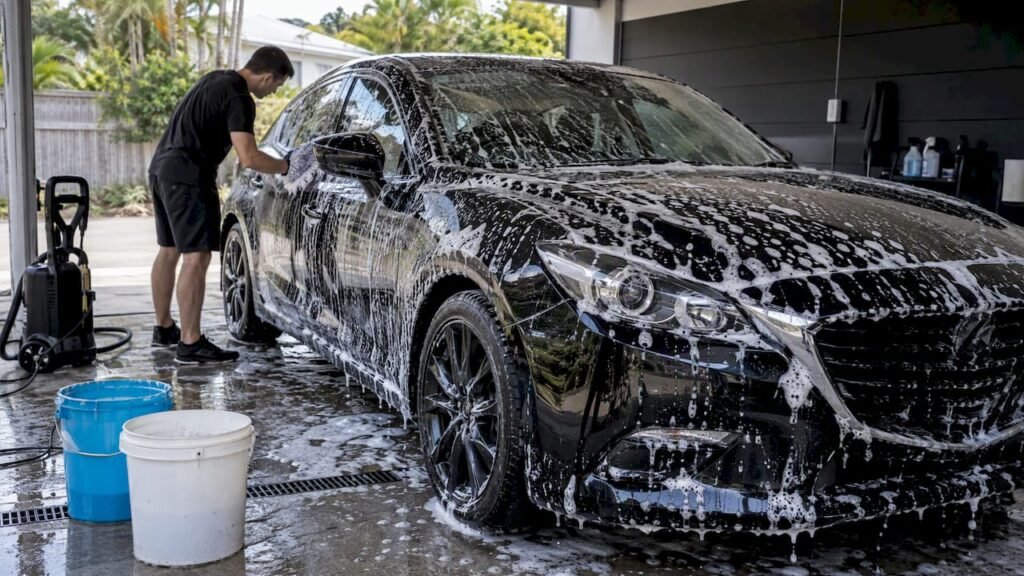
The choice is a false one. A foam cannon is a pre-wash tool and the two bucket method is a contact-wash technique, so they do different jobs. Foam loosens and lifts grit before you touch the paint. The two buckets keep that grit off your mitt while you wash. If you have to pick one, pick the two bucket wash, because only a mitt removes the bonded film that foam leaves behind. If you can have both, use both, in that order.
Below we cover what each method does, where each one falls short, how a foam gun differs from a foam cannon, and what changes on the Sunshine Coast, where salt, red dirt, beach sand and stormwater rules all come into it.
TL;DR
- A foam cannon is a pre-wash. It does not usually replace the mitt wash, except on very lightly dirty, well-protected cars.
- The two bucket method (one bucket of soapy water, one of clean rinse water) keeps grit off your mitt and is the safer contact wash.
- A foam cannon needs a pressure washer. A foam gun runs off a garden hose and gives wetter, shorter-lasting foam.
- The lowest-risk routine is: rinse, foam, rinse, two bucket wash, rinse, dry.
- Wash on grass or a lawn where you can, not on a hard driveway that drains to the street.
Table of Contents
- What the two bucket method actually does
- What a foam cannon does, and what it does not
- Foam gun vs foam cannon
- Head-to-head: which suits which situation
- The best routine uses both
- Safety on paint: where swirls really come from
- Cost, time, water and the Sunshine Coast
- Our perspective at Isaac’s
- When a home wash is not enough
- FAQ
- Sources
What the two bucket method actually does
The idea is simple. One bucket holds your shampoo solution. The other holds plain water. After each panel, you rinse the mitt in the plain water to knock the grit out, then reload it with soap. According to Farecla’s explanation of the two bucket method, the separate rinse bucket helps keep grit and grime away from the paintwork.
Without that rinse step, every bit of dirt you pick up on the first panel goes straight back into your soap and onto the next one. That is how fine swirl marks happen. A wash mitt full of sand dragged across clear coat is sandpaper with good intentions.
Some practical details that make the method work:
- Wash top to bottom. The roof, bonnet and boot lid are cleanest. The lower doors, bumpers and sills are dirtiest and go last.
- Use a clean, good-quality mitt. Sponges hold grit on a flat face. A deep-pile mitt lets particles sink into the fibres, away from the paint.
- Rinse the mitt often. A US federal safety document on cleaning vehicles also recommends clean, top-quality mitts, top-to-bottom washing and frequent rinsing of the applicator in a separate bucket of clean water.
- Use a second mitt for the lower third. Many careful washers keep one mitt for the upper body and another for sills and bumpers.
- Consider a grit guard. It is a plastic insert at the bottom of the rinse bucket that traps dirt so it does not swirl back up.
The weak point of the method is time and effort. Carsales reports that a correctly performed hand wash is thorough but typically takes about 20 to 60 minutes, and that mitts or sponges that are not rinsed properly can trap dirt and cause swirls or micro-scratches. The method only works if you actually follow it.
What a foam cannon does, and what it does not
A foam cannon is a bottle-shaped attachment that mixes snow foam concentrate with water and air to make a thick blanket of suds. You spray it over a dry or lightly rinsed car and let it sit. The foam clings to the paint, softens dirt and lets the worst of it slide off when you rinse.
That is the benefit: less loose grit on the car before your mitt touches it. According to the Australian guide from Bowden’s Own, snow foam is a pre-wash. You apply it, let it dwell for about 4 to 5 minutes without letting it dry, then pressure-rinse it off before the hand wash. The same guide notes that removing dirt and grit before touching the paint reduces the chance of swirls, scratches and other wash marks.
Foam does not replace the mitt
This is where a lot of videos oversell it. Dr. Beasley’s guide says foam can reduce friction and loosen contamination, but that contact-free cleaning is generally limited to very lightly dirty vehicles, preferably ceramic coated ones. Most cars still need a mitt to lift the traffic film that clings after the rinse. Jay Leno’s Garage Australia says the same thing: after foaming and rinsing, any remaining dirt needs a hand wash with a mitt, and it recommends the two bucket method for that step.
In practice, foam alone leaves a thin film on most daily drivers. You can see it as a dull, slightly hazy surface after drying, or feel it as a slight drag when you run a clean fingertip over a panel.
Thick foam is not the same as clean
Big, dramatic foam looks good on camera. Clean Offroad cautions that thicker foam does not automatically clean better: the product, coverage and how you use it matter more than how impressive it looks. Snow foam is also more concentrated than regular car wash soap, which is why it can produce thicker suds. Thick suds are a feature of the product, not proof of cleaning power.
Foam gun vs foam cannon
The two names get swapped constantly, but they are different tools.
| Foam cannon | Foam gun | |
|---|---|---|
| Connects to | Pressure washer | Garden hose |
| Foam | Thick and dense, clings longer | Wetter and runnier, runs off sooner |
| Best for | Heavy pre-wash on dirty cars | Light maintenance washes |
| Needs | Pressure washer, compatible fitting | A hose and a trigger or screw fitting |
| Drawback | Equipment cost and setup | Less dwell time and less lifting power |
The split comes from Snow Foam Australia’s explanation: a cannon attaches to a pressure washer and produces thick foam, while a gun attaches to a hose and produces wetter foam that does not sit on the car as long. Clean Offroad describes it the same way.
If you do not own a pressure washer, a foam gun is still a worthwhile upgrade over a bare hose, because it gives you some dwell time and lubrication. Just do not expect the same lifting power as a cannon, and do not skip the mitt wash because the foam looks thick.
Head-to-head: which suits which situation
| Situation | Best approach |
|---|---|
| Lightly dusty car, ceramic coated or well protected | Foam pre-wash, then a gentle two bucket wash, or foam and rinse only if it is genuinely light |
| Daily driver with traffic film | Foam pre-wash, rinse, then two bucket wash |
| Muddy 4WD, red dirt, beach driving | Heavy rinse and foam first, then a two bucket wash with a stronger shampoo |
| No pressure washer | Hose rinse, foam gun if you have one, then two bucket wash |
| Short on time | Foam, rinse, one bucket with a fresh mitt, dry. Accept a slightly higher risk |
| Nowhere suitable to wash at home | Waterless or rinseless wash, or a mobile detailer |
The Australian guide from Bowden’s Own recommends a lubricating maintenance wash for most cars and a stronger wash for 4WDs, off-road vehicles, mud, red dirt, salt or beach driving, with a foam pre-wash whenever a pressure washer is available. That fits what we see on the Coast: a car that has spent a weekend at Double Island Point needs a very different first step from one that has just done the school run.
The best routine uses both
Here is the sequence that keeps the most grit off the paint. It combines the two methods rather than choosing between them.
- Park in shade. Hot panels dry foam and soap too fast and leave spots. Early morning or late afternoon works best.
- Wheels first. They carry the heaviest brake dust and road grime. Use separate brushes and a separate bucket so that dirt never reaches the paint.
- Rinse the whole car. Work from the roof down and knock off loose sand and dust.
- Foam it. Cover the car from the bottom up so the foam does not run down streaks over clean areas. Let it dwell for about 4 to 5 minutes and never let it dry on the panel.
- Rinse the foam off, top to bottom.
- Two bucket wash. Soap bucket, rinse bucket, clean mitt. Top to bottom, rinsing the mitt after every panel or section.
- Final rinse. Sheet water over the panels so less is left to dry.
- Dry with a clean microfibre towel. A used or dropped towel is another source of fine scratches. Pat or drag gently rather than rubbing.
What if you only do half of this? The most valuable steps are the rinse and foam before the mitt, and the separate rinse bucket during the mitt wash. Everything else refines the result.
Safety on paint: where swirls really come from
Swirl marks are fine scratches in the clear coat, and most come from dragging contaminated material across it. The usual culprits are:
- A single bucket with a gritty mitt.
- A dropped mitt or towel put back on the paint.
- Washing a dry, dusty car with no rinse first.
- Drying with a rough or dirty towel.
- Automatic brush car washes, which we would avoid on any car you care about.
A foam cannon reduces the first three by removing loose dirt first, and the two bucket method reduces the first by keeping the mitt clean. Neither helps if your mitt is old and gritty or you drop it and carry on. If you already have swirls, washing better will not remove them. We explain the options in our guide to removing swirl marks while preserving the clear coat.
Cost, time, water and the Sunshine Coast
Equipment
A two bucket wash needs two buckets, a mitt, a shampoo and towels, which is a modest outlay. A foam cannon adds a pressure washer, a cannon and snow foam concentrate. If you already own a pressure washer, the cannon is a small extra. If you do not, a foam gun is the cheaper step.

Time
Foaming adds the dwell time of about 4 to 5 minutes plus rinsing, but it usually saves effort during the contact wash because there is less to remove. Overall, expect the full combined routine to sit within the 20 to 60 minute range carsales gives for a hand wash, longer on a dirty 4WD.
Water and runoff
Water rules vary by council and state, and they change. For example, South East Water in Victoria allows vehicle washing at any time using a high-pressure cleaner, a trigger-nozzle hose or a bucket, and requires a pressure cleaner to use 9 litres a minute or less. That is Victorian guidance. Check your own council and water authority for current local rules.
On the Sunshine Coast, the bigger issue is where the suds go. Sunshine Coast Council explains that washing on a hard driveway sends suds and contaminants straight into the stormwater system and on to waterways and beaches, and suggests alternatives such as brushing the vehicle down first. Another Queensland council, Cairns Regional Council, advises collecting wastewater, keeping it out of stormwater drains, choosing biodegradable or phosphate-free detergents and disposing of it onto gardens or grassed areas.

The practical version: wash on a lawn if you can, use a gentle, biodegradable shampoo and snow foam, and avoid sending suds down the street. If you have no lawn, a rinseless or waterless wash is a sensible option for light dirt. We cover how it works in our guide to waterless car wash and where it fits between full details.
Salt, sand and the underbody
Coastal cars collect salt and sand in places no mitt reaches. Wheel arches, sills and the underbody hold the most. A foam cannon helps with arches, but an underbody rinse is its own job, and we explain why in our piece on underbody washing on the Sunshine Coast.
Our perspective at Isaac’s
We detail cars for a living, and most of the damage we correct is wash-induced. Swirls, haze and dull clear coat usually trace back to a wash that put grit on the paint rather than a lack of products.
So our view is plain. Foam is worth using when you can, but it is a first step, not a finish. The mitt wash is where paint is either protected or marked, and a rinse bucket is the cheapest insurance you can buy. We would rather see a careful two bucket wash with a clean mitt than an expensive cannon setup followed by a quick wipe with a dirty sponge.
We also think about where the water goes. Our mobile service comes to your home, work or a spot near the beach, so we work with eco-friendly products and keep runoff in mind at every job. For owners who want a reliable routine, the sensible pattern is a careful home wash for upkeep and a professional detail when the paint needs correcting or protecting.
Coatings change the equation too. A ceramic coated car is slicker and sheds dirt more easily, which is why foam pre-washes suit coated cars so well. If your car is freshly coated, see our advice on the first wash after a ceramic coating.
— isaac’s
When a home wash is not enough
No wash method corrects paint that is already damaged, and no wash method protects paint for months. If your car has swirls, oxidation or etched marks, it needs polishing. If it is going to spend years in Queensland sun and salt air, it needs a protective layer.
This is where we come in. We are a fully mobile detailer covering the Sunshine Coast, and we come to you. Our published prices include:
- Deluxe Detail and Revival Detail: $375 to $575 for the Deluxe Detail and $575 to $775 for the Revival Detail, depending on vehicle size.
- Graphene spray sealant package: $339 to $739.
- Ultimate Protection Package: $1500 to $2200.
- Professional Mobile Underbody Wash: $50.
If swirls are the problem, our cut and polish service is the fix, and for long-term protection see our ceramic coating service. Prices for those two depend on the vehicle and the condition of the paint. Once the paint is corrected and protected, your two bucket wash has a lot less to do.
FAQ
Is a foam cannon better than the two bucket method?
They do different jobs, so neither is better outright. A foam cannon loosens and removes dirt before contact, and the two bucket method keeps your mitt clean while you wash. For most cars the safest result comes from using the foam first and the two buckets after.
Can I skip the mitt if I use a foam cannon?
Usually not. Foam can reduce friction and loosen dirt, but contact-free washing is generally limited to very lightly dirty, ideally ceramic coated cars. On a normal daily driver, a thin film remains after rinsing, and a mitt wash removes it.
What is the difference between a foam gun and a foam cannon?
A foam cannon attaches to a pressure washer and makes thick, clinging foam. A foam gun attaches to a garden hose and makes wetter foam that does not stay on the car as long. The gun is the budget option and the cannon is better for heavy pre-washing.
Do I still need two buckets if I use a foam cannon?
Yes, if you are making contact with the paint. The foam removes some dirt, but whatever remains still ends up on your mitt. A rinse bucket stops it going back onto the paint, and it costs almost nothing to add.
Where should I wash my car on the Sunshine Coast?
On a lawn or grassed area if you can, rather than a hard driveway that drains to the street. Council guidance says suds and contaminants from hard surfaces go straight into the stormwater system. Use a biodegradable shampoo, or choose a waterless wash if you have no suitable spot.
Sources
- What is the “Two Bucket” Car Wash Method? (Farecla)
- How to Use a Foam Cannon (Dr. Beasley’s)
- Your essential car washing guide (Bowden’s Own)
- How do you use a Foam Cannon? (Jay Leno’s Garage Australia)
- Foam Gun vs Foam Cannon (Clean Offroad)
- How To Snow Foam Your Car (Snow Foam Australia)
- Vehicle cleaning guidance (NHTSA)
- What’s the best way to wash my car? (carsales)
- Permanent Water Saving Rules (South East Water)
- Smart car washing (Sunshine Coast Council)
- Reducing water contamination and runoff (Cairns Regional Council)