
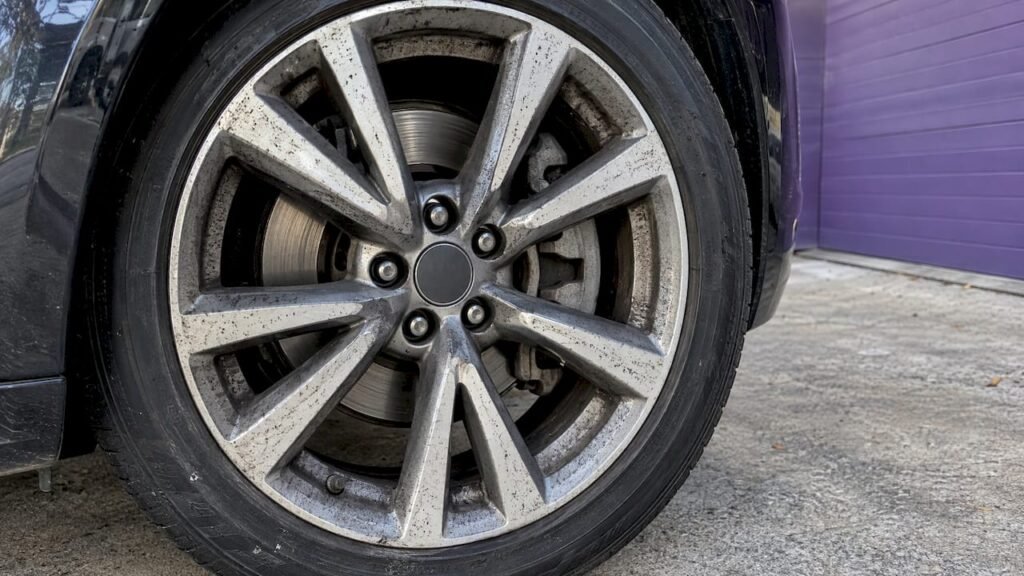
Wheel iron contamination is a layer of tiny metal particles, mostly from brake dust, that bonds to your rims and stays put after an ordinary wash. You can see it as black or brown specks that survive washing, and you can remove it with a pH-neutral iron remover that turns purple as it reacts, followed by a soft brush and a thorough rinse. Left alone, it dulls the finish and can progress to rust spots.
This guide explains where the contamination comes from, how to confirm you have it, how to treat it step by step, which finishes need extra care and how often to repeat the job.
TL;DR
- Iron contamination on wheels is mostly brake dust. One brake manufacturer reports its tested dust was 92% iron.
- Dark or brown dots left between the spokes and in the rim barrel after washing are the classic sign.
- Use an acid-free iron remover on a cool, clean wheel. Let it dwell for a few minutes without drying, agitate with a soft brush, then rinse well.
- Avoid bare aluminium and decorative anodised finishes, and never spray the product directly onto brake discs or pads.
- Most owners treat wheels every few washes. Coated wheels are easier to keep clean afterwards.
Table of Contents
- What iron contamination on wheels actually is
- How to tell if your wheels are contaminated
- Can iron contamination damage wheels?
- How to remove iron contamination from wheels
- Which wheel finishes are safe, and what to avoid
- How often to decontaminate wheels
- Our perspective on wheel decontamination
- Why a professional visit can make sense
- Book wheel and paint decontamination on the Sunshine Coast
- FAQ
- Sources
What iron contamination on wheels actually is
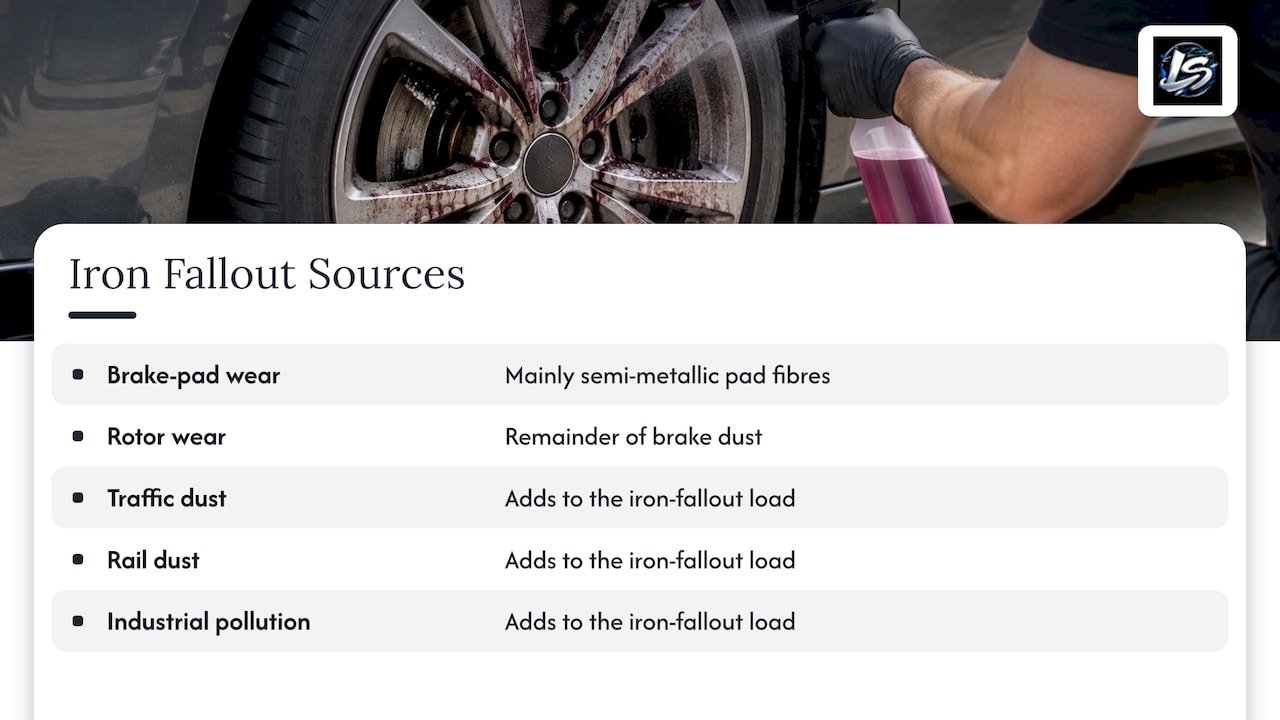
Every time you brake, the pads and rotors wear a little. That wear comes off as fine dust, and a large part of it is iron. The same brake manufacturer says braking continuously wears pads and rotors, and that the dust comes mainly from semi-metallic pad fibres, with the remainder from the rotor itself.
The dust is hot when it leaves the brakes. Particles land on the wheel face, settle into the barrel behind the spokes and can lodge in the wheel’s clear coat or finish. Once they sit there, moisture oxidises them and they grip harder. A cleaning guide on the chemistry of iron fallout also notes that traffic brake dust, rail dust and industrial pollution all add to the load, not only your own brakes.
That matters on the Sunshine Coast. Stop-start traffic on the Bruce Highway and the Sunshine Motorway, hilly runs to the hinterland and salty coastal air all give metal particles plenty of chances to bond and start oxidising.
Why shampoo does not shift it
Car shampoo is built to lift oils, road film and loose dirt. Metallic iron is inorganic, so it needs reactive chemistry rather than only detergent. That is why a wheel can look clean from a metre away yet still feel gritty under your fingertips.
How to tell if your wheels are contaminated
Check after a proper wash, when the wheel is clean and dry. These are the signs to look for:
- Black or dark-brown dots left between the spokes or in the rim channel. An Australian product guide treats these as an indicator of ferrous contamination.
- A rough, gritty feel on the wheel face, even though it looks clean.
- A dull finish that no longer reflects like it did when the wheels were new or freshly protected.
- Orange or brown discolouration patches. A detailing supplier’s guide describes these as an early sign that can progress to visible rust spots as the particles oxidise and hold on more firmly.
The same particles settle on paint too, where they show up as tiny orange specks. If you have seen those on your bonnet or boot, our guide to orange spots on car paint explains why iron remover comes before claying.
Can iron contamination damage wheels?
It can. Autoglym Australia says iron particles on paintwork and brake dust on wheels can dull their shine. The bigger risk is slow: particles that stay embedded oxidise, spread discolouration and make the surface harder to clean each time. Removing them early is cheaper and gentler than trying to fix a pitted or stained finish later.
How to remove iron contamination from wheels
Product directions differ slightly, so always read your bottle first. The Australian directions from several makers agree on the same core method.
What you need
- A pH-neutral, acid-free iron remover made for wheels
- A soft wheel brush and a smaller detailing brush for the spokes and lug nut recesses
- Gloves and eye protection
- A hose or pressure washer
- Clean microfibre towels
Step by step
- Start cold and in the shade. Autoglym Australia’s directions say to work on cool surfaces out of direct sunlight. A premium coating maker’s guide adds that wheels and brakes should be fully cooled and treated one wheel at a time. In a Queensland summer, that usually means early morning or a shaded driveway.
- Wash the wheel first. Remove loose dirt, mud and brake dust so the remover can reach the bonded iron.
- Spray the remover over the whole wheel, including the barrel behind the spokes where the heaviest deposits collect.
- Let it dwell without drying. Australian guidance gives about 3 to 4 minutes and warns against letting it dry. Another Australian maker asks for a rinse with high-pressure water within 2 minutes. Dwell times differ by formula, so follow your label rather than a rule of thumb.
- Watch the colour change. The product turns purple as it reacts with iron and dissolves it into a water-soluble complex, as one Australian supplier describes it. A deeper colour means more iron. A lightly contaminated wheel shows less.
- Agitate gently. Use a soft brush between spokes, around the lug nuts and inside the barrel.
- Rinse thoroughly, then dry with microfibre so you can inspect the result.
The colour change is feedback, not proof the wheel is finished. A UK workshop guide makes the point that loosened residue and non-ferrous grime still need agitation and a full rinse.
When iron remover is not enough
Iron remover targets ferrous particles. It does not necessarily remove tyre dressing, oily grime, baked-on road film or mineral deposits, so neglected wheels may need a suitable wheel cleaner and controlled agitation as well, according to the same guide. Tar and tree sap need a different step again, such as clay, as Autoglym Australia notes.
For everyday brake dust that is not yet bonded, our brake dust removal guide covers the quick wipe-off method.
Which wheel finishes are safe, and what to avoid
Most modern wheels are factory clear-coated alloy, painted, powder-coated or chrome, and acid-free remover is generally intended for them when used as directed. Makers still list exceptions:
| Finish | What makers say |
|---|---|
| Clear-coated, painted, chromed, polished | Intended use for a pH-neutral Australian formula |
| Painted, powder-coated, chrome | Suitable, but avoid raw metals and decorative anodised finishes |
| Bare or unprotected aluminium | Avoid, and take care around unpainted iron callipers, which may blacken |
| Brake discs and pads | Do not spray directly onto them, and rinse before the product dries |
Practical precautions: wear gloves, keep product out of your eyes, and test a small hidden area first if you are unsure what your wheels are finished in. If the wheels are custom, forged or aftermarket and you do not know the finish, check with the wheel maker before treating them.
Dwell times and rinse instructions are the part most people get wrong, because they vary by product. For more on following label directions with car care products, see this guide to auto care product precautions.
How often to decontaminate wheels
There is no single rule, but the published guidance is consistent enough to plan around:
- Clean wheels and tyres at every wash, and use iron remover about every three washes. The same source suggests 1:1 dilution for maintenance or light contamination and undiluted product for heavy build-up.
- Another maker says wheels generally need iron remover every few washes rather than every wash. Its paint guidance is once or twice a year, and before polishing or applying protection.
- A coating manufacturer recommends chemical decontamination every three months.
Your own brake pads change the answer. Pad type strongly affects how much dust is produced, and non-metallic pads can reduce it but will not eliminate it. A performance car or a ute that tows regularly will generally need treatment more often than a light commuter.
How to slow the build-up
- Wash wheels regularly, before dust has time to oxidise.
- Treat before you apply any protection, since coatings and sealants need a decontaminated surface to bond properly.
- Protect the wheel faces. A smooth, slick surface gives particles less to grip, so washing removes more with less effort.
The last point is where wheel coatings earn their keep, which brings us to what we do.
Our perspective on wheel decontamination
We see the same pattern on Sunshine Coast wheels every week. Owners wash carefully, yet the barrels and spoke edges still carry bonded brake dust, because normal shampoo cannot dissolve metal. Once that dust has oxidised, it grips harder, and every later wash gets slower.
Our approach is to decontaminate first and protect second. There is no point sealing a wheel over embedded iron, because the coating is only as good as the surface it bonds to. That is why iron removal sits at the start of our process, and why we do it at your home, workplace or wherever the car is parked, with eco-friendly products.
After decontamination, we can apply a ceramic coating to your wheels. Our aim is a smoother, slicker finish that sheds brake dust more readily and makes your regular washes quicker. For owners who drive daily and brake hard on hills and highways, we think that is the most practical way to keep wheels looking good between details.
We also treat the car as a whole. If the wheels are contaminated, the lower panels and paint usually are too, and doing it all in one visit means a consistent result and no repeat work.
isaac’s
Why a professional visit can make sense
Doing this yourself is entirely possible if you have a free shaded hour and the right brush. A professional visit suits you better when:
- The wheels are heavily contaminated or have started to show rust-coloured staining.
- You are not sure what finish your wheels have.
- You want the paint and wheels decontaminated together before a polish or a coating.
- You would rather skip the cleanup and have the car ready at the end of a workday.
If you are planning protection, the order matters. Our workflow for ceramic coating shows why decontamination comes before any coating goes on, and our guide to safe iron fallout removal for Australian cars goes deeper on paint. If you are wondering why it matters beyond wheels, read why remove iron contaminants from your car’s paint.
Book wheel and paint decontamination on the Sunshine Coast
We come to you across the Sunshine Coast, whether the car is at home, at work or near the beach. Our Deluxe Detail and Revival Detail packages are published at $375 to $575 and $575 to $775 respectively, depending on vehicle size. Tell us at booking that your wheels are contaminated and we will confirm what is included for your vehicle.
If you want longer-lasting protection after decontamination, our Ultimate Protection Package is published at $1,500 to $2,200, and we also offer ceramic coatings for paint, wheels and leather. Our packages are all-inclusive with no hidden extras, and we back our work with a 100% satisfaction guarantee. Contact us to get a quote for your car.
FAQ
Is iron contamination on wheels the same as rust?
Not exactly, but they are related. Iron contamination is metallic particles, mostly brake dust, sitting on the surface. If those particles are left to oxidise, they can discolour the wheel and develop into visible rust spots. Removing them early stops that progression.
Does the purple colour mean my wheels are damaged?
No. The colour appears when the remover reacts with iron and begins dissolving it. A stronger colour generally means more iron was present. Treat the colour as feedback, then still agitate and rinse thoroughly, since non-iron grime remains afterwards.
Can I use iron remover on any wheel?
Most factory painted, clear-coated, powder-coated and chrome wheels are fine with an acid-free formula used as directed. Avoid bare aluminium and decorative anodised finishes, and never spray it onto brake discs or pads. If you are unsure of your finish, ask the wheel manufacturer or a detailer before you start.
How often should I treat my wheels?
Many makers suggest every few washes for wheels, and some suggest a full decontamination every three months. Heavy braking, towing and metallic brake pads all push you towards the more frequent end.
Sources
- Where does brake dust come from, EBC Brakes
- Why wheel cleaners turn purple and what iron fallout is, Mosschem
- Ultimate wheel and tyre cleaning guide, Bowden’s Own
- Iron remover product guidance, Detailing Shed
- What is iron contamination and why should it be treated, Cleenly
- Magma 500ml directions, Autoglym Australia
- Iron Burn 500ml directions, Fireball Australia
- Maintenance guide, GYEON
- When an iron remover belongs in a proper wash, Liquid Laboratories
- pH neutral iron and fallout remover, Alchemist Car Care
- Iron fallout remover and brake dust cleaner, Mile Deep