

Salt air attacks your car because salt pulls moisture out of the air and holds it against the metal, which speeds up rusting. The Sunshine Coast’s humidity and beach lifestyle make this worse. The fix is mostly routine. Rinse the car with fresh water often, keep wheel arches, sills and the underside clean, fix paint chips quickly and keep the paint protected. Below is how it works, how often to rinse by distance from the beach, and where professional detailing fits.
TL;DR
- Salt is hygroscopic, so it keeps dirt and metal damp for longer. That is what drives rust, according to carsales.
- Wheel arches, sills, door edges and the underside collect salt, sand and mud first. Clean these areas after every beach trip.
- MG Australia’s schedule suggests rinsing beachfront cars 2 to 3 times a week and washing them fully every 2 weeks. Cars further inland can stretch that out.
- Fix chips and scratches early, dry wet mats and keep a protective layer on the paint.
- If you are short on time, we come to your home, work or the beach car park and handle the detailing and protection.
Table of Contents
- How salt air actually corrodes a car
- Where corrosion starts first
- How often to rinse and wash by distance from the coast
- How to wash a car properly in salt air
- Repair chips, keep the paint sealed
- Rustproofing versus paint protection
- Our perspective on protecting coastal cars
- What professional detailing adds
- Book mobile detailing on the Sunshine Coast
- A simple salt-air routine for the year
- FAQ
- Sources
How salt air actually corrodes a car
Rust needs metal, oxygen and water. Salt makes the water part far more effective. Carsales explains that salt absorbs water and increases its conductivity, which speeds up the electron transfer behind oxidation and rusting. A film of salty moisture on a panel is a much better environment for corrosion than plain water.
The Australasian Corrosion Association (ACA) makes a related point: corrosion begins when dirt becomes damp and stays damp, and salt mixed with damp mud is a particularly bad combination. This is why the car can look clean and dry on top while sand and mud keep working inside the wheel arches.
Renault’s owner guidance adds a local-conditions angle. It says saline atmospheres near the sea, especially in hot weather, are corrosive influences. A warm, humid, salty coastal summer is the situation it describes, and it is the Sunshine Coast’s normal.
Is it only cars parked on the beachfront?
Distance matters, but it is not a safety line. Carsales notes that prolonged exposure is the main concern, so a car that lives near the beach is at more risk than one that only visits. It also says all coastal owners should wash regularly. If you drive to Mooloolaba, Coolum or Noosa on weekends, the trip still leaves salt and sand on the car. Treat a beach visit as a cleaning event.
Where corrosion starts first
Salt, sand and dirt collect where air and water do not flush them away. The ACA says to prioritise wheel arches, sills and the underside, and also to check door drain holes, brake pipes, battery terminals and exhaust components. MG Motor Australia’s coastal guidance names wheel arches, sills, door edges and underbody panels as the places to clean and inspect.
A practical walk-around list:
- Wheel arches and inner guards. Mud packs in here and stays damp long after the paint is dry.
- Sills and lower doors. Spray from the road and the beach sits low on the body.
- Door edges and drain holes. Blocked drain holes hold water inside the door.
- The underside. You cannot see it, so it gets forgotten. It is the area most worth washing deliberately.
- Engine bay metal, battery terminals and exhaust parts. Look for white or green crust and orange staining.
- Paint chips and scratches. Bare metal is the easiest entry point for rust.
Warning signs worth acting on
Bubbling paint, orange or brown staining, and rough or flaky patches near seams, arches and lower doors are the usual early signs. Surface staining caught early is a cleaning and paint-repair job. If rust is spreading, has eaten through metal, or sits near brakes, suspension or other structural parts, have a mechanic or panel specialist inspect it. Those are safety questions, not cosmetic ones.
How often to rinse and wash by distance from the coast
MG Australia publishes a distance-based schedule that is easy to adapt to the Sunshine Coast. According to MG’s FAQ, the pattern looks like this:
| Distance from the coast | Fresh-water rinse | Full wash | Other items |
|---|---|---|---|
| 0 to 1 km (beachfront) | 2 to 3 times a week | Every 2 weeks | Wax or sealant every 6 to 8 weeks, undercarriage wash every 3 to 6 months |
| 1 to 5 km | Weekly | Every 3 to 4 weeks | Follow the same protection and underbody advice |
| More than 5 km | Weekly if you can | Monthly | Follow the same protection and underbody advice |
The Sunshine Coast is a long, narrow strip, so many suburbs sit within a few kilometres of the surf, and the beachfront rows apply to a lot of drivers. Treat the table as a guide for your own habits, not a rule.
When you cannot do a full wash
A quick rinse is far better than nothing. RAC advises that after exposure to salt water, salt air, mud or red dirt you should wash and polish as soon as possible, or at least rinse with clean fresh water. The most important thing is not leaving deposits sitting.
How to wash a car properly in salt air
Technique matters as much as frequency. A few points from the guidance above:
- Rinse first. PD Insurance advises rinsing before washing so salt grains are not dragged across the paint by a wash mitt.
- Use car detergent and water. The ACA recommends washing paint with water and a special car detergent, not household products.
- Do not scrape dry mud. Renault says not to scrape it off and not to let contamination build up, so soften it with water instead. See its bodywork maintenance guidance.
- Wash underneath as well. The same PD Insurance advice covers the underside, not just the visible body.
- Dry the car. Do not leave it to air-dry, because evaporating water leaves its salts behind.
- Dry the interior mats. The ACA lists wet mats as a corrosion risk, because trapped moisture sits against the floor.
The underbody is the hard part
Most home washes skip the underside because it is awkward to reach. A long-reach tool such as a jet spray wash brush can help you get water into spots a standard hose misses. Even so, the underside is the area where a thorough job on a ramp or with proper equipment is worth it.

We offer a professional mobile underbody wash for $50. It is built for exactly this situation: you get the underside cleaned at your home or workplace without driving anywhere.
Repair chips, keep the paint sealed
Paint is the car’s first barrier. When it is chipped, the metal under it is exposed to salty moisture. MG Australia recommends repairing chips and scratches promptly because exposed damage can compromise corrosion protection. Renault says similar: corrosion can spread from damaged areas, so repair paint damage quickly.
Three habits help:
- Check the bonnet edge, front bumper and lower doors for stone chips every time you wash.
- Do not wait for the next service to deal with a chip. A small repair now is cheaper than rust treatment later.
- Where paint is dull, oxidised or swirled, a machine cut and polish restores a smooth surface that is easier to keep clean and protect.
Storage helps too
Carsales advises garage storage or a breathable car cover for coastal vehicles. It also notes that clear coat protects paint but other metal components still need monitoring. Do not use a non-breathable cover, which can trap moisture against the paint.
Rustproofing versus paint protection
These are two different things, and mixing them up leads to the wrong purchase.
Rustproofing is a coating applied to underbody cavities and panels. The ACA’s position is that it should be considered only for new cars, done by a reliable professional with materials and workmanship compliant with AS2662 and backed by at least a five-year guarantee. It also warns that treating a car already on the road can be worse than no treatment. That is a decision to make with a rustproofing specialist, ideally at purchase.
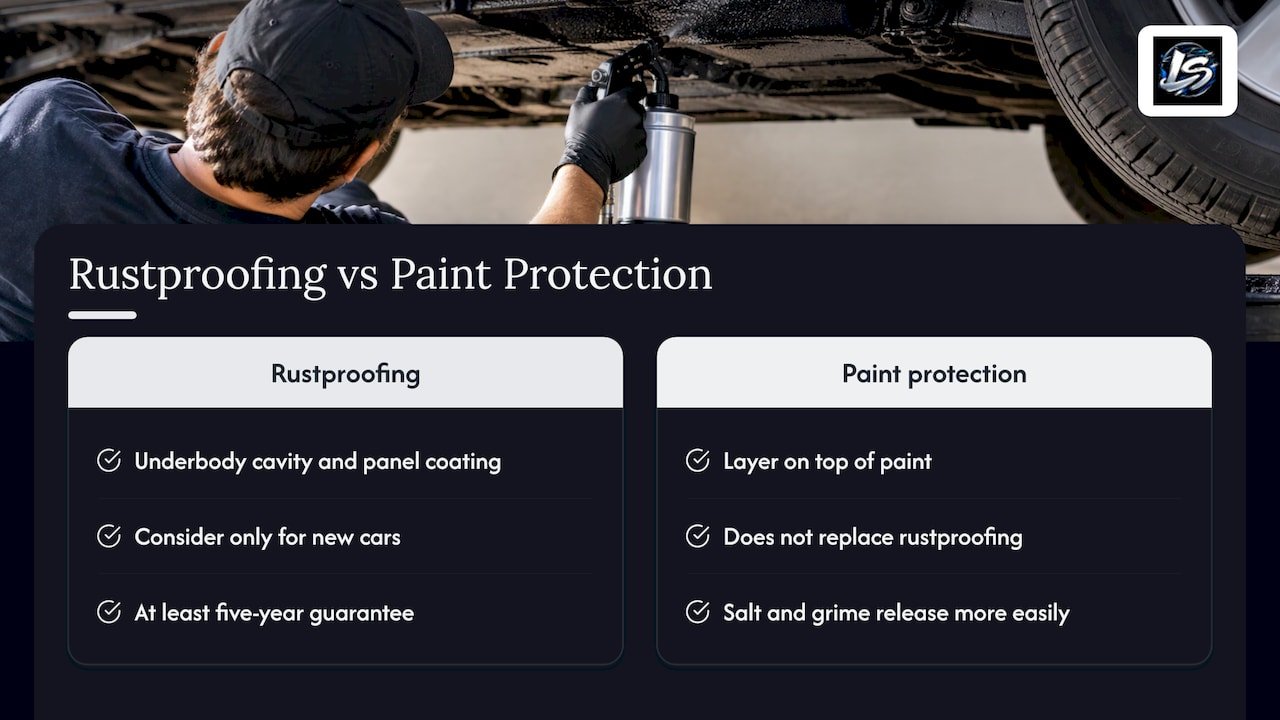
Paint protection is a layer on top of the paint: sealant, graphene or ceramic coating. It does not replace rustproofing, and we do not sell it as a rustproofing system. What it does is keep the paint surface sealed and slick, so salt, sand and grime release more easily when you wash. Protected paint is also much easier to clean thoroughly, and a car that is easier to clean tends to get cleaned more often.
Our perspective on protecting coastal cars
We detail cars on the Sunshine Coast every week, and the pattern is consistent. Salt rarely does its damage in one dramatic event. It builds up in the places owners do not look: arches, sills, door edges, the underside and the seams of the paint.
That is why we think about coastal protection as a routine, not a one-off product. Start with a proper clean that reaches those hidden areas. Correct any dull or oxidised paint with a cut and polish. Then put a protective layer over it that suits how you use the car. Our graphene spray sealant package, our ceramic coatings and our Ultimate Protection Package are designed to give coastal paint that layer.
We work at your home, your workplace or near the beach, so you do not lose half a day driving to a workshop. We use eco-friendly products, which matters when the wash water ends up near gardens and waterways. Our all-inclusive packages are built so you know what you are getting without hidden extras.
Between visits, keep up the rinsing habit above. Protection makes cleaning easier. It does not replace it.
isaac’s
What professional detailing adds
A home wash handles the routine. Detailing handles what a hose and a mitt cannot reach or fix. Our published prices are below. Each runs by vehicle size and condition, and each is done at your location.
| Service | What it is for | Price |
|---|---|---|
| Professional Mobile Underbody Wash | Flushing salt and mud from the underside | $50 |
| Deluxe Detail | A thorough clean inside and out | $375 to $575 |
| Revival Detail | Heavier restoration for tired or neglected cars | $575 to $775 |
| Graphene spray sealant coating package | A protective layer on the paint | $339 to $739 |
| Ultimate Protection Package | Our full protection package | $1500 to $2200 |
| Leather ceramic coating | Protecting leather seats | $50 per seat |
| Fabric Guard | Protecting fabric seats | $25 per seat |
We also do ceramic coating and cut and polish. Both are quoted to the vehicle, so contact us for a price.
Picking the right level
- Daily driver parked at the beach or within a couple of kilometres: start with a detail, then a protective layer. Keep rinsing weekly at least.
- Newer car you want to keep looking new: protect the paint early, before salt and UV have a chance to dull it. Our guide to protecting car paint covers the reasoning.
- Older car with dull or hazy paint: correct it first, then protect it.
- Family car with pets and beach trips: add Fabric Guard and the leather coating, and ask us about odour elimination for sandy, damp interiors.
Book mobile detailing on the Sunshine Coast
If salt is already on your car, the easiest next step is to have us clean it properly and put a protective layer on. We come to you, whether that is your driveway, your office car park or a spot by the beach. See our Deluxe and Revival detail options or the Ultimate Protection Package, or start from the Isaac’s Pro Detailing home page to get in touch.
We back our work with a 100% satisfaction guarantee, and our ceramic coatings are applied by certified installers.
A simple salt-air routine for the year
- After every beach visit: hose the wheel arches, sills and underside, and dry the car or at least rinse it with fresh water.
- Weekly to fortnightly: rinse, then wash with car detergent (more often if you are within a kilometre of the coast).
- Every month: check for chips, scratches, blocked door drains and damp mats.
- Every 6 to 8 weeks: MG’s schedule suggests wax or sealant for beachfront cars. A longer-lasting coating reduces how often you need to do this.
- Every 3 to 6 months: a thorough undercarriage wash.
- Whenever you see bubbling, orange staining or flaking: get it looked at, and see a mechanic if it is near brakes or structural parts.
FAQ
Does salt air really damage cars on the Sunshine Coast?
Yes. Salt holds moisture against the car, and damp, salty dirt is what starts corrosion. The risk is highest for cars that live close to the beach, but anyone who drives to the beach should rinse the car afterwards.
How often should I wash my car if I live near the beach?
MG Australia suggests rinsing beachfront cars 2 to 3 times a week and washing them fully every 2 weeks. For cars 1 to 5 km away, it suggests a weekly rinse and a full wash every 3 to 4 weeks. Beyond 5 km, a monthly full wash is its guide.
Does ceramic coating stop rust?
No coating makes a car rust-proof. Ceramic and graphene coatings protect the paint surface and make salt and grime easier to wash off. The ACA treats rustproofing as a separate treatment for new cars, done to AS2662. Chips still need repairing, and the underside still needs washing.
Can I just rinse the car with a hose?
A fresh-water rinse is a good fallback. RAC advises at least rinsing with clean fresh water after salt exposure. Rinse before washing, and include the wheel arches, sills and underside, which a quick spray over the body will miss.
Do you come to me for a salt clean-up?
Yes. We are fully mobile across the Sunshine Coast and work at your home, workplace or a spot near the beach. Contact us through our website for a quote on your vehicle.
Sources
- Corrosion in cars, Australasian Corrosion Association
- How to keep your car’s paint looking good, carsales
- FAQ, MG Motor Australia
- Bodywork maintenance, Renault user manual
- Sea Air vs Car: Protecting Your Car from (as)Salt, PD Insurance
- Car Doctor: blotchy bonnet, RAC