
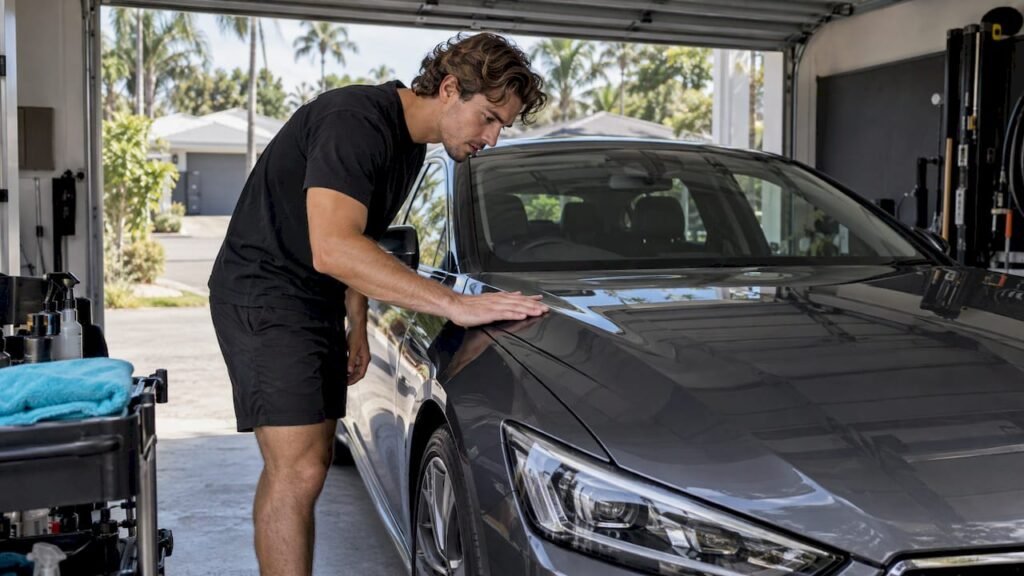
Ceramic coating is worth considering for a car that lives near the coast, because it gives salt, sand, UV and bird droppings a hard, slick layer to land on instead of your clear coat. It won’t stop stone chips, rust or scratches from a bad wash routine. Its results depend on how well the paint is prepared before application and on how you wash the car afterwards. If your car is parked within a few kilometres of the beach, it is a sensible form of protection. We apply ceramic coatings at your home, workplace or wherever you park, so the car doesn’t need to go to a workshop.
TL;DR
- A ceramic coating adds a hard, hydrophobic layer over your clear coat. On the coast that layer makes salt film, sand dust and water easier to rinse off.
- It doesn’t make paint chip-proof, scratch-proof or rust-proof, and automatic brush washes can damage it.
- Most coatings last roughly two to seven years depending on type, brand and care. Near the coast, the care routine decides where in that range you land.
- Paint preparation (decontamination, and polish where needed) matters as much as the coating itself, because the coating locks in whatever is underneath.
- Rinse with fresh water after beach trips, wash regularly with a mild soap, and keep the underbody clean.
Table of Contents
- What the coast does to your paint
- How a ceramic coating helps against each one
- What ceramic coating does not do
- Why preparation decides the result
- How long does a ceramic coating last on the coast?
- Washing and maintaining a coated car near the coast
- Does ceramic coating help in winter?
- Ceramic or graphene: which suits a coastal car?
- Protecting the interior, wheels and leather as well
- Perspective: why we coat coastal cars the way we do
- What a coastal ceramic coating job looks like with us
- A simple coastal care checklist
- FAQ
- Sources
What the coast does to your paint
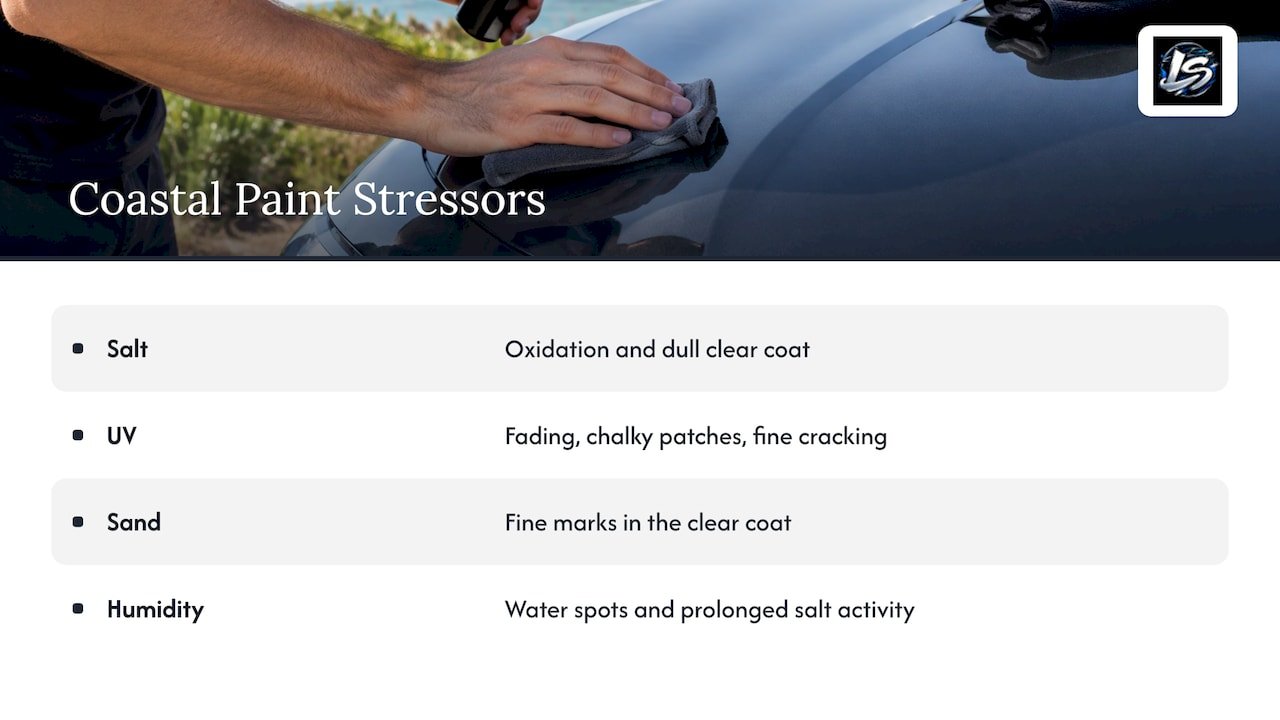
A car on the Sunshine Coast faces four things at once: salt, sun, sand and humidity. None of them is dramatic on its own. Together they wear paint down slowly, which is why many owners only notice the damage once the gloss has gone flat.
Salt. Sea spray carries fine salt inland, and it settles on bodywork, wheels, trims and the underbody. Salt stays on a surface and holds moisture, which speeds up oxidation and can dull the clear coat over time. Cars parked outside, or driven along beachfront roads, collect it daily without you seeing it, until it forms a pale film.
UV. Queensland sun is intense for much of the year. UV gradually breaks down the resins in factory clear coat, which shows up as fading, chalky patches and, eventually, fine cracking. Dark colours and horizontal panels (bonnet, roof, boot) show it first. We cover this in more depth in our piece on the impact of UV rays on car paint on the Sunshine Coast.
Sand. Wind-blown beach sand is abrasive. Wiped or brushed off a dry panel, it leaves fine marks in the clear coat. Most of the swirling people blame on the sun is actually from dry wiping, dusty wash mitts and grit that was never rinsed away.
Humidity. Humid air slows drying, so water sits on panels longer. That gives dissolved minerals and salt more time to leave spots that etch into unprotected paint. Humidity also means the surface stays damp after rain, so salt film is more likely to stay active rather than dry and blow away.
How a ceramic coating helps against each one
A ceramic coating is a liquid applied by hand that cures into a thin, hard, glass-like layer bonded to the paint. USA Today describes it as bonding with the paintwork in a way that isn’t easily washed off like wax or sealant, which is the key difference to a product you wipe on and top up every few weeks.
On the coast, that translates into practical benefits:
- Salt and water: the coating is hydrophobic, so water beads and runs off, taking a good share of the salt with it. What stays on is easier to rinse away than it would be from bare clear coat.
- UV: the coating sits between the sun and your clear coat. It takes the exposure first, which is why we treat it as protection for the paint rather than only a shine product.
- Sand and grit: a slick, hard surface lets loose grit slide off during a rinse, so there is less to drag across the paint when you wash.
- Bird droppings, sap, bugs: these sit on top of the coating instead of bonding into the clear coat, and they are easier to lift off. They still need to be removed promptly.
- Washing time: a coated car gets clean faster, which makes it much more likely you will actually rinse it after a beach trip.
That last point is the real coastal advantage. Protection that makes the rinse-and-wash habit easy does more over three years than any single product claim.
What ceramic coating does not do
Honest expectations matter more than a bigger promise. According to USA Today’s guide to ceramic coatings, a coating can’t remove swirls or scratches, fix paint that needs correction, completely shield paint from rocks and gravel, prevent rust over time, or survive automatic car wash brushes.
In practical terms for coastal drivers:
- Stone chips: the layer is only microns thick. If you drive unsealed roads or follow trucks on the Bruce Highway, a coating is not a substitute for a physical film.
- Existing damage: a coating seals the paint in whatever condition it is in. Swirls, haze and oxidation underneath stay visible, and look glossier. That is why polish comes before coating.
- Rust: a coating on paint does not stop corrosion in places it doesn’t reach, such as the underbody, brake components or exposed metal.
- Neglect: no coating makes a car maintenance-free.
This is why our approach starts with the paint and ends with an aftercare routine, not with the product.
Why preparation decides the result
A coating bonds to a clean, correctly prepared surface. On a coastal car, that surface usually carries embedded salt residue, iron fallout from brake dust and rail or industrial sources, tree sap, old wax and light oxidation. Apply coating over that and you seal in a flat, dull finish for years.
The sequence we work to is:
- Wash and decontaminate. Remove surface dirt, then iron and other bonded contaminants.
- Assess the paint. Look at swirls, haze, water-spot etching and fading under proper light.
- Cut and polish where needed. Correction is what restores depth and clarity. See our cut and polish service.
- Panel wipe. Strip polishing oils so the coating bonds properly.
- Apply the coating in controlled conditions, panel by panel, and let it cure.
- Protect the extras. Wheels, glass, trims and interior surfaces can be treated separately.
If you want to see how the process is laid out, our workflow for ceramic coating guide walks through it in more detail.
Why curing conditions matter
Coatings are sensitive to temperature, humidity and direct sun during application. Surface temperature, not just the air temperature, controls how quickly the product flashes and cures, and a panel left in full Queensland sun can be much hotter than the air around it. That is one reason a mobile application works best in shade or under cover, with panels cooled before we start. For the first couple of days after application the coating is still curing, so the car should stay clean, dry and away from sprinklers, sea spray and bird droppings. Our guide to the first 48 hours of ceramic coating cure time explains what to do during that window.
How long does a ceramic coating last on the coast?
USA Today reports that coatings can last from two to seven years depending on type and brand. Treat that as a broad range, not a promise. Where your car sits inside it depends on a few things:
| Factor | Coastal effect |
|---|---|
| Parking | A car garaged at night sees far less salt and UV than one parked under open sky near the beach |
| Wash frequency | Salt that sits for weeks does more harm than salt rinsed off within days |
| Wash method | Brush-style automatic washes and harsh detergents wear coatings down faster |
| Paint preparation | A coating over polished, decontaminated paint holds its gloss longer |
| Colour | Dark paint shows UV fade and water spots earlier |
| Use | Daily beach-run vehicles and boat-ramp towing rigs gather more salt and sand |
Because the climate is demanding, we think of a coastal coating as something to inspect each year, not something to forget. A regular check shows when the top hydrophobic layer is tiring, and whether a maintenance treatment is worth doing. Our article on how to extend ceramic coating lifespan covers the inspect, wash and reapply cycle.
Washing and maintaining a coated car near the coast
The routine is simple. Most of it is about speed: get salt and grit off before they have time to sit.
After a beach trip or a drive along the foreshore: rinse the car with fresh water, including wheel arches and lower panels. You don’t need soap. You just need to flush the salt and sand off before you wipe anything.
Regular wash (every one to two weeks for most coastal cars):
- Rinse thoroughly first so loose sand and grit come off without contact.
- Use a pH-neutral car shampoo and a clean wash mitt, with a second bucket or rinse for the mitt.
- Wash in shade, on cool panels. Soap and water that dry in the sun leave streaks and spots.
- Rinse again and dry with a clean, soft microfibre towel or a blower. In humid weather, a blower helps clear water from mirrors, trims and panel gaps that otherwise drip and spot.
Avoid: automatic washes with brushes, high-pH degreasers and abrasive wipes. USA Today lists brush washes among the things a coating cannot withstand.
Remove quickly: bird droppings, bugs, sap and tar. Left on a hot panel they can mark the surface, coated or not.
Every few months: a decontamination wash to remove iron fallout and other bonded contamination that a normal wash won’t lift. Our guide on how to maintain your ceramic coating on the Sunshine Coast lays out the schedule, and maintaining your vehicle after getting a ceramic coating covers the finer points.
Don’t forget the underbody
The paint is only part of the story. Salt collects on the chassis, suspension, exhaust and brake components, where a paint coating does nothing and where corrosion does the most serious damage. Our professional mobile underbody wash is $50 and is a straightforward add-on for any car that spends time near the beach.
Does ceramic coating help in winter?
Yes, in the sense that the things a coastal coating deals with don’t stop in winter. Salt spray, sand blown by cooler onshore winds, rain and road film are all still there, and a slick surface still sheds them. Winter on the Sunshine Coast is generally milder than winter in southern states, so it isn’t a case of frost and snow. The practical points are:
- Shorter, cooler days mean panels dry slowly, so use a blower or towel to avoid water spots.
- Sun is still strong enough on clear days to affect unprotected clear coat.
- Winter is a good time to apply a coating or book a maintenance check, because cooler conditions suit application and cure.
As always, check the weather before application. Rain in the first couple of days after coating can mark a car that is still curing, which is why we plan around forecasts.
Ceramic or graphene: which suits a coastal car?
Both are options for coastal cars, and the better choice depends on how you use the vehicle. Graphene products are often chosen by owners who are concerned about water spotting on dark paint. Our graphene spray sealant coating package is listed at $339 to $739, depending on the vehicle. If you want to compare the two in detail, read when graphene beats ceramic on Australian cars, or how ceramic coating compares with sealant.
Protecting the interior, wheels and leather as well
Sand and salt don’t stop at the paint. They come in on shoes, towels and wet swimmers, so coastal cars wear their interiors fast too.
- Fabric Guard is $25 per seat and helps stop spills and sand-laden dirt from soaking into seat fabric.
- Leather ceramic coating is $50 per seat, which gives leather a protective layer against sun, sweat and sunscreen.
- Wheels can be ceramic coated as well, which makes brake dust and salt easier to wash off.
Owners with young children, pets or beach gear in the boot tend to get the most from these. If odours are the problem (wet dogs, damp towels, stale boardshorts), we also offer odour elimination and ozone deodorisation.
Perspective: why we coat coastal cars the way we do
Most of the coastal cars we are asked about don’t have a coating problem. They have a preparation and routine problem. A coating on tired, hazy paint locks in tired, hazy paint, so we start by deciding what the paint needs before we talk about product.
We built Isaac’s Pro Detailing around being mobile because the best protection is the one that gets done. Your car is coated at home or at work, in the place it actually lives, rather than sitting in a workshop queue. That also means we can talk you through where it is parked, how much sun and salt it gets, and what that means for the way you wash it.
We would rather set honest expectations than oversell. A ceramic coating makes a coastal car easier to keep clean and protects the clear coat from sun and salt. It doesn’t stop stone chips, and it doesn’t replace washing. Used with a simple rinse-and-wash routine, it is one of the best things you can do for paint that lives within sight of the water.
isaac’s
What a coastal ceramic coating job looks like with us
We work at your location across the Sunshine Coast, using eco-friendly products. Packages are priced by vehicle size and what the paint needs. Current published prices are:
| Service | Price (AUD) |
|---|---|
| Deluxe Detail | $375 to $575 |
| Revival Detail | $575 to $775 |
| Ultimate Protection Package | $1,500 to $2,200 |
| Graphene spray sealant coating package | $339 to $739 |
| “Holy Grail” detail | $600 to $1,000 |
| Underbody wash | $50 |
| Leather ceramic coating | $50 per seat |
| Fabric Guard | $25 per seat |
Ceramic coating and cut and polish don’t have a single published price, because both depend on the vehicle and the condition of the paint. Our Paint Protection Sunshine Coast page explains what the protection options cover, and our ceramic coating page is the place to start if you want a coating assessed for your car.
If you are ready to protect your car from salt, sun and sand, book a mobile detail with Isaac’s Pro Detailing and we will come to you.

A simple coastal care checklist
Pin this to the garage wall:
- Rinse with fresh water after every beach or foreshore trip.
- Wash every one to two weeks with pH-neutral shampoo, in shade.
- Dry with a blower or clean microfibre towel.
- Skip brush-style car washes.
- Remove bird droppings and sap as soon as you see them.
- Book a decontamination wash and coating check once a year, or sooner if water stops beading.
- Get the underbody washed regularly if you drive on sand or park near the water.
FAQ
Can I go through a car wash with a ceramic coating?
Avoid automatic washes with brushes, which can dull or wear the coating. USA Today lists brush washes among the things a coating can’t endure. A hand wash with pH-neutral shampoo, or a touch-free rinse, is the safer option for a coated car.
Do ceramic coatings attract dust?
A coating doesn’t attract dust, but it does show it when the car is dirty, because the surface is glossy. The slick finish means light dust and pollen usually rinse off easily. Dust that sits on damp panels, as it often does in humid coastal weather, will mark the paint like it would on any car, so rinse it off before wiping.
Can ceramic coating be applied in direct sunlight?
It is better not to. Surface temperature controls how fast the product flashes and cures, and a panel in full sun can be far hotter than the air. Hot panels can cause streaking and uneven bonding. Applying in shade or under cover, on cool panels, gives a cleaner result, which is a good reason to book a mobile detailer who plans around the conditions.
Is ceramic coating worth it if I park outside near the beach?
It is one of the situations where it earns its cost. A car parked outside near the water takes the most salt, UV and sand, and a coating gives that exposure a protective layer to hit first. Pair it with a regular rinse and a yearly check and it keeps paint looking better for longer.