
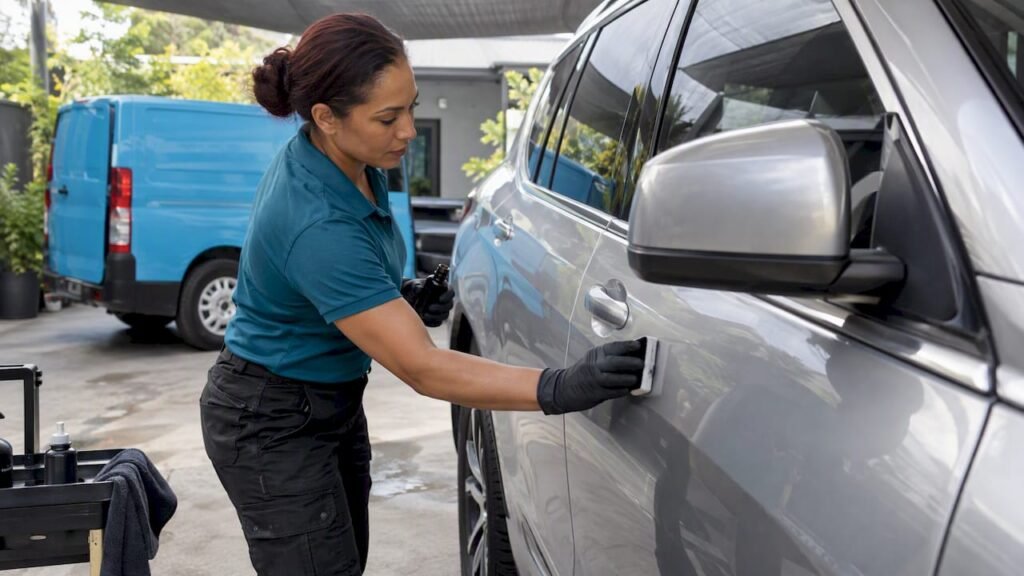
Ceramic coating is a hard, slick, hydrophobic layer that bonds to your paint. It is not armour, it is not permanent, and it does not make washing optional. Most of the myths below come from the gap between that description and how coatings get sold. If you know where the gap is, you can buy the right product and look after it properly.
We apply coatings on site across the Sunshine Coast, so we hear these myths on the driveway every week. Here is what holds up and what doesn’t.
TL;DR
- No coating is scratch-proof. It resists light marring and chemicals, but it won’t stop stone chips or deep scratches.
- “Lifetime” is a sales word. Expect roughly 2 to 5 years in Australia, depending on parking, washing and climate.
- “9H” refers to a pencil test, not to how your paint copes with road debris.
- A coated car still needs regular, gentle washing with the right products.
- DIY kits and professional systems are not the same thing, and preparation decides the result.
Table of Contents
- Myth 1: “Ceramic coating makes paint scratch-proof”
- Myth 2: “It’s permanent, you only do it once”
- Myth 3: “9H hardness means it can’t be scratched”
- Myth 4: “A coated car never needs washing”
- Myth 5: “Any soap is fine, because the coating is tough”
- Myth 6: “DIY kits from the shop do the same job”
- Myth 7: “Ceramic coating hides or fixes paint damage”
- Myth 8: “Ceramic coating is just expensive wax”
- Does Sunshine Coast climate change any of this?
- Our perspective: sell the result, not the number
- How we can help
- FAQ
- Sources
Myth 1: “Ceramic coating makes paint scratch-proof”
This is the one that causes the most disappointment. A ceramic coating bonds to the clear coat and creates a harder surface that resists light marring, chemicals and UV. That is useful: fewer wash-induced swirl marks, easier cleaning, less fading.
But the layer is thin. A stone flicked up on the Sunshine Motorway, a shopping trolley, a key or a roo-bar-height branch will mark a coated panel just as it marks an uncoated one. The RACV’s guide to paint protection draws the line clearly: for physical impact resistance you need paint protection film (PPF), which uses clear urethane layers to absorb the energy of road debris.
What is true: a coating reduces light swirling and makes the surface harder to stain.
What is not: that it stops chips or deeper scratches.
If stone chips are your worry, for example on a new car you drive on highways, the honest answer may be film on the high-impact areas, a coating over the top, or both. We cover that decision in our guide to protecting a new car with mobile PPF, ceramic or both.
Myth 2: “It’s permanent, you only do it once”
A coating is a sacrificial layer. It wears. Claims of lifetime protection are, in the words of one Australian write-up, marketing misnomers. The same source puts typical life at around 2 to 5 years in Australia, from about a year for a street-parked car that is rarely washed to 5 or more for a garaged one.
That range matches what we see locally. Sun, salt air, tree sap, bird droppings and frequent washing all shorten it. Shade, a garage and a sensible wash routine all stretch it.
A few practical points:
- Warranty wording matters. Ask what a “warranty” actually covers and what maintenance it requires.
- Annual inspection is cheap insurance. A coating that has started to lose its beading can often be topped up before the paint is exposed.
- Plan the next layer. Treat the coating like tyres: long-lasting, but not forever.
Our article on extending ceramic coating lifespan walks through the inspect, wash and reapply cycle in detail.
Myth 3: “9H hardness means it can’t be scratched”
Search for “9H” and you will find it printed on nearly every bottle. It comes from the pencil hardness scale, where 9H is the hardest pencil lead on the list. In a lab test, a coating is scratched with pencils of increasing hardness until it marks.
That tells you something narrow. Drive’s quick guide to vehicle coatings covers how coatings are marketed, and industry experts treat 9H as a marketing term rather than a measure of real-world scratch resistance. Pencil lead is not grit on a dirty wash mitt, a zip on a jacket or gravel at 100 km/h. A coating can post a 9H number and still swirl if the car is washed badly.
When someone quotes 9H at you, ask better questions instead:
- What is the real-world durability, in years, for a car parked like mine?
- What prep is included (wash, decontamination, paint correction)?
- What maintenance does the coating need?
- Who applies it, and in what conditions?
A confident installer answers these without reaching for the hardness number.
Myth 4: “A coated car never needs washing”
Coatings make dirt release more easily. They don’t make dirt stop existing. Water beads, grime slides off more readily, and a wash takes less effort. That is the benefit, and it is a good one. It is not self-cleaning.
A dirty coated surface also loses its slickness. Contaminants sitting on top mask the hydrophobic effect, and owners sometimes think the coating has failed when it just needs a wash.
A workable routine:
- Rinse off salt and sand soon after beach trips.
- Wash every one to two weeks with a gentle, two-bucket or foam method.
- Use a clean microfibre drying towel, not an old chamois or bath towel.
- Use a spray-and-rinse hydrophobic refresher when beading fades.
Myth 5: “Any soap is fine, because the coating is tough”
This myth quietly shortens coating life. Household detergents and cheap car-wash chemicals are often strongly alkaline or acidic. Sources on car care chemistry note that non-pH-neutral products are harsh on paintwork, and the same source describes pH-neutral shampoos as sitting in roughly the pH 6 to 8 range.
Coatings are chemically resistant, not chemically immune. Strong unbuffered bases and some fluoride-based acids in industrial-strength cleaners can degrade them. The more common problem is gradual: repeated washes with the wrong product strip hydrophobic performance, a slow “death by a thousand washes”.
What to do:
- Choose a pH-neutral shampoo made for cars.
- Avoid truck-wash, wheel-acid and degreaser products on painted panels.
- Keep dishwashing liquid for dishes.
What about automatic car washes?
Brush-style tunnel washes are the bigger concern, because the brushes hold grit from previous cars and can inflict the very swirl marks you paid to avoid. Touchless washes are gentler on the paint, though their chemicals are often aggressive. If you must use one occasionally, touchless beats brushes, but hand washing is the better habit for a coated car.
Myth 6: “DIY kits from the shop do the same job”
Retail kits have improved, and a careful owner can get a nice result from a spray sealant or a consumer ceramic product. But they are not the same as a professional multi-stage system. The RACV notes that professional-grade coatings can’t be perfectly replicated by retail products, which lack the chemical density and bonding performance of professional systems, and which need precise preparation and curing conditions to deliver advertised durability.
In our experience, the product is only half the job. The other half is everything before it:
- Washing and chemical decontamination (including iron removal)
- Clay or equivalent mechanical decontamination
- Machine polishing to remove swirls, because a coating locks in whatever is underneath
- Panel wipe to remove polishing oils
- Controlled application and curing
Skip any of those and the coating can look patchy, high-spot or fail early. If you want to see what’s involved, our step-by-step ceramic coating application guide breaks it down, and our piece on cut and polish explains why correction comes first.
Myth 7: “Ceramic coating hides or fixes paint damage”
Coatings are clear. They enhance gloss and depth, but they do not fill swirls or remove oxidation. A coating over damaged paint just seals in the damage with a shiny lid on it. That is why correction before coating is the step that most affects how the car looks for the next few years.

It also explains price differences. A quote that includes a proper polish takes much longer than a wash-and-coat, and it should cost more.
Myth 8: “Ceramic coating is just expensive wax”
This one runs the other way, and it is only half wrong. Wax is naturally derived, looks warm and glossy, and wears off in weeks to a few months. Sealants are synthetic and last longer. Coatings bond more strongly and last years. The RACV compares wax, sealants and ceramic coatings as three levels of the same idea, with coatings the most durable.

So coating is not magic, but it is not wax either. Whether it is worth the money depends on how long you’ll keep the car, where it is parked and how much you value easy upkeep. Our comparisons of ceramic coating versus sealant and coating versus wax go through the trade-offs.
Does Sunshine Coast climate change any of this?
Yes, mainly through UV and salt. Australia has one of the highest UV indexes in the world, and strong sun degrades paint and trim over time. A coating helps resist UV damage, which is one of the better reasons to consider one here. Our article on UV rays and car paint on the Sunshine Coast goes deeper.
Salt air near the beaches, afternoon storms, sap and bird droppings mean coastal cars get dirty fast. Regular rinsing and washing matters more here than it would inland.
Our perspective: sell the result, not the number
We don’t think ceramic coating needs exaggerating. It’s a very good product when it’s applied over properly prepared paint and maintained sensibly. It suffers when it’s oversold.
Our approach is simple. We work mobile, at your home, workplace or wherever the car is parked, and we use eco-friendly products. We would rather tell you that a coating will make your car easier to clean and protect it from UV than promise it will never mark. If your main worry is stone chips, we will say so and point you toward film. If your car’s paint is tired, we will suggest correction before any coating.
When you ask any installer about a coating, ask what they do before it goes on. The prep tells you more than the brand name.
— isaac’s
How we can help
If you’re on the Sunshine Coast and want a coating that is applied properly, our ceramic coating service is done on site, and it can be paired with cut and polish so the paint underneath is right first. Our Ultimate Protection Package is published at 1500-2200 AUD one-off, depending on the vehicle. For smaller upgrades, leather ceramic coating is 50 AUD per seat and Fabric Guard is 25 AUD per seat, both on our special services page.
If you’d rather start lighter, our graphene spray sealant package is published at 339-739 AUD one-off.
FAQ
How long does ceramic coating last on a car in Australia?
Typically around 2 to 5 years, according to an Australian guide to coatings. A street-parked car washed rarely may see closer to a year, while a garaged, well-maintained car can exceed 5. How you wash it matters as much as the product.
Can I take a ceramic-coated car through a car wash?
It’s best to avoid brush tunnel washes, which can cause swirl marks. A touchless wash is the lesser evil if you are short of time, but a hand wash with a pH-neutral shampoo is better for the coating and the paint.
What destroys ceramic coating?
Mostly harsh chemicals and neglect: strongly alkaline or acidic cleaners, household detergents used repeatedly, and abrasive washing. Some industrial cleaners with fluoride-based acids can break down a coating. Physical damage such as stone chips can also breach it.
Is a ceramic coating worth it?
If you plan to keep the car for years, park outside, and want easier cleaning and UV resistance, it often is. If your priority is stopping chips, film does that job better. For a rough guide to cost, the RACV notes professional coating commonly starts around $800 for small to medium vehicles, while our own prices depend on the package and vehicle.
Sources
- How to protect car paint: wax & coatings explained, RACV
- Is Ceramic Coating Worth It in Australia? Tint a Car
- A quick guide to vehicle coatings, Drive
- Can Car Shampoo Damage Your Paint? Car Care Products
- How to Protect Your Car’s Paint From Scratches, The Times