
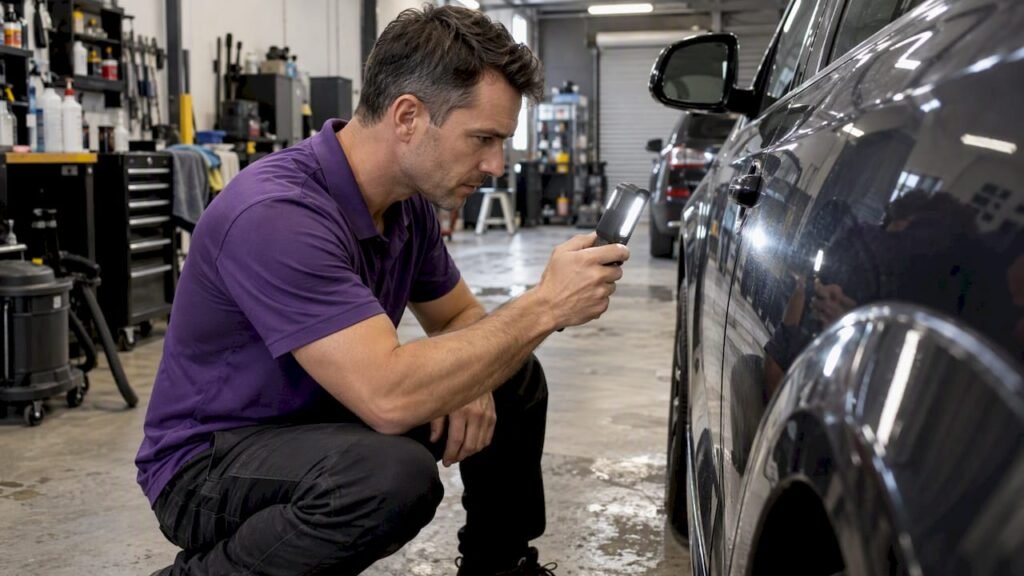
Mobile detailing usually wins for busy owners, routine maintenance, interior extractions and small polish or spray-sealant jobs, because the detailer comes to you and recurring plans keep the car looking fresh. A shop is the better call for heavy paint correction, multi-day restorations, full ceramic cures and paint protection film, where a controlled environment matters. At Isaac’s Pro Detailing Sunshine Coast, we work to the same boundary, and industry bodies such as ACWA set the environmental standards.
TL;DR:
- Before booking mobile service, confirm access to water and power, or that the detailer brings both, plus shade, level ground, room, and several hours.
- Reschedule outdoor polishing or coating when rain, wind, heat, or dust threatens the finish, and ask how the operator keeps wastewater away from storm drains.
- Compare written inclusions rather than totals; quotes depend on vehicle size, condition, correction stages, and extras such as clay treatment or iron removal.
- For unclear paint condition, send photos and request an inspection before booking; confirm correction limits, curing conditions, turnaround, and remedies if results disappoint.
Table of Contents
- What is mobile detailing and what does it include?
- What is shop detailing and what can only a workshop do?
- How do convenience and scheduling compare?
- How do equipment, lighting and environment affect results?
- Which services suit mobile and which suit a shop?
- How do weather and environmental rules limit mobile work?
- What should you expect to pay, and how do quotes get scoped?
- How do you choose, and what should you ask before booking?
- Where do we draw the line between mobile and shop?
- How can you book our mobile detailing service?
- FAQ
- Sources
What is mobile detailing and what does it include?
Mobile detailing means the detailer brings the workshop to your vehicle. We work at your home, your office or a favourite spot near the beach. Nothing about the vehicle’s care is left to chance, but everything happens on your turf, so you never have to arrange a lift or wait around in a reception area.
According to Sprintlaw’s overview of the trade, detailing in Australia includes both mobile operators and workshop-based detailers, and successful mobile operators often rely on tiered packages and recurring bookings. That matches how we run our own mobile service: a clear menu, a clear scope and a booking pattern that suits busy people.
Typical mobile services include:
- Maintenance washes that go well beyond a drive-through rinse
- Interior vacuuming and seat and carpet extraction
- Quick polishes and spot correction on light marks
- Spray sealants and graphene-style protection
- Odour removal, including ozone treatment
- Small-scale ceramic spray jobs
- Fabric and leather protection
What a mobile detailer needs from you
Mobile work is only as good as the spot it happens in. A few practical requirements make the difference between a smooth visit and a compromised one:
- Water and power: access to a tap and a power point, or a team that carries its own tank and generator
- Shade and level ground: polishing and sealants behave much better out of direct sun, on a flat surface
- A realistic time window: a proper detail takes hours, not minutes, so the car needs to stay put
- Room to work: enough clearance to open every door and move around the vehicle safely
Why packages and recurring plans suit mobile
DayRoute’s business plan guide notes that mobile detailing meets a clear market need because it saves owners time and often targets recurring, time-poor clients such as busy professionals and fleets. Tiered packages let you choose the depth you need, from a Deluxe Detail for regular upkeep to a more involved Revival Detail when the car has had a harder life. If you want more on why this model works for busy drivers, our guide on why mobile detailing suits busy Aussies goes further.
What is shop detailing and what can only a workshop do?
Shop detailing happens at a fixed site: dedicated bays, industrial extractors, stable water and power, and zones set aside for jobs that hate dust. The car goes to the work rather than the work coming to the car. For most everyday jobs that is simply a different way of doing the same thing. For a few specialised jobs, it is the only sensible way.
Key features of a fixed-site workshop include:
- Fixed bays with permanent, reliable water and power
- Industrial-grade extractors and polishers
- Dust-free or low-dust zones for finishing work
- Controlled lighting that reveals every swirl and haze
- Dedicated areas where coatings can cure undisturbed
Jobs that usually belong in a workshop
Some work depends on conditions that a driveway cannot guarantee:
- Multi-stage paint correction: repeated passes with different pads and compounds, checked under strong lighting between each stage
- Full professional ceramic coatings: application and curing are sensitive to dust, humidity and temperature
- Paint protection film installation: film needs a clean, still environment so no debris ends up trapped beneath it
- Extensive restorations: multi-day projects where the car needs to stay indoors and untouched overnight
The quality control advantage
The real strength of a workshop is control. Sprintlaw’s legal guide for detailing businesses records practitioners noting that advanced services such as paint correction and ceramic application benefit significantly from controlled, dust-free lighting conditions that only fixed-site workshops can provide. Good lighting shows defects you would otherwise miss, and a clean bay keeps airborne grit away from freshly prepared paint.
None of this makes a workshop better at everything. It makes it better at a narrow band of demanding work. For the rest, convenience tends to matter more than a dust-free ceiling.
How do convenience and scheduling compare?
The biggest practical difference between the two models is what your day looks like. With a mobile detailer, the car stays where it is. With a shop, you plan around drop-off and collection. Neither is wrong, but one will suit your week better than the other.
- Mobile service happens where you are. Your home, workplace or a car park becomes the work site. You can book an at-home slot or a lunchtime window and carry on with your day while the work happens nearby.
- Mobile plans reward regular upkeep. Maintenance plans spread the effort, so the car never gets bad enough to need a rescue job. For busy owners, that regularity is often worth more than any single visit.
- Shops mean drop-off and collection. You arrange a time, hand over the keys and arrange a lift or a loan vehicle if the shop offers one. Concentrated appointment slots suit people who can leave the car for the day.
- Shops can move faster on very large jobs. Several technicians working in parallel on a car in a bay can finish a big job in fewer calendar days than one mobile operator working alone.
- Fleet and sale prep favour mobile. Real-estate vehicles, work utes and company cars are easier to keep presentable when the detailer visits the car park instead of every vehicle making a trip.
When to favour convenience
Choose mobile when the job is frequent, light to moderate and easy to scope: regular washes, interior refreshes, a quick tidy before a family trip or a monthly plan. Choose a shop when the job is infrequent, heavy and benefits from being left alone in controlled conditions.

If you want to see how a booking works end to end, our complete booking guide walks through it step by step.
How do equipment, lighting and environment affect results?
Equipment and conditions shape the final finish more than most buyers realise. The honest answer is that mobile kit can match shop results on many jobs, while a smaller group of jobs genuinely depends on shop-grade conditions.
What a mobile detailer carries
According to PressUp’s guide to mobile detailing setups, a typical mobile setup includes:
- A pressure washer and water tank
- A vacuum or extractor
- Polishers and pads
- Products and microfibre towels
- A generator or access to vehicle or site power
A well-equipped operator can deliver a thorough wash, deep interior extraction and a quality polish with this kit. We cover how that workflow runs in our mobile detailing best practices guide.
What a workshop adds
Fixed sites typically add:
- Industrial polishers and heavier extraction equipment
- Dust-free bays that protect fresh paint
- Extraction pits and drainage built for wet work
- Dedicated curing areas for coatings
Why lighting and dust control matter
Multi-stage correction is judged by what you can see. Weak or shifting light hides holograms, haze and leftover swirls, and wind-blown dust can scratch paint between stages. Coating application is even less forgiving: dust, moisture or a sudden gust can leave high spots or marks that are hard to fix once the product cures. This is why practitioners quoted by Sprintlaw point to controlled lighting as a real quality factor for advanced work.
For light polishing and spray sealants, good mobile technique, shade and calm weather deliver excellent results. The environment starts to dominate only as the job gets more demanding.
Pro Tip:Ask any detailer, mobile or shop, for their pre-inspection checklist and photos of previous jobs similar to yours. A confident operator will have both ready.
Which services suit mobile and which suit a shop?
Matching the service to the delivery model before you book saves disappointment later. Here is how common jobs usually split.
- Routine interior cleaning and extraction: well suited to mobile. Vacuuming, seat and carpet extraction and surface cleaning do not depend on a controlled environment.
- Maintenance washes: mobile handles these easily, including iron removal and underbody washes where water and run-off can be managed.
- Cut and polish: light to moderate work suits mobile. Multi-stage correction on heavily damaged paint is usually safer in a workshop where lighting and dust can be controlled.
- Ceramic coatings: spray sealants and graphene-style products suit mobile application. Full professional ceramic systems normally prefer a workshop because of curing conditions. Our ceramic coating workflow guide explains why.
- Paint protection film: installation usually belongs in a workshop, where a clean, still space keeps debris out from under the film.
- Fabric and leather protection: typically fine for mobile, since application is straightforward and controlled by the technician.
- Odour elimination: ozone deodorisation can be done on site when you can leave the car undisturbed for the treatment time.
- Engine bay cleaning and headlight restoration: often workable mobile, depending on access to water, shade and the condition of the parts.
How to read this list
If the job is about cleaning, refreshing or light protection, mobile will almost always do it well. If it is about reshaping paint or applying a coating that needs a clean cure, a shop earns its place. Our guide on what a detailing package actually includes helps you check a package against the job you actually have.
How do weather and environmental rules limit mobile work?
Weather is the honest weak point of working outdoors, and responsible operators plan around it rather than pretending it does not exist. Environmental rules matter too, because washing a car creates run-off that has to go somewhere sensible.
How weather affects the work
- Rain: ruins polishing, contaminates fresh sealants and makes interior work awkward
- Wind: carries dust and grit onto prepared paint, which is a problem for coating application in particular
- Heat: panels that are hot to the touch dry products too fast, leave streaks and make polish harder to work
- Dust: any airborne grit can scratch paint during polishing or settle into a coating before it cures
Environmental responsibilities
ACWA’s environmental guidance explains that commercial car wash premises typically use trade waste systems so contaminated run-off is treated before it enters the sewer, and that mobile operators should manage water and run-off carefully to avoid polluting stormwater. Regulators also assess commercial car wash sites individually, as Water Corporation’s car wash guidance describes, so it pays to ask how any operator handles wastewater.
What good operators do about it
- Offer clear rescheduling when weather turns
- Use low-water or waterless methods where suitable
- Keep run-off away from stormwater drains
- Suggest an indoor or covered alternative for critical jobs such as coating application
Ask about these before you book. A detailer who has a plan for bad weather and wastewater is usually a detailer who plans the rest of the job just as carefully.
What should you expect to pay, and how do quotes get scoped?
Price follows vehicle size and service depth more than it follows where the work happens. A large SUV costs more than a hatchback, and a multi-stage correction costs far more than a maintenance wash, whichever model delivers it.
Price bands
PressUp’s Australian guide indicates that per-car pricing for detailing commonly ranges from around A$170–A$500 depending on service depth. For our own services, the ranges we publish are:
- Deluxe Detail: 375-575 AUD
- Revival Detail: 575-775 AUD
- Graphene spray sealant coating package: 339-739 AUD
- Ultimate Protection Package: 1500-2200 AUD
Current prices for cut and polish and ceramic coating are on our website.
Why quotes differ
Two quotes for the same car can differ for good reasons: paint condition, interior soiling, pet hair, the number of correction stages and the products used. They can also differ for bad reasons, such as a vague scope that leaves the real work to be added later.
How scoping protects you
Industry experts quoted by Sprintlaw emphasise that clear scoping, meaning what is included in a package and what counts as correction versus protection, is the most effective way to align expectations. The same source notes that a thorough pre-inspection documenting rock chips and scratches prevents disputes about realistic outcomes.
Comparing quotes fairly
- Compare written inclusions, not just totals
- Check whether coatings, clay and iron removal are included or extra
- Ask what correction is promised and what is excluded
- Treat a very low price with no written scope as a warning sign
How do you choose, and what should you ask before booking?
The shortest decision rule is this: maintenance and light protection go to a mobile detailer, while deep correction and full coating or film installs go to a shop. If your job sits in the middle, the questions below will tell you which way to lean.
- Define the job. Write down what you want: a clean, a polish, a coating. Note any damage, pet hair or odours.
- Ask what is included. Request a written scope with inclusions and exclusions.
- Ask where coatings cure. A serious coating job should have a plan for dust, moisture and temperature.
- Ask how wastewater is managed. A good operator can explain how run-off is controlled.
- Ask about turnaround and guarantees. How long will it take, and what happens if you are not happy?
- Compare answers. Pick the delivery model whose answers show the most care, then confirm logistics: time window, parking, water and power.
Pro Tip:Send photos of your car with your enquiry. A detailer who can see the paint and interior can give a far more accurate scope before anyone arrives.
Our booking guide for mobile detailing covers what to prepare on the day.
Where do we draw the line between mobile and shop?
We think the mobile versus shop debate is framed too tightly. Most owners are not choosing between two equal options for every job. They are choosing between a convenient service that handles the bulk of what a car needs and a specialist environment for a narrow set of demanding tasks. Treating every job as a showdown pushes people to overpay for a workshop or to expect miracles from a driveway.

At Isaac’s Pro Detailing Sunshine Coast, we position mobile detailing as the convenient, eco-conscious choice for maintenance and many full detail jobs, and we say plainly when heavy correction or a full PPF or ceramic cure belongs in a workshop. Our Deluxe Detail, Revival Detail and graphene spray sealant package match the kind of work a mobile visit does very well.
What we think owners underestimate is the value of regularity. A well-kept car needs less drastic intervention, which means fewer jobs that need a workshop at all. If you are unsure which category your car falls into, ask us for a pre-inspection and we will confirm the scope and the logistics before you commit.
— isaac’s
How can you book our mobile detailing service?
If your job suits mobile, we come to you across the Sunshine Coast with the right kit for the work. Our mobile-capable packages are:
- Deluxe Detail: a thorough clean and refresh for regular upkeep
- Revival Detail: a deeper restoration of a car that has had a hard run
- Graphene spray sealant coating package: durable protection applied on site
To book, choose a package on our Deluxe Detail and Revival Detail page, or request a pre-inspection or quote so we can confirm the scope first. For protection options, see our graphene spray sealant page. Plan for a time window of several hours, shaded or level parking if possible, and access to water and power, and we handle the rest. Message us today and we will lock in a time that suits your week.
FAQ
Why is it called detailing?
The word describes the level of attention. Detailing means working on the small details of a vehicle, such as seams, vents and paint finish, rather than a quick surface wash. It aims to restore and protect, not just clean.
What are the downsides of using a car wash?
Automatic washes are quick but generic, and they rarely reach interior surfaces, door shuts or fine paint marks. Brushes and rollers can also leave swirls on some finishes. A detail is slower but treats the whole vehicle to a defined scope, as we explain in our guide to the difference between washing and detailing.
What is a mobile detailer?
A mobile detailer is a professional who brings the equipment, water and products to your location instead of you visiting a shop. They handle jobs such as washing, extraction and polishing at your home or workplace. Many offer tiered packages and recurring plans.
Is mobile detailing worth it?
For most routine maintenance, yes, because it saves the time of dropping off and collecting a vehicle. Sunshine Coast owners with busy schedules often find it the easier habit to keep. For heavy correction or full coating cures, a workshop may still be the better choice.
Sources
- The Environment
- How to start a mobile car detailing business in Australia: costs, earnings, steps — PressUp