
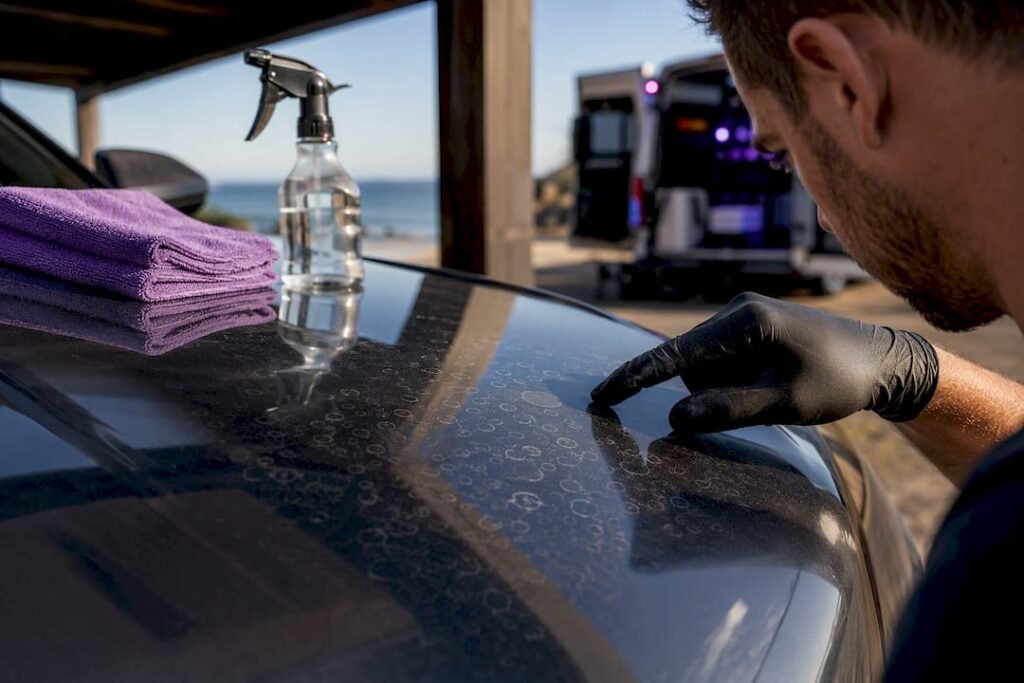
Grab a wet microfibre and wipe the mark first. If it lifts, you’re dealing with a surface mineral deposit that a mild acid product will dissolve in minutes. If it won’t budge and you can feel a rough dip with your fingernail, that’s etching, and no chemical will fix it. At that point you’re choosing between polishing and, for deep damage, a body shop.
TL;DR:
- Minor surface deposits can be dissolved with mild acids within seconds, but deeper etching requires polishing or possibly a repaint.
- Always diagnose water spot depth correctly using a wet wipe, acid dwell test, and fingernail check before choosing chemical removal or polishing.
- Avoid aggressive polishing on spots that only sit on the surface, as overdoing it can strip UV protection from the clear coat.
- Prevent spots by immediately drying after washing with deionized water and applying ceramic coatings or sealants to make the paint water-repellent.
- Professional detailers use precise diagnostics and controlled correction methods for extensive or deep etching, especially when DIY fixes are ineffective.
Table of Contents
- What is water spot removal for cars, and which type are you dealing with?
- How do you remove water spots from a car yourself?
- When do you need polishing instead of chemicals?
- How do you stop water spots coming back?
- How does a professional detailer handle water spot removal?
- Why chemistry first, abrasion last is the only sane approach
- Get a mobile assessment instead of guessing with a polisher
- Sources
- FAQ
What is water spot removal for cars, and which type are you dealing with?
Water spot removal on a car means matching the fix to the depth of the damage, not just scrubbing harder. There are three tiers, and mixing them up is how people burn through their clear coat for nothing.
- Type 1 (surface deposit): Calcium carbonate and other minerals sitting on top of the paint. Wipes off, dissolves fast, no permanent mark.
- Type 2 (shallow etch): The mineral has started eating into the clear coat. Chemistry alone won’t clear it.
- Type 3 (deep etch): The etching has gone through enough clear coat that only mechanical correction or a respray will fix it.
The diagnostic ladder is simple: wet wipe first, then a short acid dwell, then check with a fingernail or an angled LED torch. Fresh surface spots dissolve with mild acids, while etched spots need polishing or respray, so this test alone decides your next move.
Most factory clear coats run roughly the width of a human hair thick, which is a very thin layer. Guess wrong on the diagnosis and jump straight to compounding, and you can strip years of UV protection off a panel in one session.
How do you remove water spots from a car yourself?
Work in the shade on a cool panel. Hot paint flashes chemicals dry before they can work, and it can also stress the finish.
- Pre-rinse the panel to remove loose grit before any chemical touches the paint.
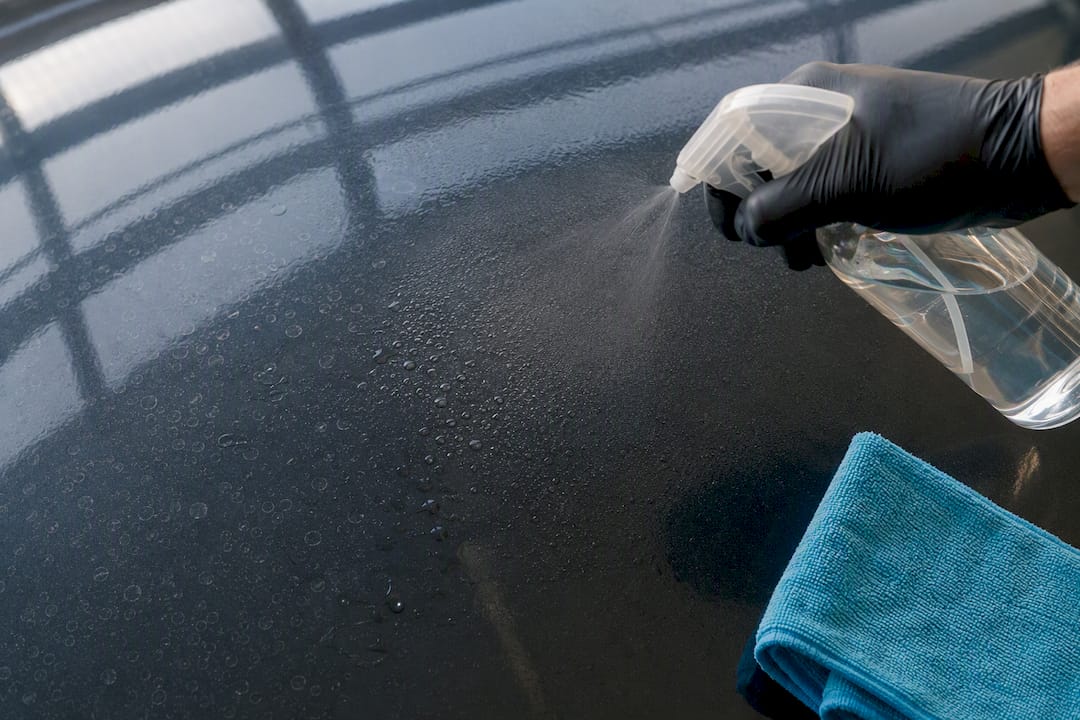
- Test on a small area with a diluted vinegar mix (roughly one part white vinegar to one part water) or a dedicated water spot remover.
- Dwell for 30 to 60 seconds.Dedicated citric and oxalic acid blends outperform plain vinegar on stubborn mineral deposits because oxalic acid binds directly to the calcium and iron ions causing the spot.
- Agitate gently with a soft microfibre, then rinse thoroughly before the product dries.
- Re-check with the fingernail test. If the spot is gone, you’re done. If it’s fainter but still there, repeat once more before moving on.
- Clay bar any remaining rough patches that chemicals didn’t shift. Clay lifts bonded surface contamination that cleaners can’t dissolve and preps the paint for wax or coating.
Wear nitrile gloves and eye protection whenever you’re handling acid-based removers, and always follow the product’s safety data sheet for exact dwell times. Skip the kitchen cupboard shortcuts. Industry guidance consistently warns against improvised cleaners and against WD-40 on paint, since both can strip protective layers or leave staining behind. For a broader rundown of safe products and steps, Diamondbrite’s water spot guide is a solid companion read.
Pro Tip:Never let a water spot remover dry on the panel in direct sun. If you can’t rinse it within the stated dwell time, mist the area with water to keep it wet until you can.
When do you need polishing instead of chemicals?
If chemistry didn’t shift the mark and the fingernail test confirms a dip, you’ve moved into Type 2 territory. Confirm the etch is real before you pick up a polisher. A quick way to check: view the panel under an angled LED light. Etching shows as a dull halo that chemicals can’t clear no matter how long you leave them on.
- Start with the least aggressive option: a consumer-grade compound like Ultimate Compound on a dual-action (DA) polisher fitted with a light cutting pad.
- Run the pad at speed 4 to 5, three slow passes over the area, then stop and inspect under angled light before repeating.
- If the etch plateaus without clearing, step up to a stronger compound such as Meguiar’s M105, then finish with a fine polish to remove any hazing or holograms left behind.
Once the etch is gone, jump to a finishing polish. Skipping that step is the main reason DIY correction jobs end up with swirl marks or holograms under sunlight.
Deep etches that have hydrolysed the clear coat can’t be chemically reversed. At that point you’re looking at wet-sanding and heavy correction, or in the worst cases a full respray of the panel, which typically runs into hundreds of dollars per panel depending on paint type and body shop labour rates.
How do you stop water spots coming back?
Removal fixes today’s problem. Prevention decides whether you’re doing this again next month.
- Dry immediately after washing, using a leaf blower or a plush microfibre. Don’t let water sit and evaporate on the panel, since that’s exactly how mineral deposits form in the first place.
- Skip the tap water for your final rinse. Water softeners swap calcium for sodium, they don’t remove it, so softened water still leaves spots. A proper fix is a deionised or reverse-osmosis final rinse. DI water strips dissolved minerals down to close to 0 ppm TDS, so it evaporates clean.
- Consider a portable DI unit if your local water sits above roughly 150 to 200 ppm hardness. A small tank typically uses a moderate amount of water for a full final rinse on a standard car, which is efficient enough for most home setups.
- Add a ceramic coating or a quality sealant.Coatings make water bead and shed rather than sit and dry on the paint, which lowers the odds minerals ever get a chance to bond.
Pro Tip:A DI final rinse also cuts out most towel-drying entirely, since properly deionised water sheets off on its own. Fewer wipe-downs means fewer chances to put a swirl mark in fresh paint.
For a longer view on what coating actually changes about your maintenance routine, see this step-by-step ceramic coating guide.
How does a professional detailer handle water spot removal?
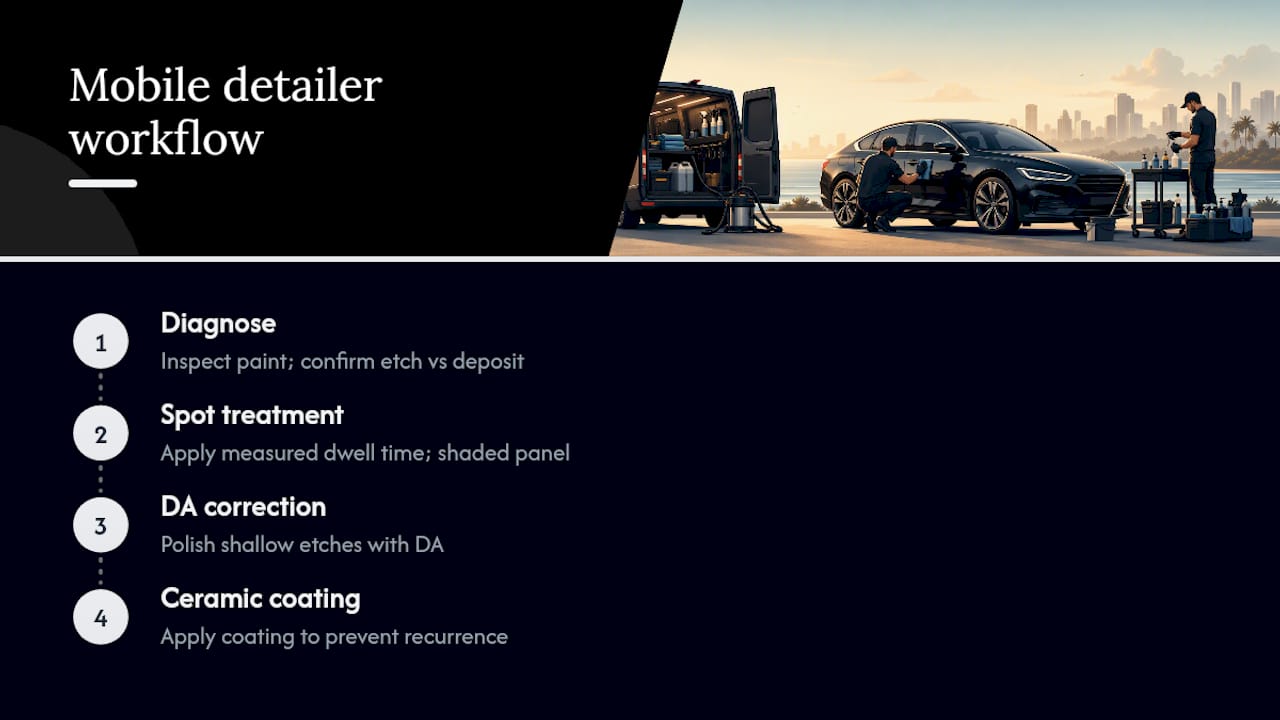
On a mobile job, the workflow doesn’t change from what is described above. It just gets executed with better tools and tighter controls. A cool, shaded panel, gloves and eye protection for any acid product, and a measured dwell time rather than a guess. The diagnostic step happens before a single product touches the paint, because misreading a Type 2 etch as a surface deposit wastes time and risks the clear coat.
Where a professional visit earns its keep is on jobs that are too big or too risky for a home kit: a car with etching across multiple panels, a DA polisher a homeowner doesn’t own, or paint correction that needs to be finished the same day. A typical on-site visit might involve targeted chemical spot treatment on light areas, DA correction on shallow etches, and a ceramic coating application to stop the problem recurring, all in one appointment.
Why chemistry first, abrasion last is the only sane approach
Every etched panel I’ve read about started as a surface deposit someone left too long or attacked with the wrong tool. The ladder exists for a reason: test wet, test with acid, test with your fingernail, and only pick up a polisher once you’ve ruled out a gentler fix. Prevention (a proper DI rinse, a decent coating) beats repeated correction every time, because paint doesn’t grow back.
— isaac’s
Get a mobile assessment instead of guessing with a polisher
If a panel won’t respond to chemicals or the etching has spread across the car, Professional mobile detailing services bring the full triage and correction workflow to your driveway, workplace, or wherever the car sits.

A typical on-site visit starts with the same diagnostic ladder covered above: a wet wipe, an acid test, a fingernail check under angled light, so you get an honest answer about whether your spots are cosmetic or structural before any work begins. From there, treatment might mean a targeted chemical spot job, DA-based paint correction, or a ceramic coating to stop the problem coming back. Every quote is assessed on-site and given before any work starts, no surprises on the invoice.
If your water spots have gone past what a bottle of remover can fix, check the wash menu for spot-treatment and correction packages, or book an on-site assessment to get a straight answer on what your paint actually needs.
Sources
- What causes water spots (and what dissolves them) · CarCareTruth
- Water Spot Removal: Fix mineral deposits on car paint · Gilroy Blackout
FAQ
Can water spots be removed from a car?
Yes, most can. Surface mineral deposits dissolve with a mild acid product in under a minute, while shallow etching needs polishing rather than chemicals.
How much does it cost to remove water spots from a car?
DIY chemical removal costs little beyond the price of a spot remover, while professional DA polishing or a mobile detailing visit varies by panel count and etch severity. Deep etches needing a respray can run into hundreds of dollars per panel.
Does WD-40 remove water spots on a car?
No. WD-40 and other improvised household products aren’t designed for automotive clear coat and risk stripping protective layers or leaving stains, so a dedicated water spot remover or diluted vinegar is the safer choice.
Can water spots on a car be permanent?
Yes, once mineral deposits have etched into the clear coat, chemistry alone can’t reverse the damage. At that stage the fix is polishing, or in severe cases, a respray.