
You can mostly remove cigarette smoke from a car, but only if you get rid of the residues, not just the smell. Start by clearing out debris and booking a staged deep clean that covers fabrics, hard surfaces and the ventilation system to effectively diagnose the source first to stop car odour for good. Severe or long-standing contamination may need repeat sessions or a cabin air filter swap before the cabin genuinely smells clean again.
TL;DR:
- Removing cigarette smoke from a car requires deep cleaning of fabrics, hard surfaces, and the ventilation system, often needing multiple sessions for severe contamination.
- All loose debris, ash, and ashtray contents must be cleared first, and vacuuming with a crevice tool is essential to prevent residue from spreading during cleaning.
- Using extraction or shampooing tools on upholstery, carpets, and the headliner is crucial, with lighter cases taking around 2 to 3 hours and heavier contamination possibly requiring repeated treatments.
- Replacing the cabin air filter and thoroughly cleaning vents with compressed air or deodorising sprays are necessary, as filters often trap smoke particles and act as reservoirs for odour.
- Final deodorising methods, such as enzyme treatments or ozone, should only be applied after physical cleaning, with ozone used exclusively by trained professionals in unoccupied vehicles due to health risks.
Table of Contents
- Step 1: remove loose debris and prepare the cabin
- Step 2: deep-clean fabrics, seats, carpets and the headliner
- Step 3: clean hard surfaces, glass and interior trim
- Step 4: HVAC, vents and cabin air filter
- Step 5: deodorising treatments and ozone safety
- Prevention and maintenance: stop the smell returning
- Why a staged, professional-first approach gets better results
- How Isaac’s Pro Detailing can help with smoke odour removal
- Sources
- FAQ
Step 1: remove loose debris and prepare the cabin
Smoke odour clings to more than fabric. Ash, butts and stale clothing left in the cabin keep releasing particles long after the last cigarette, and cleaning around them just spreads the problem. Clearing everything out first means every later step actually works instead of shifting grime from one surface to another.
- Take out all rubbish, cigarette butts, ashtray contents and anything stored loose in the cabin.
- Pull the floor mats and shake, brush or extract them outside the car.
- Check under the seats, in door pockets and inside the centre console: these are where ash and butts collect unnoticed.
- Vacuum every surface with a crevice tool and a stiff brush to lift loose particulate before any liquid cleaner goes near it.
Skipping this stage is the most common reason a “clean” car still smells stale a week later. Wet cleaning over loose ash just grinds it deeper into the carpet fibres, and once residue is trapped in wet fabric it takes far longer to shift.
Step 2: deep-clean fabrics, seats, carpets and the headliner
A wipe-down never touches the residues doing the real damage. Third-hand smoke settles into upholstery, plastics and headliner foam, and airing the car out or spraying an air freshener does not remove it: it takes physical extraction to pull the contaminants back out of the fibres.
- Hot-water extraction or shampooing lifts embedded tar and nicotine that a surface wipe leaves behind.
- Enzyme or tobacco-targeted cleaners break down organic residue in fabric seats and carpets more effectively than a general upholstery spray.
- Leather takes a gentler approach: a pH-balanced leather cleaner rather than a wet fabric shampoo, to avoid drying or cracking the hide.
- The headliner needs restraint: avoid soaking it, and stick to dry extraction or a light steam pass, since a saturated headliner can sag or delaminate.
Pro Tip: Work the headliner last and with the least moisture of any surface, it’s the hardest panel to dry and the easiest to damage.
Time on the job scales with how bad the contamination is. A mildly affected interior usually takes 2 to 3 hours of extraction work, a moderate case runs 4 to 6 hours, and heavy, years-long contamination can mean multiple sessions, sometimes with foam or headliner replacement if the smell has bonded into the material itself.
Step 3: clean hard surfaces, glass and interior trim
Smoke leaves an oily film across every hard surface in the cabin, and that film both smells and dulls visibility through the windscreen. It needs its own pass, separate from the fabric work.
- Use a dedicated interior plastic or vinyl cleaner on the dash, door cards and console, and test it in a hidden spot first in case of discolouration.
- Clean leather with a purpose-made leather cleaner, never a generic all-purpose spray.
- Clean interior glass in two stages: a first wipe to cut through the oily film, then a second pass with a dry microfibre cloth to remove streaking.
- Wipe every touchpoint, the steering wheel, dash and door sills, since missed spots simply redeposit film onto surfaces you have already cleaned.
Step 4: HVAC, vents and cabin air filter
The ventilation system recirculates smoke odour every time the fan runs. Smoke particles and nicotine accumulate in the vents, the evaporator and especially the cabin air filter, which traps particulate and then acts as a reservoir that keeps releasing odour long after the rest of the car has been cleaned.
- Replace the cabin air filter: this is not optional if the car has been regularly smoked in, since a contaminated filter undoes the rest of the clean.
- Use compressed air or a dedicated vent-cleaning tool to dislodge dust and residue from the duct openings.
- Apply a vent-safe deodorising spray through the intake for ducts you cannot physically reach.
- Book professional access to the evaporator when odour persists after the filter change, since that component sits deeper in the system than DIY tools can reach.
Cabin filters frequently act as a reservoir for smoke particulate, which is why odour often returns after an otherwise thorough interior clean if the filter is left in place.
Step 5: deodorising treatments and ozone safety
Cleaning removes the source. Deodorising deals with what is left behind, and the order matters: skip straight to deodorising and you are just masking a problem that is still physically there.
- Ventilation, white vinegar in a shallow dish, baking soda left overnight and activated charcoal all help with mild, lingering odour once the cabin is clean.
- Enzyme cleaners, thermal fogging and activated carbon filtration are the professional-grade step up, used after extraction rather than instead of it.
- Air fresheners and scent-masking sprays cover the smell temporarily and can make it worse, since the sweet fragrance mixed with stale smoke often smells more offensive than the smoke alone.
Pro Tip: If a car still smells like smoke under a fresh coat of air freshener, the cleaning step was skipped, not the deodorising step.
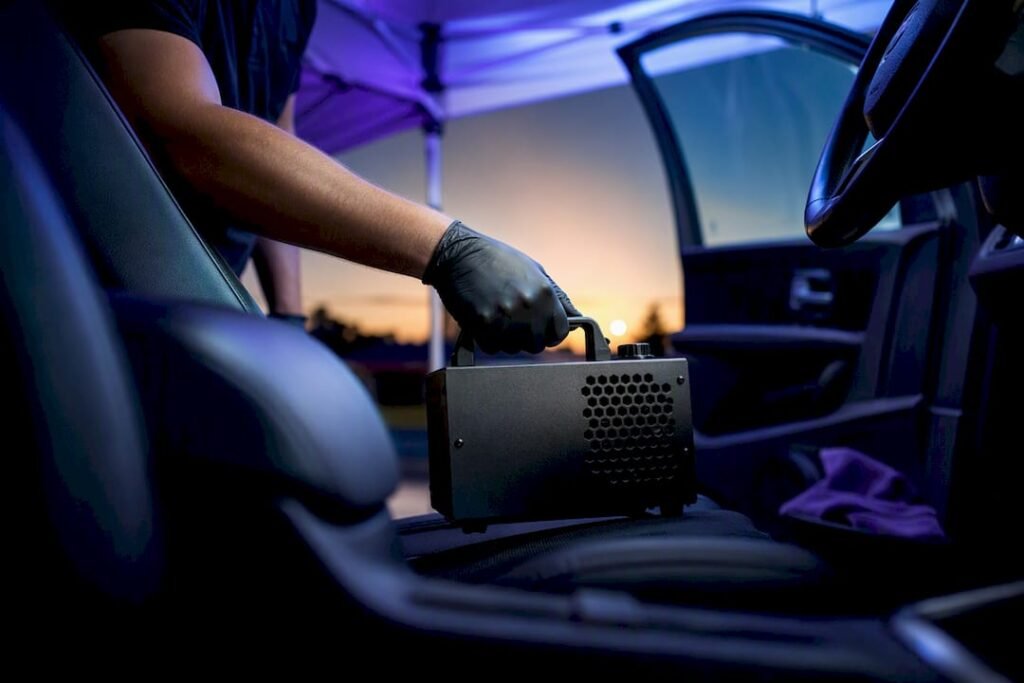
Ozone deserves its own caution. It is a powerful oxidiser that can help neutralise stubborn residue as a final polish, but public-health guidance cautions against using ozone or ionisers in occupied spaces, and it should only be run by a trained operator in an unoccupied vehicle. Ozone carries recognised workplace exposure limits, which is exactly why it is treated as a controlled, professional-only tool rather than something to run in a closed car with the windows up. It also does not penetrate tar-laden fibres on its own, so it works best applied after the fabric and surface cleaning is already done, not as a shortcut around it.

Prevention and maintenance: stop the smell returning
A clean cabin stays clean with a few consistent habits rather than another deep clean every few months.
- Keep the car smoke-free going forward: even one cigarette can redeposit residue into freshly cleaned fabric.
- Replace the cabin air filter on a regular schedule, not just after a smoke clean-up.
- Dry the interior fully after any spill, since damp fabric holds odour and encourages mould.
- Crack the windows when weather allows to keep air moving through the cabin.
- Empty and wipe out ashtrays or cupholders promptly if anyone does smoke in the car.
Why a staged, professional-first approach gets better results
Clean first, extract fabrics, replace the filter, then deodorise: skipping the order is why so many DIY attempts fail and the smell creeps back within weeks. Mobile detailers who handle odour removal regularly see the same pattern, mild jobs wrapped in a few hours, heavier cases needing a return visit or filter and foam replacement before the cabin is genuinely neutral again. Realistic expectations matter more than a quick fix.
— isaac’s
How Isaac’s Pro Detailing can help with smoke odour removal
If the smell has soaked in deeper than a weekend clean can fix, a mobile detail brings the extraction, filter replacement and controlled deodorisation together in one visit at your home, work or wherever suits you, without the drop-off hassle of a workshop booking. Relevant services include:
- Interior extraction and odour removal through the Deluxe Detail and Revival Detail packages.
- Cabin air filter replacement as part of a full interior service.
- Controlled ozone treatment applied as a final step, only once cleaning is complete.
Quotes reflect severity: a car with light residue costs less to treat than one where material replacement is genuinely the better option, and we will say so honestly rather than oversell a deodorising pass that will not hold. Get a quote through the Deluxe Detail and Revival Detail page to see what your cabin needs.
Sources
- Tobacco in Australia: third-hand smoke
- WorkSafe Victoria — ozone exposure safety
- What is a cabin air filter and why you shouldn’t forget about it
- IQAir Australia — are ionizers and ozone air purifiers safe?
FAQ
Can you fully remove smoke smell from a car?
Substantial odour reduction is usually achievable with staged cleaning covering fabrics, hard surfaces and the ventilation system, though severe or long-standing contamination may need repeat sessions or component replacement. Third-hand smoke residue settles into materials rather than sitting on top of them, which is why extraction, not just airing out, is the deciding factor.
How can I get rid of the cigarette smell in my car?
Remove debris first, then deep-clean the seats, carpets and headliner with extraction or shampooing, followed by cleaning hard surfaces and interior glass to remove the smoke film. Finish by replacing the cabin air filter and using a deodorising step only once the physical cleaning is done.
Will the smell of smoke come out of a car?
In most cases, yes, once the residue causing it is physically removed rather than masked. Ventilation and air fresheners alone will not shift third-hand smoke sitting in fabric and foam, so extraction and surface cleaning are what actually make the difference.
What do car dealers use to get rid of smoke smell?
Dealers and professional detailers typically follow the same order: extraction cleaning of fabrics, cleaning of hard interior surfaces, cabin air filter replacement, then a deodorising step such as enzyme treatment or controlled ozone. Ozone is applied only in unoccupied vehicles by trained operators, since it carries workplace exposure limits and is best used as a final polish rather than a first step.