
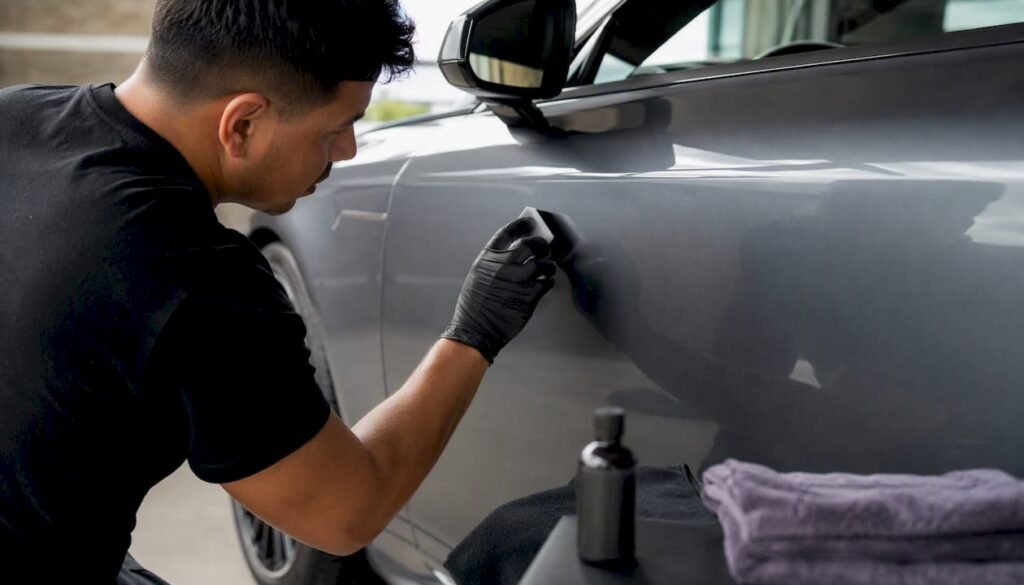
The main protective coatings for vehicles fall into eight categories: ceramic (SiO2) paint coatings, paint sealants, carnauba wax, ceramic wheel coatings, hydrophobic glass coatings, leather protectants, fabric protectants, and paint protection film (PPF). Each targets a different surface and a different threat. Ceramic paint coatings resist UV fade and chemical etching for two to seven years depending on grade. Wax lasts four to eight weeks but gives that warm, wet-look gloss sealants can’t quite match. PPF physically absorbs stone chips that no liquid coating can stop.
Here’s where each one belongs on your car:
- Paint — ceramic coatings, sealants, or wax for UV and chemical protection
- Wheels — ceramic wheel coatings for brake dust and road grime
- Glass — hydrophobic coatings for rain visibility
- Leather — protectants against UV cracking and oil transfer
- Fabric — stain and moisture repellents for carpets and seats
- High-impact zones (bonnet, mirrors, front bumper) — PPF for chip resistance
Key Takeaways
Protective coatings only perform to their rated lifespan when surface prep, product tier, and an ongoing maintenance schedule all line up correctly.
| Point | Details |
|---|---|
| Match coating to surface | Use ceramic or sealant for paint, ceramic-specific formulas for wheels, and PPF for high-impact panels like the bonnet. |
| Prep decides bond quality | Clay, decontaminate, correct, and panel wipe before any coating touches the paint. |
| Maintenance sets real lifespan | pH-neutral washing and boosters every 3 to 6 months turn a 1-year coating into a 5 to 7-year one. |
| PPF and ceramic aren’t rivals | Combine PPF on impact zones with ceramic over the full car for chip and chemical protection together. |
| Com applies coatings professionally | Mobile ceramic, wheel, leather, and fabric protection with documented prep and a maintenance plan for Sunshine Coast owners. |
Table of Contents
- What are protective coatings and how does each type work?
- How do you prepare and apply a protective coating properly?
- How do you maintain a coating once it’s applied?
- How do you choose the right coating for your car?
- What does each coating cost and how long does it actually last?
- Book a mobile ceramic coating service that protects the whole car
- Frequently asked questions
- Sources
What are protective coatings and how does each type work?
Ceramic paint coatings are silica-based polymers that chemically bond to your clear coat rather than sitting on top of it like wax does. That bond is what gives them their hydrophobic “beading” effect and resistance to bird droppings, tree sap, and UV oxidation. Not all ceramic coatings are equal, though. Professional-grade formulas typically run 70 to 100% SiO2 concentration, while consumer sprays and DIY kits often sit at 20 to 30%. That gap explains why a $50 bottle from an auto parts shop rarely performs like a studio-applied coating, even with careful application. Graphene and titanium dioxide (TiO2) variants exist too, mostly aimed at improving heat dissipation and scratch resistance slightly beyond standard silica formulas.
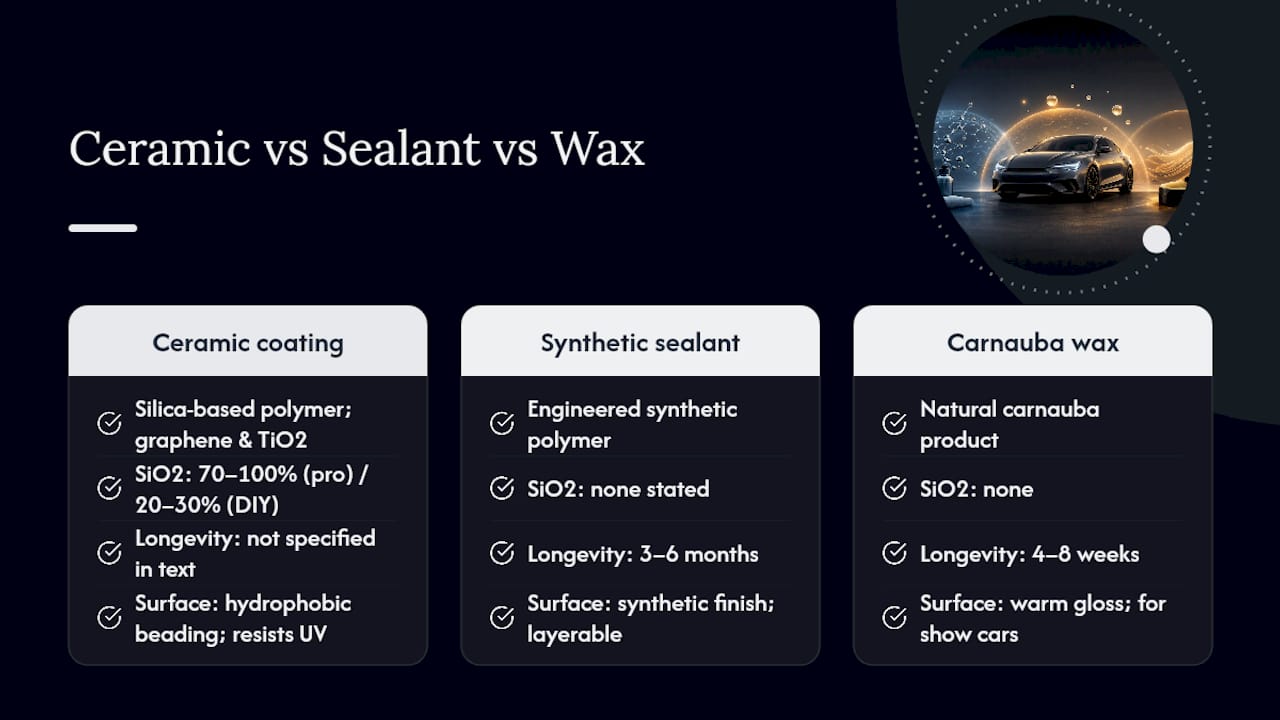
Sealants and wax sit at the more accessible end. Synthetic sealants are engineered polymers that typically last three to six months and can be layered for extra depth. Carnauba wax, by contrast, is a natural product that lasts only four to eight weeks but produces a distinctive warm gloss many owners still prefer for show cars.
Wheel coatings use a similar ceramic chemistry to paint coatings but are reformulated to withstand brake dust, which is abrasive and heat-charged, along with the acidic wheel cleaners many owners use without thinking twice. Glass coatings work on the same hydrophobic principle, causing rain to bead and roll off at speed instead of smearing across the windscreen.
Leather and fabric protectants work differently again. Rather than beading water, they typically fill or coat the fibre or leather surface to block oil, UV, and staining agents from penetrating.
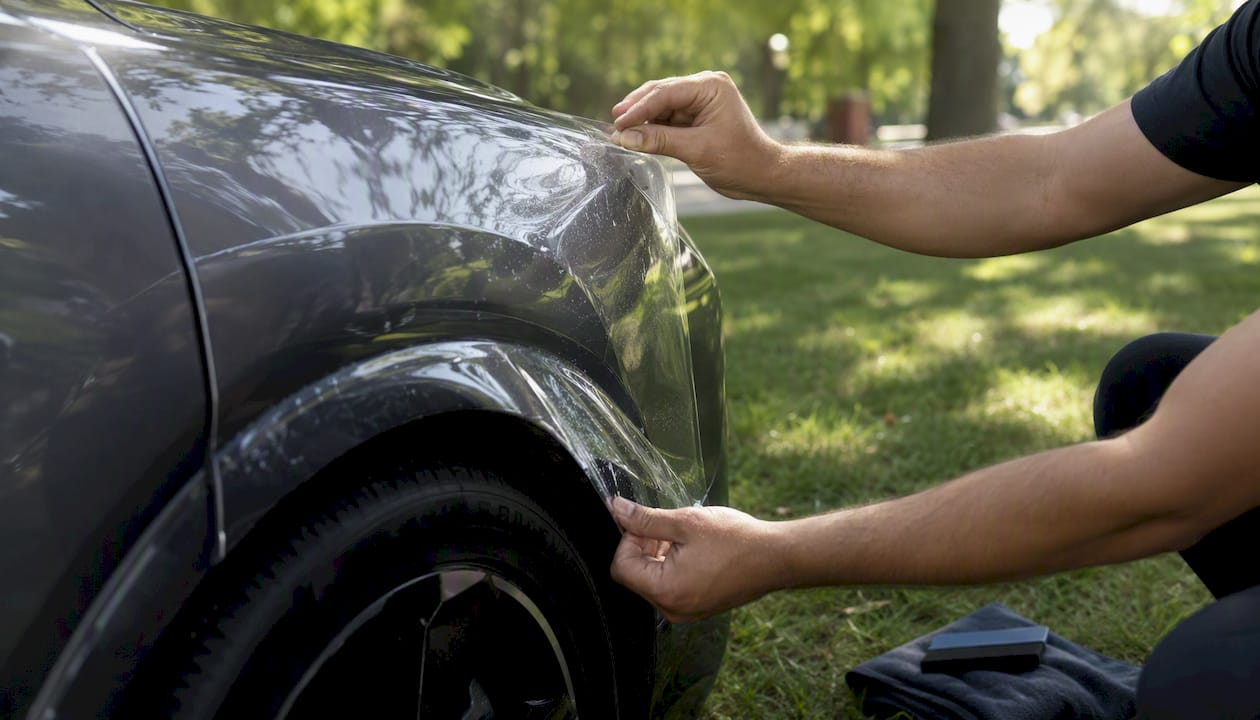
Paint protection film isn’t a coating at all in the chemical sense. It’s a urethane film that physically absorbs impact from stone chips and road debris, something no liquid coating can replicate. That’s why the professional standard for high-value vehicles is often PPF on the front end paired with ceramic coating over the rest of the car.
Pro Tip: If your car has a matte or satin finish, never use a standard gloss-enhancing ceramic coating. Matte-specific formulas exist precisely because standard coatings will add unwanted shine and ruin the factory finish permanently.
How do you prepare and apply a protective coating properly?
A coating is only as good as the surface underneath it, and skipping steps here is the single biggest reason coatings fail early. A proper prep and application sequence looks like this:
- Wash with a pH-neutral shampoo to lift loose dirt without stripping any existing protection.
- Decontaminate with an iron remover to dissolve embedded brake dust particles from the clear coat.
- Clay bar the surface to physically remove bonded contaminants a wash alone can’t shift.
- Polish or correct the paint if swirl marks or oxidation are present, since coatings lock in whatever finish is underneath.
- Panel wipe with isopropyl alcohol to strip any polishing oils that would block the coating from bonding.
- Apply the coating in controlled conditions, away from direct sun and moisture.
Every one of these steps exists to give the ceramic coating a clean, bare surface to bond with at a molecular level. Skip the panel wipe and the coating bonds to leftover polish residue instead of the clear coat itself, and it can fail within months.
Full prep for a typical sedan runs six to sixteen hours before a professional even applies the coating. After application, most coatings need a 24 to 48 hour dry cure before the car can get wet, and around seven days before the bond fully hardens. Boosters and quick detailers are usually fine within that initial window, but a full wash should wait for the manufacturer’s stated cure time.
How do you maintain a coating once it’s applied?
The prep and application matter, but maintenance is what decides whether your coating lasts one year or seven. Here’s a routine that actually works:
- Wash weekly to fortnightly using a pH-neutral shampoo and the two-bucket method, one for soap and one for rinsing your wash mitt, to avoid dragging grit across the paint.
- Skip automatic car washes with brushes. Their abrasive bristles and harsh, often alkaline detergents attack the SiO2 bond faster than almost anything else you’ll expose the car to.
- Apply a ceramic-safe booster every three to six months. Boosters add a sacrificial hydrophobic layer on top of the base coating, restoring beading without needing a full reapplication, according to Bryan Car Care’s maintenance guidance.
- Run a decontamination cycle (iron remover plus a light clay treatment) every six to twelve months, or sooner if you park under trees or near industrial areas.
- Book an annual professional inspection, especially in coastal or high-UV climates where salt air and sun exposure accelerate wear.
If you’re on the Sunshine Coast or anywhere with strong coastal salt exposure, tighten that decontamination cycle to every four to six months rather than annually.
Pro Tip: Think of a booster spray as a sacrificial layer sitting on top of your real coating. It takes the UV and chemical hits first, so the base ceramic layer underneath barely ages between full maintenance visits.
How do you choose the right coating for your car?
Your choice depends on four things: how long you’ll own the car, your local climate, how much maintenance you’re realistically willing to do, and your budget. A daily driver you’ll trade in two years from now doesn’t need the same investment as a car you plan to keep for a decade in a coastal, high-UV environment.
Before booking, ask your detailer:
- What prep steps are included, and is paint correction part of the quote or an add-on?
- What’s the cure time, and when can the car safely get wet or be driven in rain?
- Is there a warranty, and what maintenance is required to keep it valid?
Watch for detailers who skip paint correction on swirled paint, apply coating without a panel wipe, or claim a ceramic coating alone will stop rock chips. It won’t. That’s a job for PPF.
What does each coating cost and how long does it actually last?
Rough guides only, since brand, vehicle size, and prep level all shift these numbers:
- Wax — $20 to $50 DIY, 4 to 8 weeks lifespan
- Synthetic sealant — $50 to $150, 3 to 6 months
- Consumer ceramic (DIY) — $50 to $300, roughly 1 to 2 years
- Professional ceramic — $500 to $2,000+, 2 to 7+ years with maintenance
- PPF — $1,500 to $6,000+ depending on coverage, 5 to 10 years
Rated life and real-world life are two different numbers. A professional coating rated for five years can fail in eighteen months without the maintenance routine outlined above, and thin or single-coat DIY applications rarely hit their advertised lifespan at all.
Why prep and maintenance decide whether a coating actually lasts
Bonded contaminants sitting on the clear coat create microscopic high points. A coating applied over them bonds unevenly, leaving weak spots that fail first, well before the rest of the panel does.
- Acidic and alkaline cleaners break down the SiO2 network, which is why pH-neutral soap isn’t just a preference.
- Multiple thin coating layers plus scheduled boosters consistently outlast a single thick application.
A mobile detailer’s view on professional application
Applying a coating is one thing. Applying it in controlled, contaminant-free conditions with a documented process is another. That gap is where mobile professional service earns its keep, particularly for owners who want a repeatable maintenance record behind their warranty.
Book a mobile ceramic coating service that protects the whole car
There’s a real gap between what a DIY ceramic spray promises on the bottle and what it delivers in an unshaded driveway with leftover polish still on the paint. Com handles the full spectrum: paint ceramic coatings, wheel coatings, leather and fabric protectants, and PPF-ready prep for high-impact panels, all done on-site at your home, workplace, or wherever your car happens to be parked.
Booking follows a simple flow. You get a quote based on vehicle size and condition, Com’s team handles decontamination and paint correction where needed, then applies the coating under controlled conditions with a stated cure window and a follow-up maintenance plan so the warranty actually holds up over time. That documented process, from the wash menu options right through to the full ceramic coating workflow, is what separates a coating that lasts two years from one that lasts seven. If your paint, wheels, or interior are due for real protection rather than another bottle of spray wax, request an inspection and get a maintenance plan built around your car and your climate.
Frequently asked questions
What are the most common examples of protective coatings for cars?
Ceramic paint coatings, synthetic sealants, carnauba wax, ceramic wheel coatings, hydrophobic glass coatings, leather and fabric protectants, and paint protection film cover the main options most owners choose between.
Do ceramic coatings stop rock chips and scratches?
No. Ceramic coatings protect against UV fade, chemical etching, and staining, but only PPF absorbs the physical impact of stone chips.
How long does a professional ceramic coating actually last?
With proper prep and a consistent maintenance routine, professional coatings commonly reach two to seven years, compared to one to two years for most consumer or DIY kits.
Can I use regular car shampoo on a ceramic-coated car?
Stick to pH-neutral shampoo. Acidic or alkaline products can weaken the SiO2 bond over time and shorten the coating’s effective life.
Is wax or sealant better for everyday protection?
Sealants generally last longer, around three to six months versus wax’s four to eight weeks, though wax gives a warmer gloss many owners still prefer for show finishes.
Sources
- DIY Ceramic Coating Vs Professional | Which One is Right For You | Precision Auto Aesthetics
- How Effective Is Ceramic Coating for Car Protection? The 2026 Real-World Performance Guide
- Ceramic coating maintenance (Chemical Guys blog)
- Protection detailing guide (Detailed Image)
- Ceramic Coating Maintenance Guide | Bryan Car Care