

The best coating installer for your car is the one who treats paint preparation as the main job, explains the product and the curing process in plain words, and applies it somewhere clean and controlled. On the Sunshine Coast, that also means someone who understands salt air, strong UV and humid summers. This guide sets out what to look for, in the order it matters, so you can pick with confidence.
A quick note on terms: searches for “coating installer” also bring up powder coating, epoxy floors and cladding. This article is only about automotive coatings: ceramic, graphene and similar paint protection for cars, 4WDs and utes.
TL;DR
- Paint preparation (wash, decontamination, correction) decides how a coating looks and lasts. Judge an installer on prep before you judge the product.
- A good installer tells you which product goes on, how long it cures, when you can wash the car and how to maintain it.
- Coastal conditions make UV, salt and bird droppings the real enemies. A coating is a sacrificial-free barrier that makes them easier to wash off, not an armour plate.
- A mobile installer can work at your home or workplace, but needs shade or cover, water and power, and the right insurance.
- We apply ceramic, graphene and leather coatings across the Coast. See the ceramic coating page for details.
Table of Contents
- What a ceramic coating actually does
- Why the Sunshine Coast is a coating-friendly place
- Seven things to check when choosing an installer
- What affects the price of a car coating
- Perspective: why prep and protection belong together
- Protecting more than the paint
- Looking after a coated car
- Book a coating on the Coast
- FAQ
- Sources
What a ceramic coating actually does
A ceramic coating is a liquid applied to the paint that cures into a hard, thin layer bonded to the surface. The Drive describes it as a long-term, nanoscopic treatment that chemically bonds with the paint and can fill very small scratches and level the surface. The same article is clear that it cannot protect against serious damage.
In practice that gives you:
- Water beading and easier washing. Dirt, salt film and bugs release more readily.
- Depth and gloss. The paint looks wetter and cleaner for longer.
- UV resistance. Important where paint fades and oxidises under strong sun.
It is not a replacement for paint protection film (PPF) if your main worry is rock chips on a highway-driven car. Many owners choose a coating for the whole car and add film on high-impact areas. Wax sits at the other end: quick to apply and warm in finish, but it needs frequent reapplication. A coating is the step up when you want longer-lasting protection with less upkeep.
Why the Sunshine Coast is a coating-friendly place
Cars here live in a demanding environment. Daily UV, sea air near the beaches and river estuaries, afternoon storms, pollen, bugs on the Bruce Highway and sap or bird droppings under trees all work on the clear coat. Parking at the beach, at a marina or under a carport near the water brings salt film onto paint, glass and wheels.

A properly applied coating gives that grime less to grip. Washing becomes quicker, and the paint stays glossier between details. That is why we also coat wheels and treat leather: the whole car is exposed, not just the bonnet and roof.
Seven things to check when choosing an installer
1. How they prepare the paint
Coatings lock in whatever is under them. If there is swirling, oxidation or bonded contamination, it gets sealed beneath a hard layer. A good installer will describe their prep sequence without being asked:
- A thorough wash, including wheel arches and door shuts.
- Chemical decontamination, such as iron removal, to dissolve embedded metal particles.
- Clay or equivalent mechanical decontamination.
- Machine polishing to correct defects, matched to the paint’s condition.
- A panel wipe to remove polishing oils so the coating bonds.
Our cut and polish service is designed to be the foundation for coating work, and iron removal is part of our service range. If an installer skips straight to application on unprepared paint, the finish will reflect it.
2. What product they use, and what it is designed to do
You should be told the product name, what it is made of (ceramic, graphene-enhanced and so on) and what the manufacturer says about its design life and care. Claims differ between formulations and depend on maintenance, so a good installer talks about the specific product, not a generic promise of “lifetime” protection.
We apply premium ceramic coatings and describe our application as certified. We also offer a graphene spray sealant package, listed at $339 to $739 depending on vehicle size, for owners who want a lighter step up in protection.
3. The curing process and what you must do afterwards
This is where owners most often go wrong, so a good installer briefs you before and after. Curing data comes from manufacturers, and they differ. Koch-Chemie’s technical page for its Ceramic Body Cb0.01 coating states it is only weatherproof after at least 24 hours and should not be washed for the first time until nine days at the earliest. It adds that curing takes longer below 15°C and that very acidic or alkaline cleaners (pH below 3 or above 12) should be avoided. Your installer’s product may have different figures, which is why the briefing matters.
The sensible rules of thumb:
- Keep the car under cover, or at least out of rain and sprinklers, for the first day.
- Hold off washing until the installer’s stated time has passed.
- Avoid parking under trees where sap and droppings land during early cure.
Sunshine Coast mornings are rarely colder than 15°C for much of the year, which helps, but humidity and storms still matter. This is one reason to plan a coating around the forecast.
4. Where the work happens
An indoor workshop and a mobile service can both deliver excellent results, provided the conditions are controlled. For a mobile installer that means shade or cover, no direct sun on hot panels, no wind blowing dust onto wet product and good lighting to inspect the paint. Before you book, a good mobile installer will ask about your car’s parking spot, access to power and water, and whether the site is covered.
We are fully mobile and come to your home or workplace. A garage, carport or shaded driveway is ideal, and we will talk through your setup when you enquire.
5. Insurance and compliance
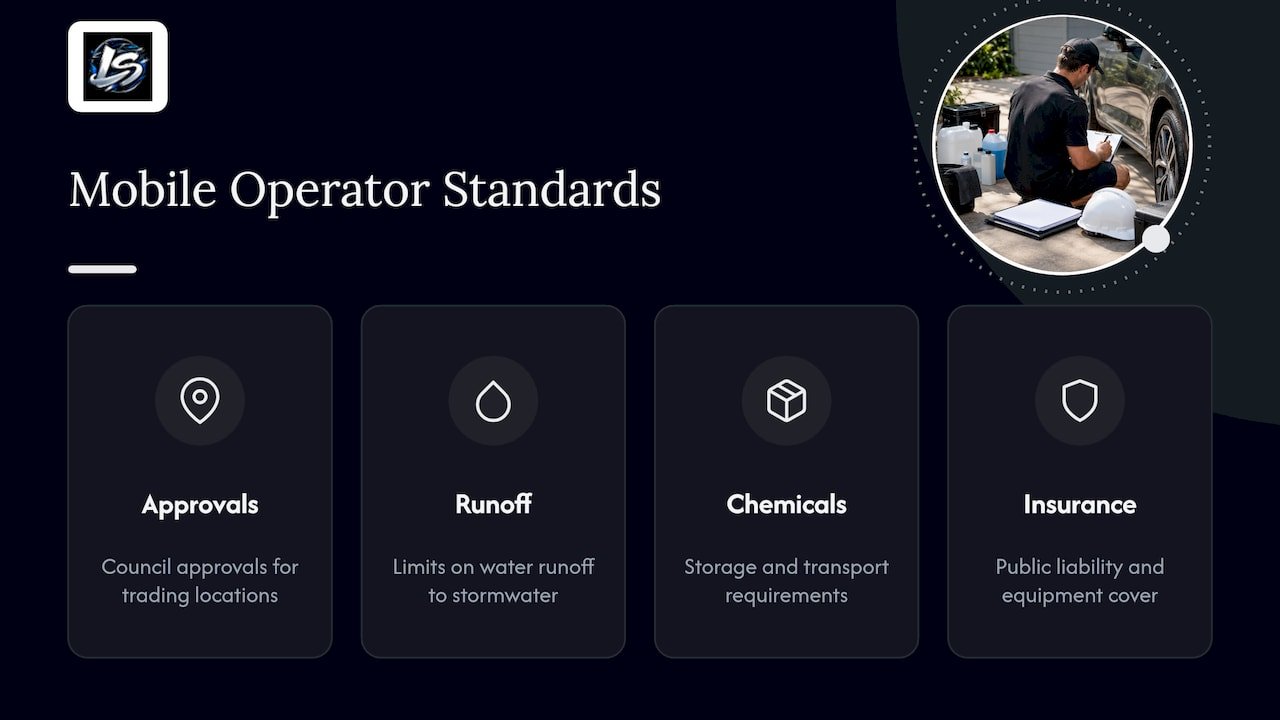
Mobile detailers working on your property or at an office should be properly set up. Sprintlaw’s Australian guide notes that mobile detailing businesses should consider council approvals for trading locations, environmental rules (including limits on water runoff to stormwater), chemical storage and transport requirements, noise rules and insurance such as public liability and equipment cover. These are the standards a professional mobile operator works to, and they are reasonable things to raise in a conversation about your booking, especially if the car is at a workplace or strata property.
We use eco-friendly products in our detailing, which suits the stormwater-conscious approach that mobile work calls for.
6. Clear scope and clear pricing
A coating quote should say what is included: how much correction, which panels, whether wheels, glass and trims are coated, whether interior or leather is covered, and what aftercare is supplied. Beware of quotes that list only the coating and leave prep as an extra.
We publish pricing for many of our services and keep our packages all-inclusive, with no hidden extras. For ceramic coating, we quote based on your vehicle, its size and the condition of the paint, so the price matches the work needed.
7. Reviews that describe the work
Look for reviews that mention the car, the finish and how the installer communicated. Photos of before and after on dark paint are the most telling because dark colours show every flaw. Our Google listing shows 4.9 stars from 70 reviews, and our customer testimonials are on our website.
What affects the price of a car coating
Prices vary because the work varies. The main factors are:
- Vehicle size. A hatchback needs less product and time than a large SUV or dual-cab ute.
- Paint condition. Heavily swirled or oxidised paint needs more correction before coating.
- Product and design life. Longer-rated coatings and multi-layer systems cost more.
- Extent of coverage. Paint only, or also wheels, glass, trims and leather.
- Add-ons. Interior treatments, odour removal and fabric protection.
Here are our published prices for related services. Ceramic coating and cut and polish are quoted to the vehicle, so we do not list a fixed price for them.
| Service | Published price |
|---|---|
| Graphene spray sealant coating package | $339 to $739 |
| Deluxe Detail | $375 to $575 |
| Revival Detail | $575 to $775 |
| “Holy Grail” detail | $600 to $1,000 |
| Ultimate Protection Package | $1,500 to $2,200 |
| Leather ceramic coating | $50 per seat |
| Fabric Guard | $25 per seat |
| Professional Mobile Underbody Wash | $50 |
The underbody wash is a smart addition for beach drivers, since salt and sand collect in places a normal wash never reaches.
Perspective: why prep and protection belong together
We started Isaac’s Pro Detailing because most cars on the Coast are washed quickly and protected rarely. Express detailing gets a car looking clean on the day. It does not deal with the paint underneath or with what the sun and salt will do next month.
Our approach is to treat the car as a system. We decontaminate, correct the paint where it needs it, then protect it, and we do it at your place so you do not lose half a day driving to a workshop. Because we are mobile, we can work in the shade of your own driveway or at your workplace while you get on with your day.
We stand behind the work with a 100% satisfaction guarantee, and we keep our protection packages all-inclusive. We also choose eco-friendly products, which matters to families with kids and pets and to anyone who cares what ends up in the stormwater drain.
If you want the paint, wheels and leather protected properly and in one visit, that is exactly what we are set up to do.
isaac’s
Protecting more than the paint
A coating is most useful when it covers the surfaces that take the most punishment.
- Wheels. Brake dust and road grime bake onto wheels. A coating makes them far easier to clean.
- Leather. Sun and body oils age leather seats. We offer a leather ceramic coating at $50 per seat.
- Fabric. Our Fabric Guard at $25 per seat helps resist spills, which is handy for families and pet owners.
- Odours. Ozone deodorisation addresses smells from pets, smoke or damp, and we pair it with seat and carpet extraction.
- PPF removal. If an old film is yellowing or lifting, we can remove it before re-protecting the paint.
Looking after a coated car
Maintenance is simple but worth doing consistently.
- Wash by hand with a pH-appropriate shampoo. Koch-Chemie’s guidance is to avoid very acidic or alkaline cleaners and to hand wash to keep the gloss for longer, as noted on its product page.
- Rinse salt off quickly after beach trips, including the underbody.
- Remove bird droppings and bugs promptly rather than letting them bake in the sun.
- Use soft microfibre towels and avoid abrasive brushes or automatic brush washes.
- Book periodic maintenance so the surface stays slick and free of bonded contamination.
Coatings are not a physical shield against stone chips or deep scratches. If you want impact protection on the front end, discuss PPF with your installer alongside the coating.
Book a coating on the Coast
If you want a coating applied at your home or workplace by someone who focuses on preparation, we would be glad to help. Our ceramic coating service covers paint, wheels and leather, and our Ultimate Protection Package is priced from $1,500 to $2,200 depending on your vehicle.
Call Isaac on 0468 075 012 or visit our website to book. We are based at Currimundi and travel across the Sunshine Coast.
FAQ
Is ceramic coating worth it on the Sunshine Coast?
For most owners who park outside or drive to the beach, yes. A coating adds gloss and makes washing off salt, bugs and grime easier. It works best on properly prepared paint and with regular hand washing.
How long before I can wash my car after a coating?
It depends on the product. One manufacturer states a first wash no sooner than nine days after application, and weatherproofing only after 24 hours. We give you the exact timing for the coating we apply on the day.
Can a coating be applied at my home?
Yes, with the right conditions. We work at homes and workplaces across the Coast, and shade or cover, access to power and water, and a reasonably level spot help us deliver the finish you want.
Does ceramic coating replace paint protection film?
No, they do different jobs. A coating adds gloss, UV resistance and easy cleaning, while film is a physical layer for rock chips. Many owners combine the two, with a coating over the whole car.