
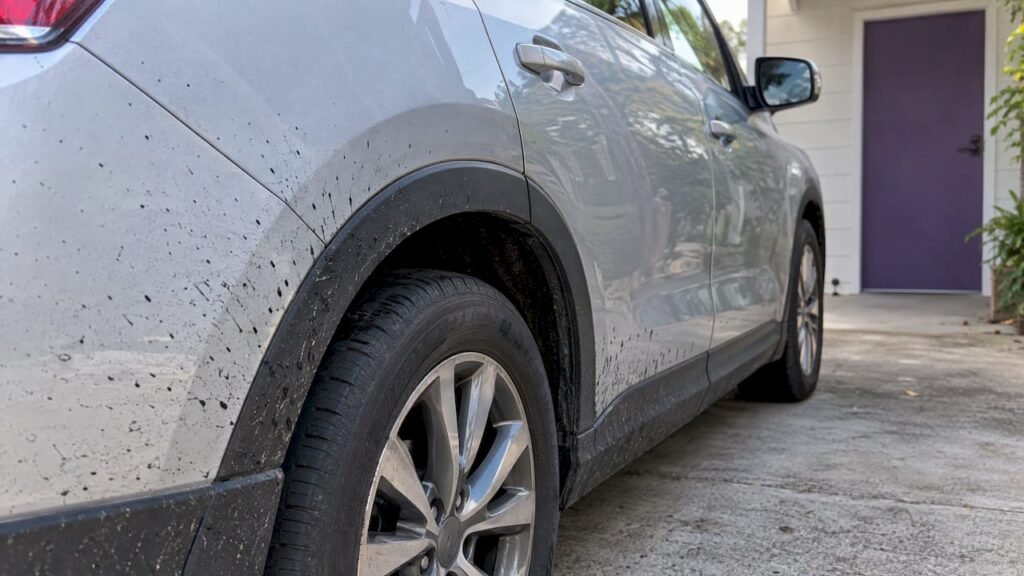
Bitumen splatter comes off safely with a solvent that dissolves the tar, a patient dwell time and a soft microfibre cloth, never with scrubbing or household cleaners. Fresh specks on a clean panel are a short job. Heavy spray after roadworks, old baked-on deposits, or tar sitting on a ceramic-coated or waxed car are where paint gets marked, and where having it done properly at your home or workplace saves the paint and your weekend. Below is the full routine, where each step goes wrong, and when to book a detailer.
TL;DR
- Tar repels water, so car shampoo alone will not shift it. You need a solvent made to dissolve bitumen.
- Wash first, spray the remover on, let it dwell for about a minute, then wipe in one direction with a clean microfibre. Do not rub.
- Keep solvents off hot panels and out of direct sun, and never use metal tools on paint or wheels.
- Rewax or reseal afterwards, because tar remover can strip protection.
- Heavy roadwork spray, old tar, or a coated car is a job for a professional. Our mobile detail packages come to you on the Sunshine Coast.
Table of Contents
- What bitumen splatter is and where it lands
- Why a normal wash does not work
- Step by step: how to remove bitumen splatter safely
- Surface by surface: paint, glass, trim and wheels
- What to avoid
- Tar on a ceramic-coated or waxed car
- A worked example: roadworks spray on a family SUV
- When to hand it to a professional
- Get the whole car sorted at your place
- FAQ
- Sources
What bitumen splatter is and where it lands
Bitumen is the black binder that holds road asphalt together. When a road is freshly sealed or patched, tyres flick small hot or softened droplets up the car. They land as black dots and streaks, mostly on the wheel arches, sills, lower doors and the rear of the car. Selleys notes that tar typically collects on wheel wells and lower panels, and that left alone it can trap moisture and contaminants against the surface, which over time leads to corrosion and rust.
So it is worth more than a cosmetic fix. Fresh splatter is soft and responds quickly. After a few weeks of Queensland sun it hardens and bonds harder, and the same job takes longer and carries more risk to the paint.
Road tar looks different to other marks. It is glossy to matte black, slightly raised when you run a fingertip over it, and it often comes in clusters of dots rather than a single smear. Bird droppings are lumpy and pale, bug splatter is brown and crusty, and brake dust is a dull grey-brown film. If it is black, sticky or rubbery and sits in the lower third of the car, it is almost certainly tar.
Why a normal wash does not work
Tar is non-polar and hydrophobic, which means water-based shampoo simply beads off it. A solvent that penetrates and liquefies the bitumen is what lifts it. This is also why scrubbing is the classic mistake: you drag hard particles across the clear coat while the tar itself barely moves, leaving fine scratches around every dot.
Household cleaners are no better. Kitchen degreasers and harsh solvents can dull clear coat and stain trim, and they are not made for automotive paint.
Step by step: how to remove bitumen splatter safely
If you want to do a light job yourself, this is the routine. Each step shows where people go wrong.
1. Work in the shade on a cool panel
Park in shade and make sure the panels are cool. Strong chemicals must not dry on the paint, and direct sun makes that happen fast. This is easy to underestimate on the Sunshine Coast, where a panel in the afternoon sun can be too hot to touch. Wheels need extra care: Selleys says never to apply solvents to wheels still hot from driving and to allow at least 30 minutes for them to cool, to prevent flash-off staining.
2. Wash and dry the area first
Rinse and wash the affected panels so grit is not dragged around under your cloth. Bowden’s Own instructs washing and drying the tar-affected areas before applying remover. Skipping this step is the quickest way to put swirl marks in the paint.
3. Choose a dedicated tar remover
Use a product made for tar, not a general-purpose spray. One note from the research: two-in-one bug and tar products tend to be less targeted than a dedicated remover. Check the label for the surfaces it is safe on. For example, Gyeon’s Australian product page states its pH-neutral remover is safe on paint, glass, plastic trim and ceramic-coated surfaces, while other removers specifically warn against use on clear protective film, sensitive plastics or rubber trim. The label is your guide.
4. Apply and let it dwell
Spray the remover directly onto the tar so each dot is covered. Dwell time varies by product and by how old the tar is:
| Situation | Typical dwell | Source |
|---|---|---|
| Fresh, light specks | 1 to 2 minutes | Bowden’s Own |
| Standard deposits | 30 to 60 seconds | Selleys |
| Hardened tar | 3 to 5 minutes, reapplying if the panel dries | Selleys |
Always follow the time on your product’s label. The remover should never dry on the panel. If it starts to, spray more and keep it wet.
5. Wipe in one direction, no scrubbing
Use a damp, low-pile microfibre cloth and wipe in straight passes with light pressure. Flip to a clean face of the cloth on every wipe so you are not rubbing dissolved tar back across the paint. If the tar has not moved, do not push harder. Reapply and wait.
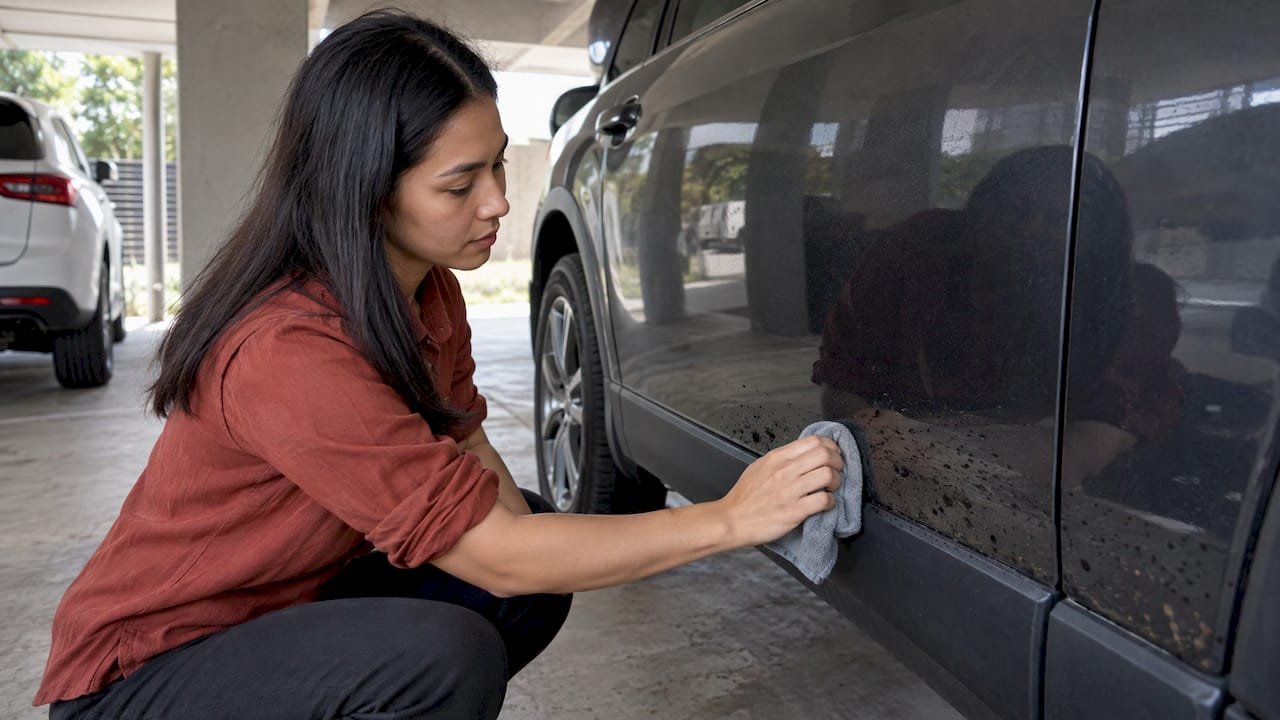
6. Repeat on larger or older deposits
On big or old blobs, the remover only penetrates the outer skin of the tar at first. Bowden’s Own explains that the process must be repeated patiently, and that only rock-hard tar that shows no softening should be escalated to a clay bar or claying rubber. Impatience is where most damage happens here.
7. Rinse and wash again
Rinse thoroughly, then wash the area with car shampoo to remove solvent residue and dry it. Leftover solvent can stain trim and dry out seals.
8. Restore the protection
This is the step most people skip. Solvents dissolve wax as well as tar. Bowden’s Own recommends washing the treated areas, drying them and reapplying wax or paint sealant. If the car carries a coating, check the product label: the Auto Finesse guide notes that some tar removers may reduce wax durability or partly weaken ceramic protection.
Surface by surface: paint, glass, trim and wheels
The same tar behaves differently depending on where it lands.
- Paint: Use the routine above. Never use metal blades or scrapers. TNZ’s workshop bulletin advises avoiding metal tools and strong solvents on painted surfaces and alloy wheels, and suggests plastic scrapers only for thick deposits.
- Glass: Apply the remover to a cloth rather than spraying it on the glass, so it does not run onto the rubber seals around the windscreen.
- Rubber seals and trim: Some solvent removers dry out rubber with repeated use, so condition the seals with a compatible protectant afterwards.
- Wheels and wheel arches: These collect the most tar. Let the wheels cool first, and keep to products that state they are safe on your wheel finish.
- Pressure washing: If you use water pressure, keep it low and angled to the surface, as the TNZ bulletin advises.
For a wider look at keeping the rest of the car in order, these car care best practices for busy drivers cover the surface precautions that matter around tar removal.
What to avoid
- Scrubbing dry tar with a rough cloth or sponge.
- Using household cleaners, petrol or thinners on paint.
- Working in full sun or on hot panels.
- Letting the remover dry on the surface.
- Using a metal razor on paint or wheels.
- Leaving the area unprotected afterwards.
Using a home hack like peanut butter or WD-40 is common advice online, but those leave oily residue that has to be washed off and that can interfere with wax or sealant. A purpose-made tar remover is the cleaner route.
We have also written a safe DIY method for removing tar from car paint that goes through the same ground in more detail.
Tar on a ceramic-coated or waxed car
Protection helps here, but it does not make tar harmless. The Auto Finesse guide says tar can bond to ceramic-coated or waxed surfaces, especially in warm weather, and can stain and gradually degrade the protection. Its advice is to tackle light tar early, during the pre-wash and contact wash, to remove tar as soon as you notice it, and to wash every one to two weeks to prevent buildup.
If your car is coated, harsh aggressive removal can do more harm than the tar. We cover what can go wrong with coatings in our guide to ceramic coating removal risks.
A worked example: roadworks spray on a family SUV
Say you drive a family SUV along a freshly sealed road on a hot afternoon. By the time you park, there is a fine spray of black dots along both sills, the rear doors and the back of the rear bumper, plus a few larger blobs in the front wheel arches.
The careful DIY route takes time. Wait for the panels to cool, wash and dry the lower half of the car, then spray and dwell, wipe, and repeat on each cluster. On a fresh spray across a few panels that can be an hour or more once you include rinsing, a second wash and resealing the lower panels. If the dots have baked for weeks, you may be repeating the dwell and wipe cycle several times per panel, and each repeat is a chance for a rushed wipe to mark the paint.
That is the point where many owners decide their time is better spent elsewhere.
When to hand it to a professional
Book a detailer when:
- The spray covers several panels or the whole lower half of the car.
- The tar is old, hard and has not softened after repeat applications.
- The car has a ceramic coating, a graphene coating or protective film you do not want to compromise.
- You see dull patches, staining or faint scratches after an attempt.
- You do not have the shade, time or space at home.
Even the product makers point this way. Gyeon’s maintenance guide directs owners to a certified detailer for contamination that survives washing and chemical decontamination.
Our view: tar is a paint-protection problem, not just a cleaning job
We treat road tar as part of how long your paint lasts. The black dots are the visible part, but what happens after the tar comes off matters just as much: the finish underneath has to be clean, and the surface has to be protected again so the next spray does not bond as hard.
That is why we work from the whole car rather than the single spot. Our mobile service brings professional detailing to your home, work or the beach, with eco-friendly products, so you do not need to lose a day to it. Our offering spans exterior washing, cut and polish, iron removal and ceramic coatings for paint, wheels and leather, which is the toolkit for a car that has been through roadworks and needs to look and stay right.
If you are going to invest in protecting your paint, protect it properly. A coated or sealed car is easier to keep clean, and tar and other road contamination are easier to deal with on it.
isaac’s
Get the whole car sorted at your place
If the splatter has spread, or you would rather not spend the weekend on the driveway, our mobile detailing comes to you anywhere on the Sunshine Coast. Our Deluxe Detail is priced from $375 to $575 depending on vehicle size, and our Revival Detail runs from $575 to $775. For long-term protection after the paint is clean, our Ultimate Protection Package is $1,500 to $2,200. Mention the tar when you book and we will take it from there.
If the paint has dulled or marked around old tar, our cut and polish service is the next step to restore the finish.
FAQ
What is the best way to remove asphalt or bitumen from car paint?
Wash and dry the area, spray a dedicated tar remover on the tar, let it dwell for the time on the label, then wipe gently in one direction with a clean microfibre. Repeat on stubborn spots rather than scrubbing, then wash again and reseal the area.
Will bitumen or tar damage my car paint?
Left for long periods it can. Tar can stain and harden on the surface, and it can trap moisture and contaminants against the panel, which over time contributes to corrosion. Removing it early, while it is soft, is the safest approach.
What does road tar look like on a car?
It shows as small black, sticky or slightly raised dots, often in clusters, mostly along the lower doors, sills, wheel arches and rear of the car. A fingertip will feel the bump, unlike a flat dirt mark.
Can I use WD-40 or household cleaners on tar?
Household cleaners are not made for automotive paint and can dull clear coat or stain trim, so avoid them. Some owners use oily products like WD-40, but they leave a residue that must be washed off and can affect wax or sealant. A purpose-made tar remover is the cleaner choice.
Sources
- Selleys: How to remove bugs and tar from your car without damaging the paint
- Bowden’s Own: Easy and effective tar removal
- TNZ workshop bulletin: Removing tar from tyres and vehicles
- Gyeon Australia: Tar Redefined
- Gyeon maintenance guide
- Auto Finesse: Car paintwork decontamination kit