
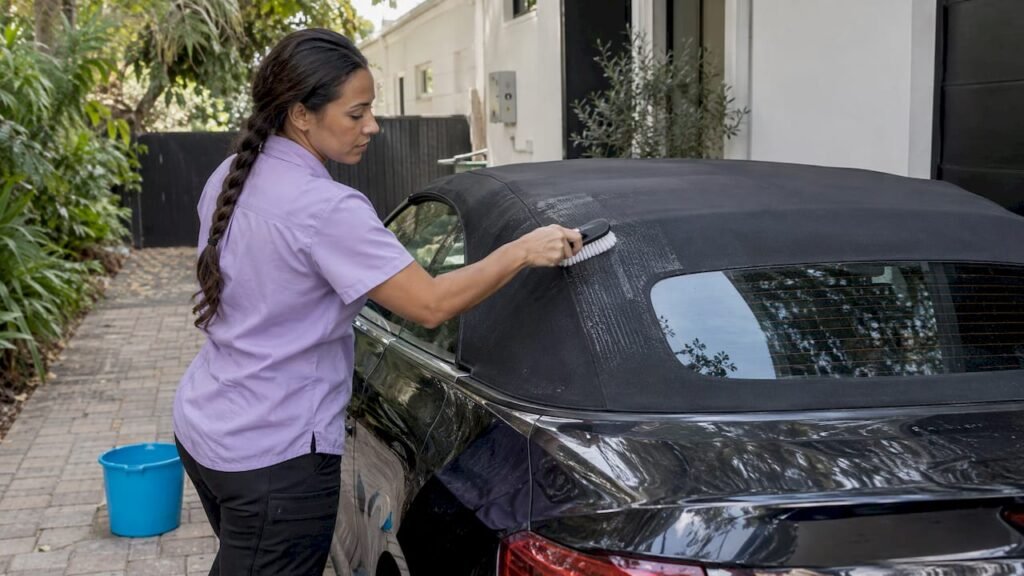
A fabric convertible roof is cleaned by hand, with cool water, a soft brush and a gentle cleaner made for soft tops, then rinsed well and dried completely before the roof goes down. It never goes through an automatic wash, and it never meets a pressure wand up close. Most roof damage comes from shortcuts: stiff brushes, household cleaners, a hot day and a roof left to dry with the cleaner still in it. If you would rather have your car looked after at home by someone who works on cars every day, we come to you anywhere on the Sunshine Coast. Below is the full method, so you know exactly what a good clean involves, whoever does it.
TL;DR
- Wash a soft top by hand with cool water, a soft brush and a neutral, soft-top-safe cleaner. Never use alcohol, bleach, solvents or household detergent.
- Automatic car washes and close-range pressure washing are the quickest ways to abrade the fabric and encourage leaks.
- Rinse thoroughly and dry the roof completely before lowering it, or you trap moisture and invite mould.
- Clean regularly and re-protect the fabric, because the factory water-repellent finish wears off over time.
- Our mobile service brings the car care to your driveway, workplace or beachside park, so the roof gets attention without a day lost at a workshop.
Table of Contents
- Why a soft top needs different treatment from paint
- What you need before you start
- How to clean a convertible fabric top, step by step
- What to keep away from your roof
- How often should you clean and protect the roof?
- Faded black roof, green patches, musty smell
- When it is worth having the roof done for you
- Our view on soft tops and detailing
- Our mobile detailing options
- FAQ
- Sources
Why a soft top needs different treatment from paint
Paint is a hard, sealed surface. A fabric roof is a woven material with a water-repellent finish on top, and often a lining and seams that must stay watertight. Every step that is harmless on a bonnet can hurt here: a stiff brush fuzzes the weave, a strong detergent strips the finish, and a jet of water forced into a seam finds its way into the cabin.
That is why manufacturers are specific. Ford’s owner guidance for convertible tops says to use a high-quality convertible top cleaner and protectant, to remove loose fuzz with a vacuum and a soft brush attachment, and to avoid stiff-bristle brushes, abrasive cleaners, hot commercial waxes and high-pressure or wand-type washes. It also says never to lower and stow the top while it is wet.
Mazda’s 2024 MX-5 owner’s manual says much the same thing from the other direction. It states that automatic and high-pressure car washes are harmful to the top, and that alcohol, chlorine bleach and organic solvents such as thinner, benzene or petrol cause discolouration or stains. Its recommended routine is to remove dust with a soft brush, clean gently with a synthetic neutral detergent and plenty of water, rinse thoroughly and dry before lowering.
Two different carmakers, one message: gentle, wet, by hand, and dry before you fold it away.
What you need before you start
A safe clean needs very little, but the right little:
- A soft-bristle brush with a head that will not scratch (a super-soft detailing brush, not a scrubbing brush).
- A vacuum with a soft brush attachment for loose dirt and fuzz.
- A cleaner made for fabric convertible tops, or a neutral detergent if your manual specifies one.
- Clean, cool water from a hose, and a bucket.
- Two or three clean microfibre towels for patting the fabric dry.
- Shade. A cool roof stops cleaner drying into the fabric and leaving streaks.
Check your owner’s manual first. Some roofs are vinyl rather than fabric, and the care for each is different. If you are unsure which you have, the manual or the badge on the roof lining will usually say.
How to clean a convertible fabric top, step by step
1. Remove loose dirt dry
Vacuum the roof with a soft brush attachment, then go over it lightly with a dry soft brush. Cottonwood fluff, leaves, grit and dust are abrasive when wet and rubbed in, so lift them off first. Pay attention to the channels and seams where debris collects. The common mistake is skipping this and going straight to a wet scrub, which grinds the grit into the weave.
2. Pre-rinse gently
Wet the roof with cool, low-pressure water. Carsales’ guidance for Australian owners is to wash convertibles by hand with cold or tepid water only. Hot water can set stains and stress the finish. Keep the hose on a soft shower setting, and do not point it into the seals or the gap where the roof meets the windscreen frame.
3. Apply the cleaner and brush with the grain
Work one section at a time. Apply a soft-top-safe cleaner and brush lightly in straight, side-to-side strokes along the fabric rather than in circles. Do not scrub harder when something stubborn appears. Let the cleaner work, then repeat.
Avoid anything not made for the job. Mazda’s manual rules out alcohol, bleach and solvents, and Ford rules out abrasive cleaners. Household products, vinegar and dishwashing liquid strip the roof’s water-repellent finish, and strong soaps can leave the fabric harsh.
4. Treat the stubborn spots
Bird droppings, tree sap and gum are acidic and can mark the fabric if left, so carsales advises removing them as soon as possible. For marks that remain after a normal wash, give the spot a second application of cleaner and more time to work, rather than more pressure. A roof with green algae or mould may need two or three rounds. Check the seams and the folds, where moisture sits longest.
5. Rinse every trace of cleaner out
Rinse each section before the cleaner dries, from the top down, until the water runs clear. Leftover cleaner attracts dirt and can leave a stiff, blotchy finish. This is the step most often rushed.
6. Dry before you lower the roof
Pat the fabric with a clean microfibre towel and let the roof air dry fully, ideally in the shade with a breeze. Both Ford and Mazda are clear that a wet top should not be folded away. A damp roof stowed in a dark roof well is how mildew starts, and in humid Queensland weather it starts quickly.
What to keep away from your roof
| Avoid | Why it harms a soft top |
|---|---|
| Automatic brush or jet car washes | Brushes and jets abrade the fabric and can encourage leaks, according to carsales |
| Close-range pressure washing | Ford warns against high-pressure and wand-type washes; water can be driven into seams |
| Alcohol, bleach, solvents, thinners | Cause discolouration and staining, per Mazda’s manual |
| Stiff brushes and abrasive cleaners | Fuzz and wear the weave |
| Hot commercial waxes | Not suitable for fabric tops, per Ford |
| Stowing the roof wet | Traps moisture, which leads to mould and odour |
The pressure question comes up constantly. We cover the difference between the two methods for paint in our pressure wash versus hand wash guide, and for a fabric roof the answer leans even harder towards the hand.
How often should you clean and protect the roof?
Little and often beats a rescue job. Carsales suggests making the roof a priority about every six months, and says an appropriate soft-top protectant helps preserve colour and texture and keeps the surface cleaner for longer. In between, a light brush-off when you wash the car keeps dust and fluff from bedding in.
In practice, on the Sunshine Coast, the roof works harder than it would in a cooler, drier place. Sun, salt air, pollen, bird droppings from trees and humid nights all land on it. If the car is parked outside, expect to clean it more often than the six-month minimum. Our guide on how often a car needs a detail explains how local conditions change the schedule, and our tips for keeping a car clean between details covers the small habits that help.
Protection matters as much as cleaning. A fabric roof’s factory water-repellent finish does not last forever. Once it fades, water soaks in rather than beading, dirt holds on, and the next clean is harder. Re-proofing after a thorough clean puts the barrier back. Never apply protectant over a dirty roof: it seals the dirt in. Our write-up on cleaning first and protecting afterwards explains the same order for fabric inside the car.
Faded black roof, green patches, musty smell
Three problems bring most owners to this topic.
A faded roof. Sun bleaches the dye in the fabric, so a black roof turns grey or brownish. Cleaning removes the film of dirt that dulls the colour and often improves it noticeably. If the fade is in the dye itself, a clean will not bring the black back, and a roof dye or reviver made for fabric is a separate job done after the roof is spotless and dry. Always test any colour product on a hidden area first, and never use fabric products on a vinyl top.
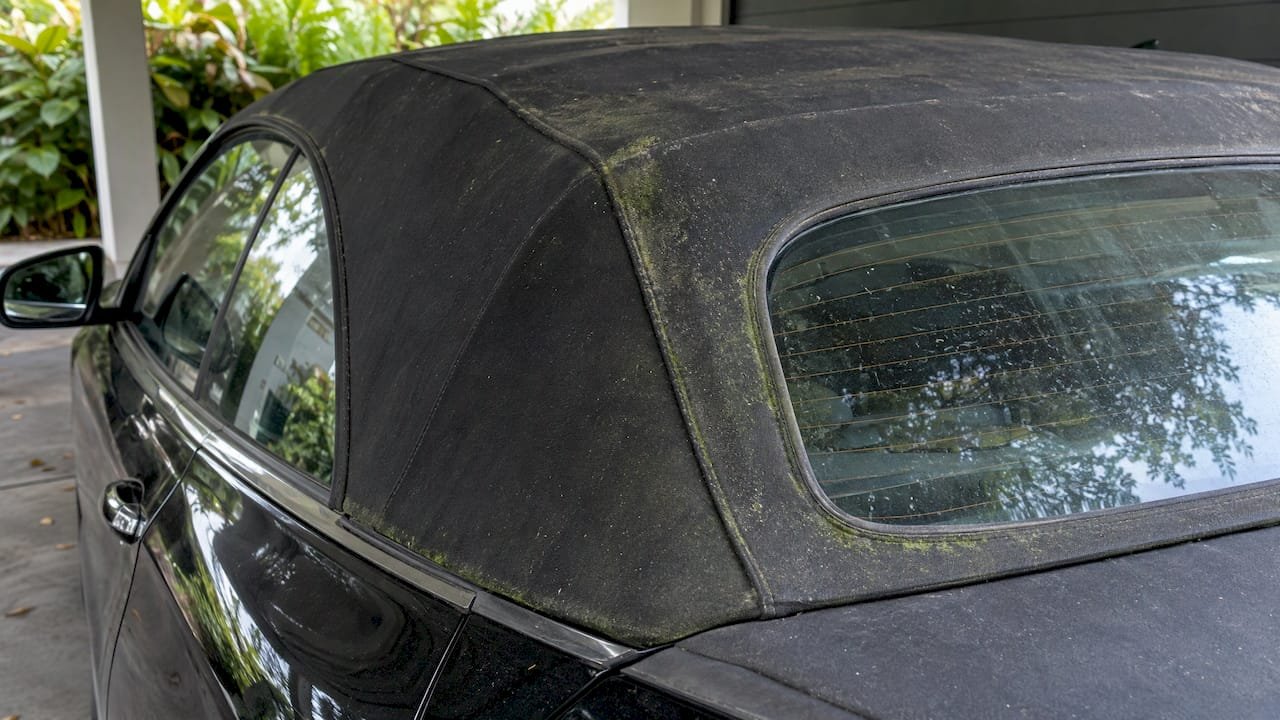
Green algae and mould. These grow where moisture and shade meet: seams, folds and the rear window surround. Repeat cleaning with a soft brush, with time for the cleaner to work, is safer than aggressive scrubbing. Dry the roof properly afterwards so it does not return.
Odours. A musty smell often comes from the lining and the roof well, not just the outer fabric. Ozone deodorisation, which we offer, deals with lingering odours in the cabin, and it is worth asking about if a damp roof has left the car smelling stale.
When it is worth having the roof done for you
Most owners can do a routine wash themselves. A professional makes sense when:
- the roof is heavily soiled, mouldy or stained and has not responded to a gentle wash;
- you are short on shade, time or a safe place to leave the roof drying for hours;
- the car is valuable or the roof is expensive to replace, so a mistake costs more than the service;
- you want the roof cleaned alongside the paint, interior and glass in one visit.
The saving is not only effort. A mistake on a fabric roof, such as a chemical that strips it or a jet that opens a seam, is far more costly than the wash.
We are a fully mobile detailing service, so the work happens at your home, your workplace or wherever the car is parked. You do not drop the car at a workshop or give up a day. We use eco-friendly products, which suits households with children and pets who share the car. For a convertible, the main drives for our customers are the paint, the interior and the protection, and a roof that looks neglected next to freshly polished paint spoils the result, so mention it when you book.
Our view on soft tops and detailing
We approach every car the same way: gentle first, thorough always. On a convertible, that means respecting the fact that the roof is fabric and the paint is not, and never letting a method that suits one damage the other.
Our work is done at the customer’s location, by hand, with products chosen to be kind to the surface and to the environment. A mobile visit suits convertible owners especially well. The car is not shuttled through a workshop, the roof can dry in your own shade, and you can see exactly what is being used on it.
The other half of a good result is protection. Our packages are all-inclusive, with no hidden extras, and we stand behind them with a 100% satisfaction guarantee. Cleaning and protecting go together: a clean surface with a fresh barrier stays cleaner for longer and is easier to maintain between visits.
If your car is a weekend drive, a daily commuter or the family’s beach runabout, the principle holds. Do not shortcut the roof, do not rush the dry time, and keep the care regular.
isaac’s
Our mobile detailing options
We come to you across the Sunshine Coast, and our published packages cover the work that surrounds a roof clean. The Deluxe Detail and Revival Detail are priced at 375 to 575 AUD and 575 to 775 AUD respectively, depending on the vehicle. For a full protection approach, the Ultimate Protection Package is 1500 to 2200 AUD. Interior fabric can be protected with Fabric Guard at 25 AUD per seat, and leather seats can be ceramic coated at 50 AUD per seat. If the paint needs attention before summer, we also offer cut and polish and ceramic coating.
To have your convertible detailed at home or work, book a mobile detail with us and tell us it has a soft top. Prices are as published on our site and vary with vehicle size and package.
FAQ
Can a convertible soft top go through a car wash?
No. Carsales calls automatic brush and robot wash booths a big no-no for convertibles, because they can abrade the roof and encourage leaks. Ford also warns against high-pressure and wand-type washes. Wash by hand instead, or have a mobile detailer do it.
What is the best way to clean a convertible car roof?
Vacuum or brush off loose dirt, wet the roof with cool water, clean with a soft-top-safe cleaner using a soft brush in straight strokes, then rinse thoroughly and dry before lowering. Avoid alcohol, bleach and solvents, which can discolour the fabric.
How do I get green algae off a soft top?
Give the affected area a second application of a soft-top cleaner and more time to work instead of scrubbing harder. Heavily affected roofs may need several rounds. Rinse completely and let the roof dry fully so moisture does not feed it again.
How often should a soft top be cleaned?
Treat the roof as a priority at least every six months, with a light brush-off whenever you wash the car. Cars parked outdoors in the Sunshine Coast’s sun, salt and humidity will benefit from more frequent attention and a fresh protective treatment after cleaning.
Sources
- Ford: How do I clean the convertible top?
- Mazda MX-5 2024 owner’s manual: Exterior Maintenance
- carsales: How do I look after my convertible’s fabric roof?