
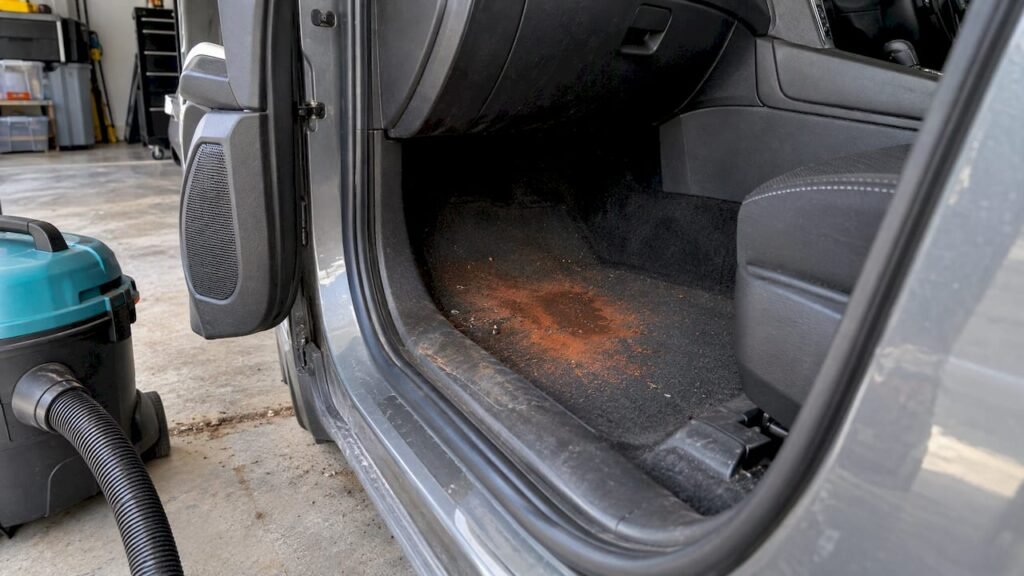
Fresh red dirt usually comes out of car carpet if you let it dry, then vacuum it thoroughly. The orange-red tint that stays behind, and the stain pressed into the walking lanes, is the hard part. That tint needs a gentle damp treatment, or hot water extraction that pulls the dirt out of the fibres and the backing. If the stain survives one careful attempt, we come to you on the Sunshine Coast and extract the carpet on site, so you avoid soaking the floor and fighting a musty smell later.
TL;DR
- Never wet fresh mud first. Let it dry fully, then vacuum slowly from several directions.
- For leftover tint, test a hidden spot, blot (don’t rub) from the outside of the stain to the centre, then blot with plain water.
- Skip hot water, bleach, rust removers and hard scrubbing. They set the colour or damage the pile.
- Car carpet sits on foam or rubber backing, so keep it damp rather than soaked and dry it within 24 to 48 hours.
- Old, ground-in or recurring stains are a job for extraction. Our mobile interior clean includes seat and carpet extraction at your home, work or the beach.
Table of Contents
- Why red dirt behaves differently from ordinary mud
- Step 1: Take out the mats and let the mud dry
- Step 2: Vacuum slowly, from several directions
- Step 3: Treat the tint with a gentle damp method
- What not to do
- Drying is half the job
- When the stain won’t shift
- What we do about it
- Stop the next stain: fabric protection
- Our view on red dirt
- FAQ
- Sources
Why red dirt behaves differently from ordinary mud
Red dirt is fine clay coloured by iron minerals. Ordinary brown dirt is mostly sand and organic matter, so it vacuums out and rinses away. Red clay particles are tiny enough to settle between carpet fibres, and the iron colour can stain the fibre itself if the dirt stays damp for a while.
That is why the same ground-in patch can look fine after a vacuum and then show an orange wash across the pile once it’s been wet. It is also why the cleaner you pick matters. Australian cleaning-industry magazine INCLEAN explains that stain treatment should match the stain chemistry, and it cautions against switching between opposite chemicals. A cleaner aimed at food or milk won’t do much for mineral soil.
Two things are worth knowing before you start:
- Fresh mud and set-in tint are different problems. Fresh mud is a dry-vacuum job. The tint left in the weave is a damp-treatment or extraction job.
- Car carpet is not house carpet. It is thin, moulded and backed with foam or rubber, so water that goes in tends to stay in. That shapes every step below.
Step 1: Take out the mats and let the mud dry
Pull the floor mats out and deal with them separately. Then resist the urge to wet the muddy patch. BISSELL’s car carpet guide says to let mud dry completely before cleaning, and to vacuum up as much of the dried soil as possible first so you don’t create a bigger muddy mess.
If there are thick clumps, lift them off with a spoon or a blunt edge before they dry. Then leave the car open in the shade. On the Sunshine Coast, summer humidity can slow drying, so a small fan or a few hours with the doors open helps. Overnight is fine.
Where it goes wrong: wetting wet mud pushes the clay down into the weave and into the foam underneath, and the iron colour spreads. Most stubborn tint we see starts with a wipe-down while the mud was still damp.
Step 2: Vacuum slowly, from several directions
Once the dirt is dry and crumbly, loosen it gently with your fingers or a stiff brush, then vacuum slowly. Go over each patch from several directions. Carpet pile lies one way, and the clay hides at the base of the fibres, so a single pass skims over it.
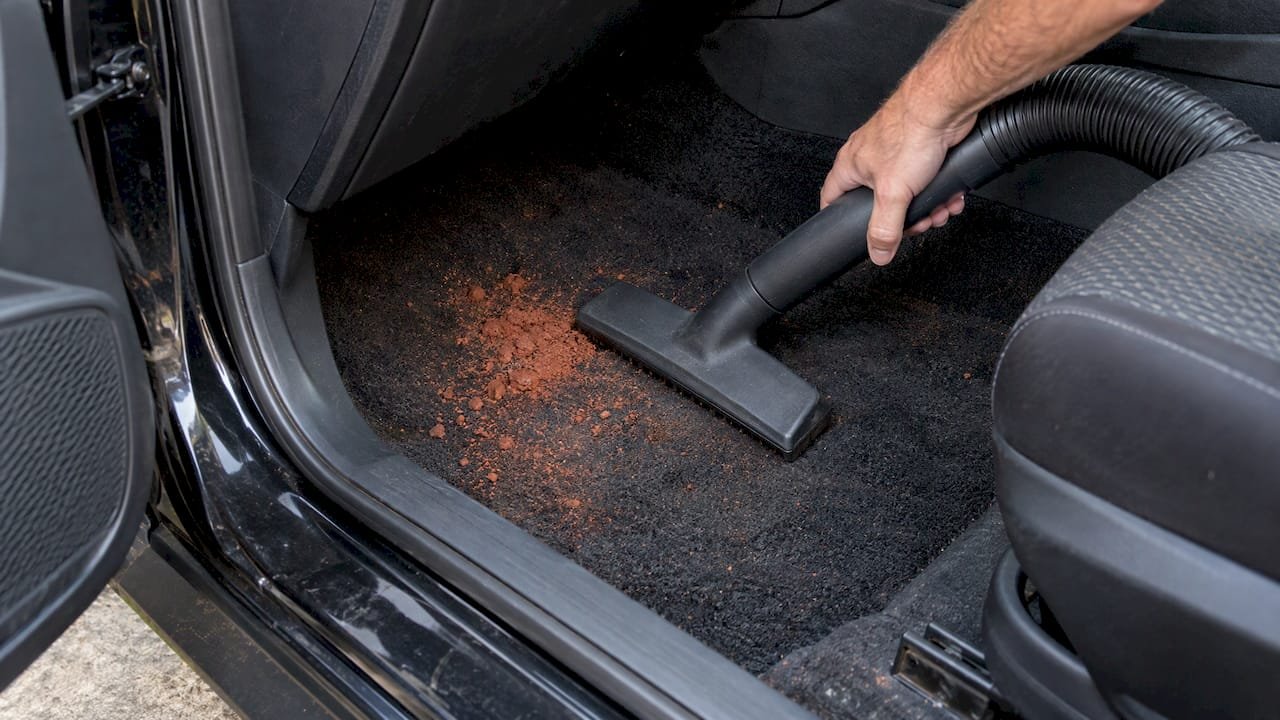
Do this before any liquid touches the carpet. A thorough dry vacuum often removes most of a fresh mud mark, and everything you take out dry is something you don’t have to dissolve later.
Step 3: Treat the tint with a gentle damp method
If an orange or pink shadow remains, the dirt has coloured the fibre or the finest particles are still in the weave. Work in this order:
- Test first. Try your cleaner on a hidden spot, such as under a seat or at the edge of the carpet. Carpet maker Feltex says to test cleaning agents in an inconspicuous spot and warns that haphazard spot treatment can cause permanent colour loss or pile distortion.
- Use mild and diluted. A few drops of clear, mild dishwashing liquid in a cup of cool water is a sensible start. Use a spray bottle or a damp white cloth, so you can see if colour transfers.
- Blot, don’t rub. Press from the outside edge of the stain towards the centre so you don’t spread it. The same Feltex guide advises blotting inward and press-drying with a clean white cloth, and notes that rubbing can fuzz or change the carpet texture.
- Rinse by blotting with plain water. Leftover soap is sticky. Bunnings’ carpet-cleaning advice is to rinse away leftover solution and ventilate until the carpet is completely dry, because residue can attract dirt.
- Dry quickly. Open the doors, use a fan, and press a folded towel onto the patch to draw moisture up.
Work in small sections, with the carpet slightly damp and never saturated. Bowden’s Own makes the same point in its carpet guide: work in small sections and lift the dirt out of the fibres instead of pushing it deeper.
A note on tools for mats
Rubber and TPE mats are easier. Carmats Culture describes a routine for outback red dirt on mats: soak with a hose, scrub a baking soda paste gently with a soft brush, then rinse and air-dry. That suits hard mats, not the fitted carpet underneath.
What not to do
Most red dirt damage is self-inflicted. Avoid these:
- Hot water. It can damage some fibres and drives the stain through to the backing.
- Bleach. It strips the carpet’s own colour and won’t lift iron-based staining, so you swap a red patch for a pale patch.
- Hard scrubbing. It frays the tips of the fibres and leaves a fuzzy, lighter patch that looks worse than the stain.
- Rust removers. They are not made for carpet and can strip dye or damage the fibre. INCLEAN notes that stronger acids are reserved for specific cases such as rust, and that mixing chemical opposites is unsafe.
- Mixing products. Read the label every time, wear gloves and eye protection, and only combine products if the label says you can.
- Soaking. Actichem’s stain-removal guide warns that delicate fibres can be discoloured by being overwet, and recommends allowing 24 to 48 hours to dry.
Drying is half the job
A carpet that looks clean but stays damp is a worse result than the stain you started with. The backing under car carpet holds moisture, and trapped moisture is what turns a clean-up into a musty smell.
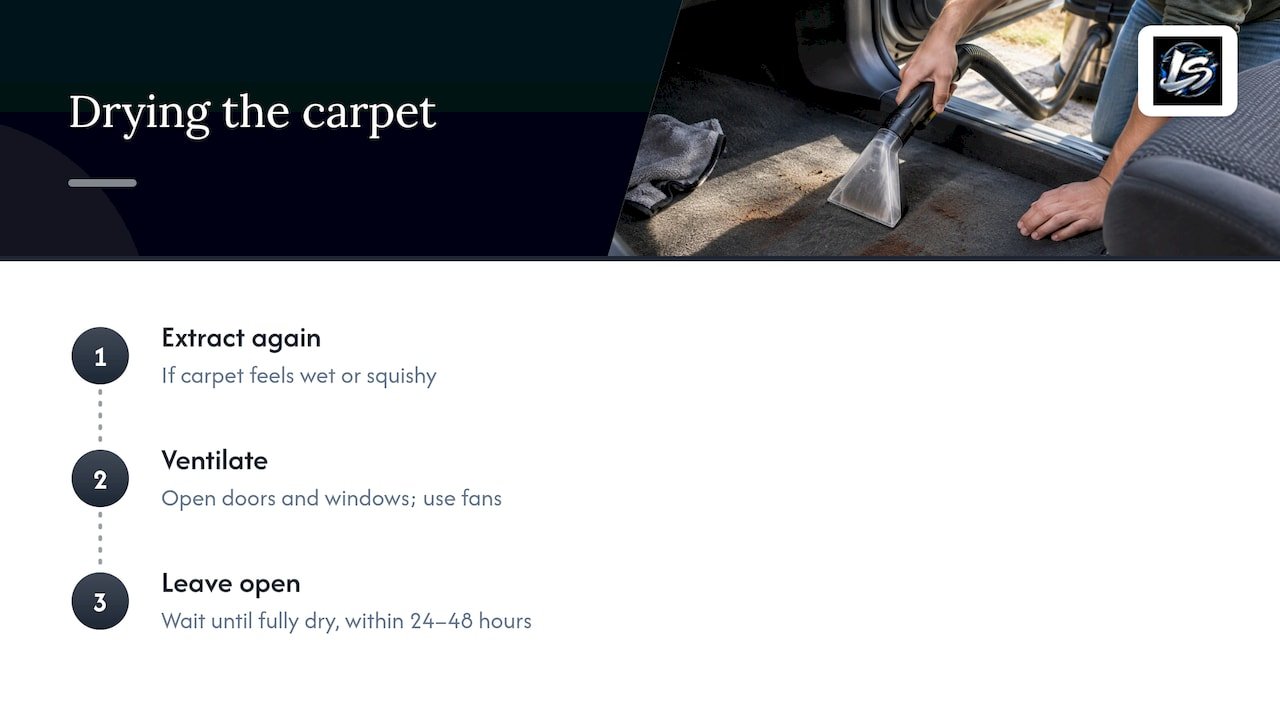
BISSELL’s advice is to make additional extraction passes if the carpet still feels wet or squishy afterwards, to open all doors and windows and use fans, and to avoid closing the car until the carpet is completely dry. Aim to have it dry within 24 to 48 hours, in line with Actichem’s guidance above.
A simple check: press your palm firmly into the carpet. If it feels cool and damp, or you notice a sour, musty odour, there is still moisture below. If that happens, read our guide to what to do about a wet carpet smell in your car and, for Queensland’s wet months, acting within 48 hours on a musty smell after rain. If you see mould specks, small patches of mould in car carpet can usually be cleaned yourself.
When the stain won’t shift
Do one careful round, let the carpet dry fully, and then look at it in daylight. Stains often seem to vanish when wet and reappear as the carpet dries. If so, repeat only once the carpet is completely dry, as Feltex advises. It also recommends calling in a professional promptly when a stain doesn’t respond adequately.
Typical signs you are past DIY:
- A tint that returns as the carpet dries.
- Red-orange traffic lanes under the driver and passenger footwells.
- A family car where dog paws, kids’ shoes and beach sand have worked the clay deep into the pile.
- A ute, 4WD or caravan tow vehicle after a trip inland, where red dust is in the seams, the seat rails and the boot.
- Light grey or beige carpet, where any remaining tint shows.
The reason is mechanical. Pulling fine clay out of the weave and the foam beneath takes a pre-treatment that suspends the particles, agitation, and then extraction that removes the dirty water. Actichem describes a carpet pre-spray whose chemistry suspends fine clays, with a vacuum first, a 5 to 10 minute dwell, agitation and then an extract-rinse. A household vacuum and a spray bottle can’t extract, which is why DIY tends to leave the dirty water in the car.
What we do about it
Our interior cleaning includes seat and carpet extraction, carried out at your home, workplace or somewhere like the beach, so you don’t give up half a day driving to a workshop. We also use eco-friendly products, which matters in a car shared with kids and pets.
For most red dirt jobs, the booking that fits is a full interior and exterior detail. Our Deluxe Detail is $375 to $575 and our Revival Detail is $575 to $775, depending on the vehicle size and condition. You can see both on our Deluxe Detail and Revival Detail page. If the car also carries a lingering odour from damp mud, we offer odour elimination and ozone deodorisation.
If the red dirt came on a trip that also left the underside caked, our Professional Mobile Underbody Wash is $50. Contact us through Isaac’s Pro Detailing Sunshine Coast to book a time and place that suits you.
Stop the next stain: fabric protection
Once the carpet is clean, the best time to protect it is straight away. Our Fabric Guard is $25 per seat, and fabric protection makes spills and soil easier to lift off seat fabric. If you are weighing it up, our guides cover what fabric protection is and whether it’s worth it and why clean comes first, then protect. Leather seats can be treated with our leather ceramic coating at $50 per seat.
For carpets, a good habit does more than any product. Keep a set of rubber mats in the car, shake them out after each trip off the bitumen, and vacuum the footwells before dirt has had a chance to get wet.
Our view on red dirt
We treat red dirt as two jobs: the dirt and the stain. Most of the dirt comes out with patience and a vacuum. Most of the damage we are asked to fix comes from what happened before a professional was called: wet mud rubbed in, hot water poured on, a bleach product that left a pale patch.
Our approach is built around extraction, because a carpet can only be clean when the dirty water leaves it. That is why our interior work includes seat and carpet extraction, and why we do it where you are. The car is back with you the same day, clean and ready to use, with no drive across town and no drop-off.
If your car works hard, whether it is a family wagon, a work ute or a weekend 4WD, we would rather see it early than after a stain has set. A well-timed detail also keeps your carpet in better shape for the years you own the car.
isaac’s
FAQ
How do I remove red dirt stains from car carpet?
Let the mud dry completely, then vacuum slowly from several directions. For any leftover tint, test a hidden spot, blot with a mild solution of dishwashing liquid and cool water from the outside of the stain towards the centre, and blot again with plain water. Dry the carpet quickly with fans and open doors.
Does red dirt stain car carpet permanently?
Not always. Fresh dirt usually comes out when it is dried and vacuumed before it gets wet. Dirt that has been wet and left, or ground in over months, can colour the fibre and is harder to shift, especially on light carpet. Extraction gives the best chance of lifting it.
Can I use bleach or a rust remover on red dirt?
No. Bleach strips the carpet colour and won’t lift iron-based staining, and rust removers are not made for carpet and can strip dye or damage the fibre. Stick to a mild, diluted cleaner that you have tested on a hidden spot.
How long should car carpet take to dry after cleaning?
Aim for 24 to 48 hours at most, with the doors open and a fan running. A sour or musty smell means moisture is still trapped underneath. Our guide to deodorising a car after a water leak covers the next steps.
Can you clean red dirt from my car at my home on the Sunshine Coast?
Yes. We are a fully mobile service, so we do interior cleaning, including seat and carpet extraction, at your home, workplace or another location across the Sunshine Coast. Get in touch through our website to book.
Sources
- BISSELL: How to Clean Car Carpet
- Feltex Wool Warranty, Care and Maintenance Guide
- Actichem: How to remove stains from carpet
- Actichem: Performance Gold pre-spray detergent
- Bunnings: How To Clean Carpet
- INCLEAN: The science of stain removal
- Bowden’s Own: Removing food and mud stains from carpets and mats
- Carmats Culture: The Car Mat Cleaning Routine Every Aussie Driver Should Know