
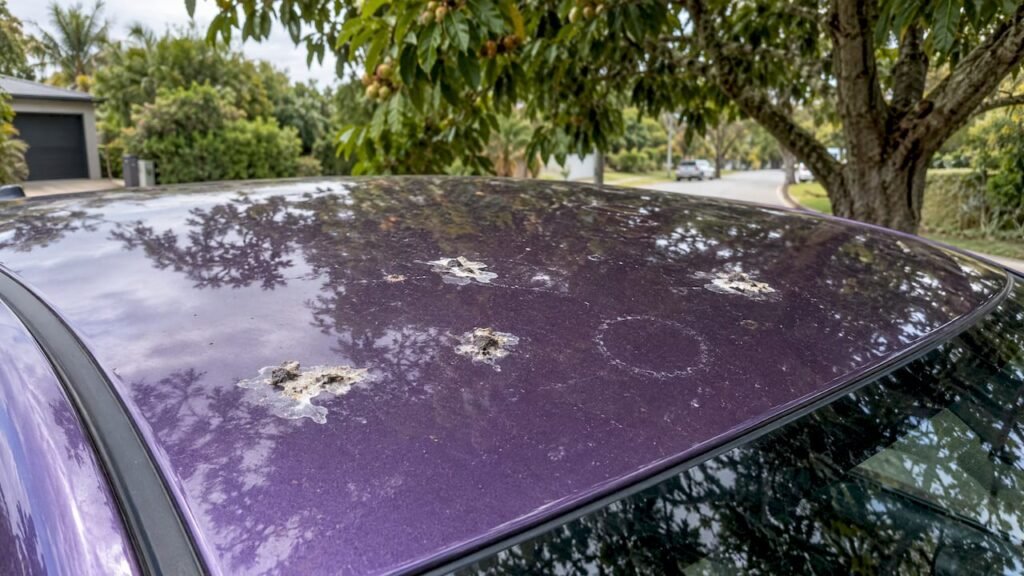
Bat droppings are acidic and can mark clear coat within hours, so the job is to soften them, lift them without rubbing and get the paint protected again. If the mark is still visible after a clean, it has usually etched into the clear coat, and that needs a cut and polish rather than more scrubbing. On the Sunshine Coast, where flying-fox colonies roost in many suburbs, we handle that repair and the protection that follows at your home or workplace.
TL;DR
- Act quickly: fruit-bat droppings can damage paint within 24 hours, well ahead of ordinary bird poo.
- Soften first, lift second, never scrub. Dry wiping drags grit across the clear coat.
- A mark that stays after a proper wash is etching, a physical dent in the clear coat, and it needs machine polishing.
- Dried droppings can carry a health risk. Wet them, wear gloves and a mask for large deposits, and wash your hands.
- Coatings and sealants buy you time and make cleaning easier. They do not make droppings harmless.
Table of Contents
- Why bat droppings hurt paint faster than bird poo
- How to remove bat droppings from car paint without scratching
- Stain or etch: how to tell what you are looking at
- Fixing etched paint
- Staying safe around droppings
- Preventing a repeat
- What a professional does that a driveway wash cannot
- Book a mobile fix and protection
- FAQ
- Sources
Why bat droppings hurt paint faster than bird poo
Fruit bats, known here as flying-foxes, eat nectar and pollen, and that diet is acidic. carsales reports a pH range of 2.7 to 6.4 depending on the plant, plus uric acid from the urine that comes with the droppings. Add Queensland heat and the acid works on the clear coat, the transparent top layer that gives paint its gloss and UV protection.
The Queensland Government notes there have been cases where flying-fox droppings left to dry on a car stripped a layer of paint, more likely when the paint is old, cracked or peeling. A detailer quoted by carsales says bird droppings may sit on paint for a few days, while bat droppings can do damage almost immediately.
Two things make the damage worse:
- Heat. A dark panel in full sun bakes the deposit, and the acid keeps working as it dries and re-wets with dew.
- Grit. Droppings contain undigested seeds and fibres. Wipe a dry deposit and you push those particles across the surface, which adds scratches to the chemical mark.
That is why the usual advice is to treat the first hour as the window that matters.
How to remove bat droppings from car paint without scratching
You need clean water, a pH-neutral car shampoo, two or three clean microfibre cloths and a few minutes. Skip paper towel, tissues, scourers and fingernails, all of which scratch.
1. Protect yourself first
Fresh droppings in small amounts carry a very low risk, according to WorkSafe Queensland. The risk rises with large accumulations of concentrated, dried droppings, because disturbing them can put fungal spores in the air. Put on gloves, and if the deposits are dry and heavy, a properly fitted particulate respirator. Mist the droppings lightly with water so they do not turn to dust, and wash your hands with soap and water afterwards.
2. Soak, do not wipe
Lay a cloth soaked in clean, lukewarm water over the dropping, or flood it gently with a hose on low pressure. Leave it for three to five minutes. High pressure can drive grit into the paint, so keep the jet soft. Moisture loosens the dried crust and floats the grit so it lifts rather than drags.
3. Pinch and lift
Fold a clean microfibre into quarters and lift the softened deposit straight up and away. Do not circle or scrub. Refold to a clean face for each lift. If it still clings, re-soak rather than pressing harder.
4. Wash the whole panel
Use a pH-neutral shampoo, not dishwashing liquid or household cleaners, which strip protection and can dull the finish. Rinse well and dry with a soft, clean towel. Drying also reveals whether a ghost of the dropping remains.
5. Check the surface
Tilt your head so the panel reflects light. A faint outline, dull patch or ring means the acid got through. Move to the next section to judge how deep it is.
Where this goes wrong
- Wiping a dry dropping, the single most common cause of fine scratches.
- Reaching for abrasive cleaners, kitchen sprays or bleach on the paint.
- Leaving it “until the weekend”. A car parked under a roost can collect several deposits overnight, and each one is a separate mark.
- Spraying a quick-detailer over a heavy deposit and wiping. Soaking and lifting first is safer.
If you are cleaning a whole car’s worth of splatter, or the car lives under a roost tree, this is exactly the routine a mobile detailer takes off your hands. Our team comes to your driveway, workplace car park or the beach, so the car is dealt with where it is parked.
Stain or etch: how to tell what you are looking at
A stain is a discolouration sitting on the surface. Etching is a shallow crater in the clear coat where acid has eaten the paint away. The first washes off. The second does not.
Two quick checks:
- Light test. Look at the mark in direct sun from a low angle. Etching shows as a dull, hazy spot or a ring with a rough edge. A stain looks like a coloured shadow.
- Fingertip test. Put your hand in a thin plastic bag and run your fingertips lightly across the area. Smooth suggests a stain. A rough or pitted feel suggests etching.
What each result means:
| What you see | What it likely is | What to do |
|---|---|---|
| Mark disappears after soak and wash | Surface residue | Re-protect the panel |
| Smooth but discoloured after washing | Light stain | Repeat the soak, then protect |
| Dull ring or rough patch | Etched clear coat | Machine polishing (cut and polish) |
| Cracked, peeling or lifted paint | Damage through the clear coat | Panel repair or respray |
We cover the logic of how correction works in our paint correction explained guide. In short, polishing levels the clear coat down to the base of the crater, and only a limited amount of clear coat can be removed before the job becomes a repaint. That is why we measure and test an area before we cut it. Our paint correction stages page explains the testing we do.
Do not try to fix an etch by rubbing a cutting compound by hand. Hand work is uneven, heats one spot and can burn through thin clear coat, especially on older paint where the Queensland Government says damage is more likely.
Fixing etched paint
Shallow etching responds to machine polishing. A polisher with the right pad and compound removes a hair-thin layer of clear coat so the surface is level again, and the gloss returns. Deep etching that has reached the base colour cannot be polished out safely and needs a panel repair.
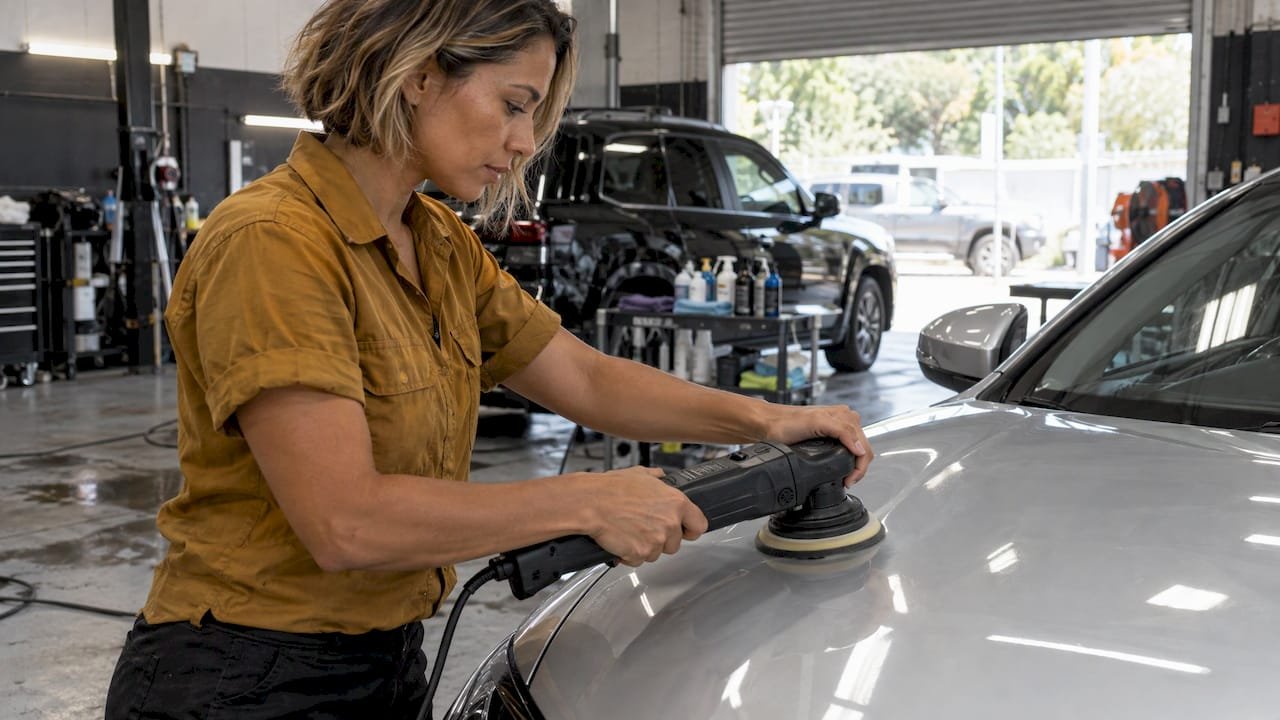
When you book a cut and polish, the point is to remove the damage with the least material, then leave the panel ready for protection. We do not publish a price for cut and polish because it depends on the vehicle size and how many panels are marked. For a general overview, see what cut and polish is and the cut and polish process.
If the whole car has been under a roost for months, our packages bundle the correction with a full interior and exterior detail:
- Deluxe Detail: $375 to $575
- Revival Detail: $575 to $775
- The “Holy Grail” Detail: $600 to $1,000
Prices depend on vehicle size and condition, and they are listed on our detail packages page.
Staying safe around droppings
Most cars only need gloves and a cloth, but there is a real health point behind the caution. WorkSafe Queensland describes histoplasmosis as an infection caused by breathing in fungal spores from soil contaminated with bird or bat droppings. Young children, older people and anyone with lowered immunity are most at risk. If you are worried about exposure, talk to your GP or your local public health unit.
For families with pets and children:
- Keep kids and animals away while you clean, and do not let pets lick or sniff fresh droppings.
- Dampen dried droppings before touching them. Never sweep or blow them, because that raises dust.
- Use gloves and wash your hands afterwards. Bag the cloths and wash them hot, separate from the family laundry.
- If you were scratched or bitten by a flying-fox, see your doctor as soon as possible, as the Queensland Government advises.
If a car has heavy, dried deposits on the bonnet, roof and around the door seals, or in a tray or boot, you may prefer to leave the job to someone fully equipped.
Preventing a repeat
No coating makes bat droppings harmless, so prevention is about parking, speed of cleaning and protection that makes removal easier.
Park smart. The Queensland Government suggests parking under shelter. Check the ground for fresh droppings before you park, because carsales recommends that too. Avoid fruiting or flowering trees where bats feed at night. A fitted cover adds a physical barrier. If you keep a vehicle long term, our notes on the humidity level for car storage help you pick a storage space that keeps the cover and paint in good shape.
Keep a kit in the boot. A bottle of water, a clean microfibre and a pair of gloves means you can start the soak on the spot, even when you cannot finish the wash.
Wash often. Fortnightly washing removes the overnight deposits before they have a chance to cook.
Add a protective layer. Wax, sealants and coatings create a sacrificial barrier between the deposit and the clear coat, and they give you more time and an easier clean. We offer several levels:
- Ceramic coating applied by our certified installers, with a guide to what it is and why your car needs it
- A graphene spray sealant package from $339 to $739
- The Ultimate Protection Package at $1,500 to $2,200
- Leather ceramic coating at $50 per seat and Fabric Guard at $25 per seat, useful if droppings or mess reach the interior
A professional underbody wash is $50 and removes the roadside grime that bats and birds are not responsible for but that wrecks paint just the same. For the thinking behind the layers, read ceramic coating vs sealant. A similar principle applies to bird poo, which we cover in our bird poop etching guide, and to bug splatter in our bug splatter guide.
What a professional does that a driveway wash cannot
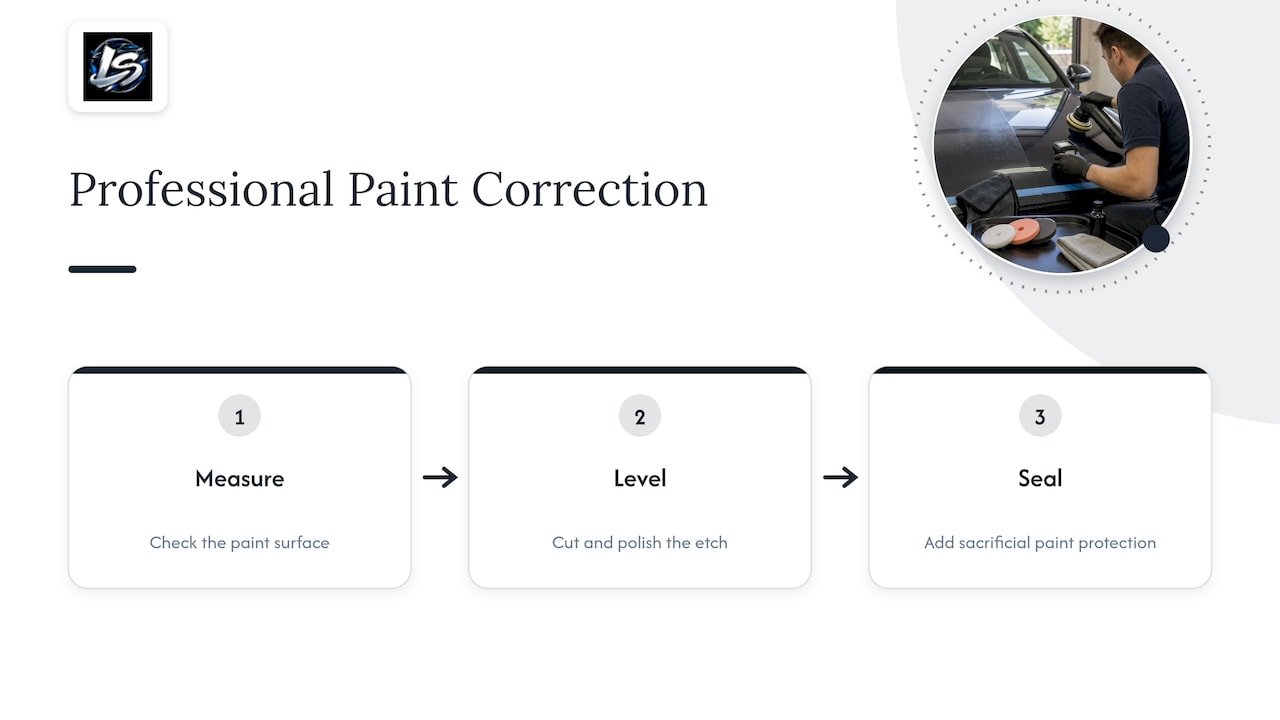
The soak-and-lift routine works on fresh droppings. It stops working once the acid has reached the paint. At that point the job is measuring, levelling and sealing, and that needs a machine, the right pads and a controlled surface.
Our mobile service means the car does not have to go to a workshop. We arrive with the equipment and water, we work at your home, at your workplace or by the beach, and you carry on with your day. We use eco-friendly products, a point that matters if the car sits on a lawn or near a creek, and our protection packages are all-inclusive with no hidden extras.
Our view on bat droppings
We see the pattern on the Sunshine Coast all the time: a car under a roost, a mark that looks small and a plan to deal with it on the weekend. By then the acid has already started. Our view is simple. Remove the dropping fast and gently, then give the paint something sacrificial to stand between it and the next one.
That is why we recommend correction first and protection second. A cut and polish removes the etch while there is still enough clear coat to work with. A ceramic coating, graphene sealant or our Ultimate Protection Package then gives the panel a harder, slicker surface, so the next dropping soaks off instead of biting in.
We bring that work to your driveway, with eco-friendly products and a satisfaction guarantee. You get workshop-grade results without losing a day.
isaac’s
Book a mobile fix and protection
If the marks are still there after a careful wash, or you want the paint protected before the next flying-fox season, we can come to you anywhere on the Sunshine Coast. Start with our Deluxe Detail and Revival Detail packages, or ask us about cut and polish and ceramic coating for etched panels. Our mobile car detailing workflow explains what happens on the day.

You can also read more on our paint enhancement checklist before you decide which panels to include.
FAQ
How fast do bat droppings damage car paint?
Often faster than bird droppings. A detailer quoted by carsales says bat droppings can damage paint almost immediately, certainly within 24 hours. Heat and dry conditions speed it up, so clean them as soon as you spot them.
Can I use a pressure washer or household cleaner?
Avoid both. High-pressure water can force grit into the paint, and kitchen or bathroom cleaners can dull the clear coat and strip protection. A low-pressure hose, lukewarm water and a pH-neutral car shampoo are the safer tools.
Will a ceramic coating stop bat droppings etching the paint?
A coating gives the paint a harder, slicker surface, so droppings release more easily and you gain time to clean them. It still pays to remove droppings promptly. Our ceramic, graphene and Ultimate Protection options are designed to make that routine simpler.
Is it safe to clean bat droppings off my car myself?
For a small, fresh deposit, gloves and a damp cloth are enough, according to WorkSafe Queensland. For heavy, dried deposits, wet them first and wear a fitted particulate respirator. People who are immunocompromised, the elderly and young children should keep clear, and anyone concerned should speak to their GP.
Sources
- How to keep your car’s paint looking good, carsales.com.au
- How do I remove bird poo from my car, carsales.com.au
- Work with bird and bat droppings, WorkSafe Queensland
- Living near flying-foxes, Queensland Government