
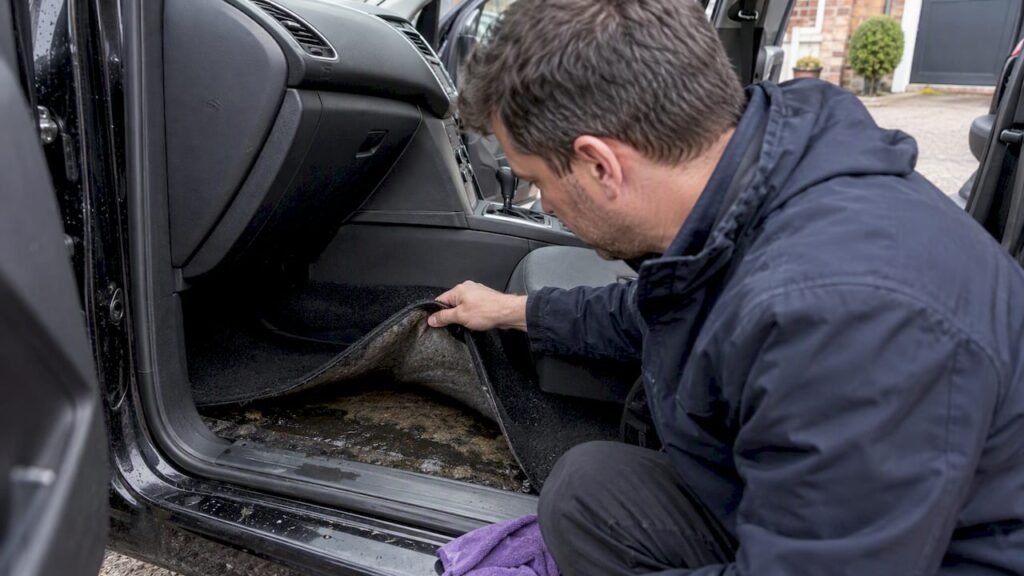
You can only deodorise a car after a water leak once the water is gone. Find and fix the leak, extract the water from the carpet and the foam underneath, dry the cabin completely, clean any mould, and only then deal with the lingering smell. Skip the order and the smell comes back, usually within days. Air fresheners and a sprinkle of baking soda over damp carpet just cover it up.
This guide walks through each stage, what you can do in the driveway, and the point where it is cheaper and safer to hand the job to a professional.
TL;DR
- Act within 24 to 48 hours. Mould starts colonising wet interiors quickly, and the smell follows.
- Fix the source first (blocked sunroof drain, door seal, windscreen seal, heater core). Cleaning a cabin that is still taking on water is wasted effort.
- If the carpet squelches when pressed, you need a wet-dry vacuum. Surface drying will not reach the foam underlay.
- Use vinegar solution on small mould patches, wear PPE and never dry-brush. Large or widespread mould is a job for a professional.
- Ozone is a last step, not a first one, and it needs a sealed, empty car and proper handling.
Table of Contents
- Why a leak makes a car smell so bad
- Step 1: Find and fix the leak
- Step 2: Get the water out
- Step 3: Dry the cabin completely
- Step 4: Check for mould and clean it safely
- Step 5: Deodorise once it is clean and dry
- What it costs: DIY versus professional
- Our perspective: why leak smells keep returning
- Getting the car sorted on the Sunshine Coast
- Stopping it happening again
- FAQ
- Sources
Why a leak makes a car smell so bad
Car carpet sits on a thick foam backing designed for sound deadening and insulation. That foam acts like a sponge when water gets in, and is very hard to dry by hand. If it stays wet, mould will grow in it. The top of the carpet can feel dry while the layer beneath stays soaked for weeks.
That is why the smell often arrives a few days after the leak, not during it. It is also why a car that “dried out” in the sun still smells like a damp towel the first time you turn on the heater or the air conditioning on a humid morning.
On the Sunshine Coast the problem is made worse by the climate. Warm, humid air and summer storms give mould everything it wants. Queensland Health notes that excess moisture, heat and humidity create conditions favourable to mould growth, especially in the state’s north.
Step 1: Find and fix the leak
Before you touch the carpet, work out where the water came from. Common culprits include:
- Blocked sunroof drains: water backs up and spills into the headlining or down the A-pillars into the footwells.
- Perimeter door and window seals: perished rubber lets in rain, and car washes, at the bottom of the door.
- Windscreen or rear screen seals: often shows up as damp at the top of the footwells or in the boot.
- Blocked air conditioning drain: condensation backs up into the passenger footwell.
- Boot seals and tail light gaskets: water pools in the spare wheel well.
- Spills and open windows: the simplest cause, and the easiest to fix.
A quick test: with a helper inside, run a hose gently over one section of the car at a time, starting low and working up, and watch for where water appears. If the leak involves electrical wiring, airbag modules under the seats or the heater core, book it in with a mechanic. Shell’s guidance is clear that owners should prioritise mechanical repair of the leak before they try to sanitise the cabin.
If the water came from a flood rather than a leak, floodwater is contaminated and affects wiring. Treat it as a bigger job; our guide to saving a flooded interior in 24 to 48 hours covers when a full teardown is the right call.
Step 2: Get the water out
Remove the floor mats and press firmly on the carpet with your hand. If it squelches, you have standing water in the underlay. Shell’s advice is to use a wet-dry vacuum to extract it. The same page puts the cost of renting or buying one from an auto store at about $100.
A practical sequence:
- Take out the floor mats and any loose items. Dry the mats separately, in the sun if you can.
- Pull the front seats as far forward and back as they go to expose the carpet.
- Press the vacuum nozzle hard into the carpet and work in overlapping lines. Keep going until little water comes up.
- Towel-press the area with dry microfibre or old towels, standing on them to draw moisture up.
- Lift the carpet edges and sill trims where you can, so air reaches the underside.
Step 3: Dry the cabin completely
Drying is where most DIY attempts fail, because the surface feels dry long before the foam is. Use airflow, not just warmth.
- Park somewhere dry and shaded from rain, with doors or windows open when it is safe and secure.
- Run a fan across the footwells for a day or two. A household fan or a dehumidifier inside a closed garage both help.
- Run the car’s heater, then the air conditioning, which pulls moisture from the cabin air.
- Check the carpet again by pressing a dry paper towel into it. Any dampness on the towel means the underlay is still wet.
Shell’s guidance suggests that if the carpet still feels wet after a couple of days of fan treatment, it is time to call in someone with industrial extraction equipment. In severe cases, the carpet and underlay need to be lifted out by a mechanic or panel beater so the floor pan can dry. For more on the Australian rain-season version of this problem, see our guide to a musty car smell after rain.
Step 4: Check for mould and clean it safely
A musty, earthy smell after a leak usually means mould is already growing, even if you cannot see it. Look under the mats, along seat rails, behind the seat belt anchors and at the lower door trims. Bowden’s Own describes mould and damp, musky smells in carpet as one of the most common complaints, typically growing in hidden, damp parts of the cabin.
Small patches you can handle yourself
The Tasmanian Department of Health advises against dry-brushing mould, because it spreads spores. Its guidance for small areas is a solution of 4 parts vinegar to 1 part water, or mild detergent, applied with a damp cloth, with gloves, a mask and eye protection, and good ventilation. Queensland’s guidance also lists white fermented vinegar solution and household detergents as effective on hard surfaces.
Some rules that keep this safe:
- Never mix cleaning products. Bleach and ammonia together release toxic fumes.
- Do not rely on bleach as your mould killer. The Tasmanian guidance says it is not recommended as the primary mould treatment.
- Dab or wipe, then extract with the wet-dry vacuum. Do not scrub dry fabric.
- Test vinegar on a hidden patch first, as it can affect some dyes and leather finishes.
For a UK-focused overview of precautions and suitable cleaners for small mould patches in a vehicle, this guide to safe interior mould removal is a useful extra read, though products and rules there differ from Australia. We also cover this in small patches of mould in car carpet.
When to stop and call a professional
Mould spores are microscopic and become airborne when disturbed. The Tasmanian Department of Health says exposure can cause problems for people with asthma or weakened immune systems, and that professional assessment is sensible for extensive contamination. Stop DIY and get help if:
- Mould covers more than a small patch, or has spread across the carpet, seat bases or headlining.
- The carpet has been wet for more than two days. The same Tasmanian guidance treats an interior flooded for more than two days as contaminated.
- Anyone who rides in the car has asthma, allergies, a compromised immune system or is a child. See your GP if symptoms appear.
- The underlay is still wet after a few days of drying.
Step 5: Deodorise once it is clean and dry
Only now does deodorising make sense. It works because there is nothing left producing the smell.
Gentle options
- Baking soda: sprinkle over dry carpet and upholstery, leave it for several hours, then vacuum thoroughly. It absorbs light odours but will not fix mould.
- Activated charcoal or odour-absorbing bags: useful for keeping a dry cabin fresh, not for curing a wet one.
- Fresh air and sun: leave doors open on a dry day, with the car in a secure spot.
- Replace the cabin air filter: a damp, musty filter will keep pushing smell through the vents. Check your owner’s manual for its location.
Fabric and carpet extraction
Hot water extraction rinses residue out of seats and carpet, rather than leaving it to feed new growth. It is the step between “dry” and “fresh”, and a professional machine pulls far more out than a household one. Once dry, a fabric protector helps resist the next spill. Our Fabric Guard is 25 AUD per seat.

Ozone: the finishing step, not the first one
Ozone treatment can neutralise odours that linger in vents, headlining and fabric after cleaning. It also has real risks. Bowden’s Own describes it as a last resort, to try only after other methods have failed. Its guidance warns that extended or frequent exposure can make plastics and vinyl brittle, fade fabric and age rubber, and that ozone is toxic to people and pets.
That means:
- The car must be empty and sealed, with no people, pets or plants nearby during treatment.
- The cabin should be aired out thoroughly afterwards.
- It must follow a proper clean and dry. Ozone on a car with a wet underlay just gives you a short break from the smell.
- It is not a replacement for fixing the leak.
What it costs: DIY versus professional
| Option | Typical cost | Best for |
|---|---|---|
| DIY: wet-dry vacuum, fans, vinegar, baking soda | About $100 for a wet-dry vacuum, plus household items | Small spills, recent leaks, no visible mould |
| Professional interior mould treatment and extraction | $260 to $440, depending on severity and scope | Persistent smell, visible mould, damp underlay |
| Carpet and underlay removal by a mechanic or panel beater | Quoted case by case | Deep-seated water, repeated leaks, severe cases |
The professional range is a general guide, not a quote. Cabin size, how long the car stayed wet and how far the mould spread all move the price.
Our perspective: why leak smells keep returning
Most leak smells we are asked about were “fixed” at least once already. The usual story: the owner dried the top of the carpet, used an air freshener or a bomb, and the smell came back the next humid week. In our experience the cause is nearly always moisture left in the underlay or an unresolved leak.

So we work from the bottom up. We confirm the leak is sorted, extract the carpet and seats, treat the affected areas, dry them properly and only then think about deodorising. As a mobile service, we come to your driveway or workplace on the Sunshine Coast, which means you do not drive a damp car across town, and you can see what is being done to the car.
We will also tell you when the job is beyond a detailer. If the underlay is saturated, the carpet needs to come out, or a mechanic must fix a seal first, we say so rather than sell you a cosmetic fix. We use eco-friendly products inside cabins, which matters when the people in the car include kids, pets or anyone sensitive to strong chemicals.
— isaac’s
Getting the car sorted on the Sunshine Coast
If you have worked through the steps above and the smell is still there, or you would rather not handle mould yourself, we can help. Our Deluxe Detail runs from 375 to 575 AUD and our Revival Detail from 575 to 775 AUD. Both include thorough interior work, with seat and carpet extraction available as part of our mobile service. Once the cabin is clean, dry and fresh, our Fabric Guard protects seats at 25 AUD per seat, and leather ceramic coating is 50 AUD per seat.
Tell us when the leak happened and how long the car stayed wet. That helps us tell you whether a detail will do, or whether you need a mechanic first. See our mobile detailing services for the full list and to book.
Stopping it happening again
- Clear sunroof and air conditioning drains each year, especially before the wet season.
- Check door and window seals for cracks or flattening, and replace perished rubber.
- Do not leave wet towels, boards or umbrellas on the floor of a closed car. Our guide on wet dog smell applies the same drying logic.
- Run the air conditioning for a minute or two before switching it off, to dry the evaporator.
- Look under the mats after heavy rain. Catching a damp patch on day one beats treating mould on day ten.
- Be careful buying second-hand. The WA Commissioner for Consumer Protection warns that water damage can cause electrical faults and corrosion, and may cause registration or insurance problems. A musty smell is a red flag.
FAQ
How do you get rid of a wet smell in a car?
Fix the leak, extract the water with a wet-dry vacuum, dry the cabin with fans and airflow, and clean any mould with a vinegar solution. Deodorise only after the carpet and underlay are completely dry. If the smell persists, the foam underneath is probably still damp.
Does water damage smell go away on its own?
Not if moisture is still trapped. A light spill that dries quickly within a day may leave no smell, but wet underlay will grow mould if it stays wet. The longer it sits, the harder the smell is to remove.
Can baking soda remove the smell from a car leak?
Baking soda absorbs mild odours from dry fabric, and is worth using after cleaning. It will not dry out damp carpet or remove mould. Treat it as a finishing touch, not the fix.
How long does it take to dry out a wet car interior?
With extraction and constant airflow, expect a couple of days. If the carpet still feels wet after that, the underlay likely needs industrial extraction or removal. Do not wait more than 48 hours to start, as mould sets in fast.
Is it safe to use an ozone generator in my car?
Only with care. Ozone is toxic to humans and pets and can damage plastics, vinyl, fabric and rubber with extended exposure. Use it as a last step on a clean, dry car, with nobody inside, and air the cabin out afterwards.
Sources
- How to clean and dry flooded car carpet, Shell Australia
- Mould, Tasmanian Department of Health
- Mould after a disaster, Queensland Health
- Mould, Queensland Government
- Mould and damp musky smells in the carpet, Bowden’s Own
- Removing bad odours from your car: a last resort, Bowden’s Own
- Flood cars: avoid buying a washed-up vehicle, Government of Western Australia
- Safe interior mould removal in cars, Diamondbrite