
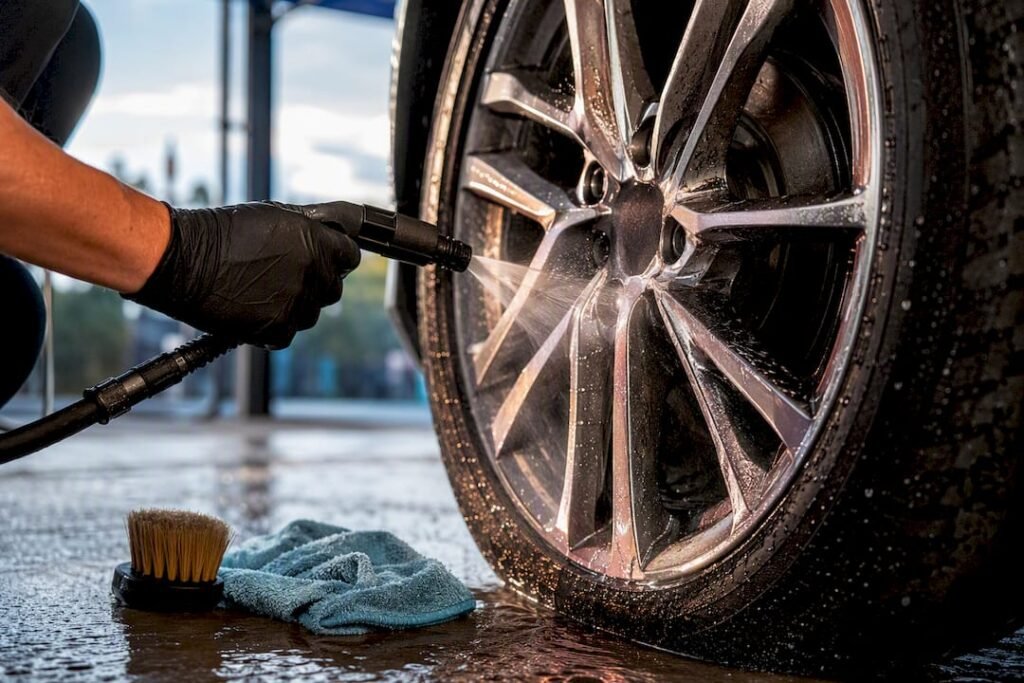
The safest way to handle brake dust removal on wheels is simple: work on cool wheels, rinse away loose grit, then clean with a pH-safe wheel cleaner and the right brushes. For bonded, baked-on residue, switch to an iron remover before you touch a brush. Finish with a wheel sealant or coating so the next round of dust wipes off in seconds, not minutes.
TL;DR:
- Using a pH-safe wheel cleaner and soft brushes on cool, shaded wheels prevents damage while effectively removing brake dust.
- Bonded, baked-on residue requires an iron remover and careful agitation to avoid scratching or etching coated or painted wheels.
- Applying a wheel sealant or ceramic coating significantly reduces future brake dust bonding, making cleanups faster and easier.
- Regular cleaning frequency depends on driving style, with city driving needing weekly to bi-weekly washes and highway driving extending to every few weeks.
- Professional decontamination and coating services ensure optimal protection and avoid damage from improper chemical use or aggressive scrubbing.
Table of Contents
- What’s the best way to clean brake dust off wheels step by step?
- Which wheel cleaning products actually work?
- How do you remove baked-on brake dust safely?
- How do sealants and coatings stop brake dust sticking?
- How often should you clean brake dust off your wheels?
- What safety and finish warnings should you know?
- What does a professional detailer do differently?
- What are the different types of brake dust?
- Does the cleaning method change by wheel material?
- How should you dispose of wheel cleaning chemicals responsibly?
- Should you use homemade brake dust removers or commercial products?
- Does brake dust actually damage your wheels and brakes?
- What should you check after cleaning your wheels?
- Why most brake dust advice misses the point
- Get baked-on brake dust handled properly, without the weekend lost to it
- Sources
- FAQ
What’s the best way to clean brake dust off wheels step by step?
Brake dust removal works best as a repeatable sequence, not a scrub-and-hope job. Do it in this order and you’ll cut your cleaning time dramatically while protecting the finish underneath.
- Let the wheels cool and park in shade. Hot wheels cause cleaner chemicals to flash-dry, which can streak or etch the surface before the product has a chance to work — a mistake Tyrepower’s cleaning advice flags as one of the most common causes of wheel damage.
- Rinse the wheel and wheel well thoroughly. A strong hose blast or pressure washer knocks off loose grit and road grime before any chemical touches the surface, so you’re not grinding sand into the clear coat later.
- Apply your wheel-specific cleaner to the face and barrel. Spray liberally, including behind the spokes where dust actually accumulates.
- Respect the dwell time on the bottle. Most pH-safe formulas need two to five minutes to loosen bonded particles, a window backed by Diamondbrite’s brake dust guide — walking away too soon means you’re agitating dirt that hasn’t softened yet.
- Agitate with a soft-face brush on the visible face. Light pressure, circular motion, no scrubbing hard enough to swirl the finish.
- Switch to a slim barrel brush for the inner rim. This is where most owners give up too early, and it’s exactly where The Detailing Bay notes contamination builds up hardest.
- Use a small detail brush around lug nuts and pockets. These tight spots trap dust that the barrel brush can’t reach.
- Rinse top-to-bottom. Work from the top of the wheel down so you’re not redepositing dirty runoff onto clean sections.
- Dry with a dedicated microfibre towel. Never use the towel you use on paint — brake dust particles embedded in a towel will scratch your clear coat on the next wash.
- Inspect for bonded spots that didn’t lift. Small dark specks that survived the wash are your cue to move to a stronger product, covered further down.
This routine, drawn from established practical wheel-cleaning guidance, handles the vast majority of everyday brake dust without escalating to harsher chemistry.
Which wheel cleaning products actually work?
Matching the product to your wheel finish matters more than brand loyalty. Get this wrong and you can strip a coating or dull polished aluminium permanently.
- pH-safe wheel cleaner is the correct default for coated, painted, or clear-coated alloy wheels — it lifts brake dust without attacking the finish.
- Acid-based wheel cleaners work faster but should only touch bare or polished uncoated aluminium; on anything sealed or painted, they risk permanent etching.
- Iron-reactive “ferrous fallout” sprays target the metallic component in brake dust directly. They turn purple or reddish as they react, a visual cue that tells you the product is dissolving embedded iron particles rather than just sitting on the surface, as Lane’s Car Products explains.
- Brush kit essentials: a soft-face wheel brush, a slim long-reach barrel brush, a small detail brush for lug pockets, and microfibre towels reserved only for wheels.
Pro Tip:Skip the dish soap and the can of WD-40 sitting in your garage. Dish soap strips wax and sealant protection, and solvent sprays like WD-40 aren’t formulated to break the chemical bond brake dust forms with metal — they just smear it around.
How do you remove baked-on brake dust safely?
Bonded brake dust needs a different approach than routine cleaning, and rushing this stage is how wheels get permanently marked.
- Apply the iron remover generously and let it dwell. Watch for the colour change; that’s your signal the product is actively working, not a cosmetic side effect.
- Agitate gently only after the colour reaction slows. Going in with a brush too early just spreads dissolved iron around instead of lifting it clear.
- Follow with a clay bar or wheel-specific decontamination clay. This lifts microscopic residue the chemical missed, and detailers keep separate clay for wheels and paint to avoid cross-contaminating the paint with metal particles picked up from the wheel.
- Never use steel wool, wire brushes, or aggressive abrasive pads on coated, painted, or clear-coated wheels. These leave scratches that trap even more brake dust going forward.
Brake wear debris is chemically why this matters: analysis of brake wear particles shows iron content commonly running between 50% and 80% of the mass, which is exactly why plain soap and water can’t shift bonded dust, but an iron-chelating spray can. If you’ve gone through two full decontamination cycles and dark staining remains, that’s embedded corrosion or clear-coat damage, not dirt, and it’s time to call a professional detailer rather than keep escalating chemistry on your own.
How do sealants and coatings stop brake dust sticking?
Protection doesn’t stop brake dust landing on your wheels. It stops that dust from bonding hard enough to need a scrub.
- Spray sealants are the entry point: cheap, quick to apply, and typically good for a few weeks before reapplication.
- Ceramic wheel coatings last far longer, often a year or more depending on driving conditions, and create a slicker surface that brake dust simply can’t grip.
- Either option means most future brake dust rinses away during a normal wash instead of requiring a full decontamination cycle, a shift detailing guides confirm changes the entire maintenance routine.
- Apply coatings to fully decontaminated, dry wheels only. Skipping the decon step traps existing dust underneath the coating permanently.
If you’re deciding between the two, this guide to wheel coating types and care breaks down realistic expectations for each.
How often should you clean brake dust off your wheels?
Your driving pattern decides your schedule more than anything else. Stop-and-go city driving loads your rotors and wheels with dust far faster than steady highway cruising.
| Driving pattern | Recommended cleaning interval |
|---|---|
| Highway commuting | Every few weeks |
| City/stop-and-go driving | Every one to two weeks or as frequently as needed |
| Performance or track driving | As soon as possible after each session |
| Coastal or winter road conditions | Every one to two weeks or as conditions require |
That interval guidance tracks with The Detailing Bay’s recommendations for city versus highway driving. Between full cleans, a two to three minute quick rinse-and-wipe stops dust from bonding in the first place. To test whether dust is surface-level or embedded, run a finger lightly over the wheel face after washing: smooth means surface dust cleared fine, gritty or rough texture means it’s bonded and needs an iron remover next time.
What safety and finish warnings should you know?
- Uncoated polished aluminium: acid cleaners are fine here, but nowhere else.
- Painted, clear-coated, or ceramic-coated wheels: stick to pH-safe formulas only. Acid cleaners etch coatings and dull clear coat permanently.
- Chrome wheels: pH-safe cleaners plus a soft brush; abrasive pads scratch chrome plating irreversibly.
- Always work on cool wheels, wear gloves, and avoid breathing in spray mist from iron removers, since they’re designed to react aggressively with metal particles.
What does a professional detailer do differently?
Professional wheel decontamination follows a fixed sequence: decontaminate with iron remover and clay, correct any bonded staining or light corrosion, then protect with a sealant or ceramic coating. That order matters because skipping straight to protection just seals dust in rather than removing it.
Mobile professionals matter most on delicate finishes, wheels with heavy years of neglect, or when a car owner simply doesn’t have the two hours a full four-wheel decontamination properly takes. Isaac’s Pro Detailing runs exactly this workflow as part of its wheel and iron removal services, treating decontamination as the foundation any coating gets applied over.
What are the different types of brake dust?
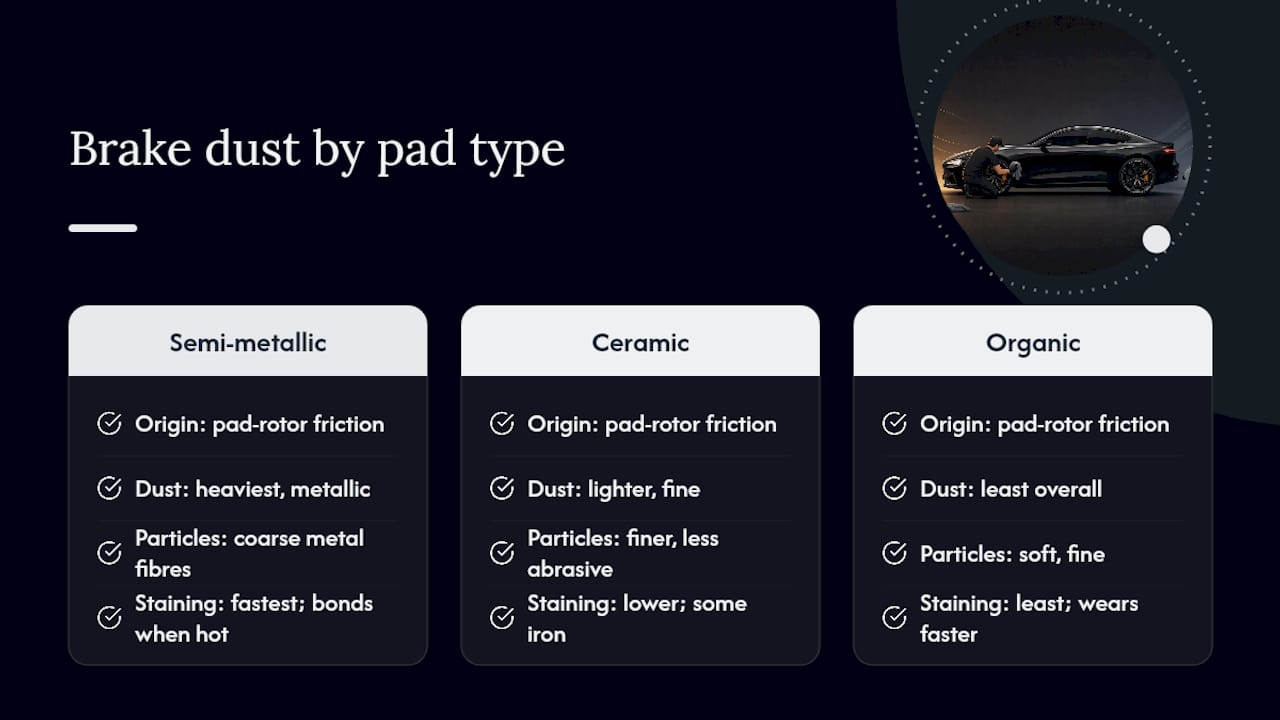
Not all brake dust is the same, and the type your car produces depends on the brake pad material.
Semi-metallic pads, common on most passenger vehicles, shed the heaviest, most metallic dust because they’re built with iron and steel fibres blended with friction material. This is the dust that stains wheels fastest and bonds hardest when baked on by heat.
Ceramic pads produce a lighter-coloured, finer dust. It’s less abrasive and less prone to staining, but it still carries measurable iron content and still needs the same iron-reactive cleaning approach.
Organic (non-asbestos organic) pads generate the least dust overall and the softest particles, though they tend to wear faster and need replacing sooner, which offsets the cleaning advantage.
Regardless of pad type, the dust itself originates from friction between the pad and rotor under braking heat, which vaporises tiny metal and resin particles that then settle on the wheel face and barrel. Braking systems are a measurable source of roadside particulate pollution, and research shows wear particles deposit heavily onto wheel components rather than dispersing into the air entirely. That’s the physical reason your wheels bear the brunt of it, not just the visible mess on the tyre sidewall.
Does the cleaning method change by wheel material?
Alloy, chrome, and painted wheels each demand a different chemical approach, and mixing this up is the single most common cause of avoidable wheel damage.
Alloy wheels are the most common and the most varied in finish, ranging from raw machined aluminium to clear-coated, painted, or ceramic-coated surfaces. Bare or polished alloy can handle a mild acid cleaner occasionally, but anything coated or clear-coated needs a strictly pH-safe formula and soft brushes only.
Chrome wheels look tough but scratch easily under abrasive pads or stiff-bristled brushes. A pH-safe cleaner with a soft-face brush is the safest combination, and chrome responds well to a final wax or sealant layer since its non-porous surface holds protection particularly well.
Painted wheels, increasingly common on factory steel and some alloy designs, behave like automotive paint. Treat them the same way you’d treat a painted panel: pH-safe cleaner, soft brush, no acid, ever. Acid formulas will dull or discolour painted wheels faster than almost any other finish.
The unifying rule across all three: when in doubt about your wheel’s exact finish, default to the pH-safe cleaner. It’s slower on stubborn dust but it never causes the kind of damage a wrong acid choice can.
How should you dispose of wheel cleaning chemicals responsibly?
Brake dust runoff isn’t just dirty water. It carries dissolved metals and cleaning chemical residue that shouldn’t go straight into stormwater drains.
Wheel cleaner runoff, particularly from acid formulas and iron removers, contains dissolved iron and other metals lifted from the brake dust itself. Letting this wash straight into a gutter sends it directly into local waterways, since most stormwater systems don’t filter or treat runoff before it reaches creeks and rivers.
Where possible, wash wheels on a lawn or gravel area rather than a driveway that drains to the street, letting the ground filter some of the runoff naturally. If you’re using a commercial car wash bay, that runoff typically goes through a proper wastewater system designed for it. Buy the smallest bottle size that suits your usage rather than stockpiling large containers of concentrated acid cleaner you’ll rarely fully use, and never tip leftover concentrate down a household drain. Most local councils accept small quantities of automotive chemicals at household chemical collection events. Check your local waste authority’s guidelines before disposing of anything beyond diluted rinse water.
Should you use homemade brake dust removers or commercial products?
Homemade mixes, usually dish soap, vinegar, or baking soda pastes, can shift very light surface dust, but they’re not built for the actual chemistry of brake dust.
Dish soap lacks the pH balance to be reliably safe on coated wheels and strips any existing sealant or wax protection in the process. Vinegar is mildly acidic, which puts it in the same risk category as commercial acid cleaners, minus the safety testing manufacturers do for wheel-specific formulas. Baking soda paste can help lift light grime but does nothing for the iron content bonded into baked-on dust, since the debris is predominantly metallic rather than simple grease or grime.
Commercial wheel cleaners, by contrast, are formulated specifically around brake dust’s chemical makeup: pH-safe surfactants for coated finishes, or iron-reactive compounds engineered to bond with and neutralise ferrous particles specifically. That targeted chemistry is the entire reason iron removers work faster and more completely than a vinegar spray ever will on genuinely bonded dust.
The honest verdict: homemade solutions are fine for very light, fresh dust on an otherwise low-maintenance driveway wash. Anything baked-on, or any wheel with a coating you care about protecting, calls for a purpose-built product.
Does brake dust actually damage your wheels and brakes?
Left untreated, brake dust does more than look bad. It’s chemically active and slowly works against both your wheel finish and your braking system’s longevity.
Bonded brake dust sits on the wheel surface and, being metallic and often acidic in its early breakdown, can etch into clear coat or paint over months of exposure. What starts as a light dusting eventually oxidises into stubborn brown staining that ordinary washing can’t shift, forcing exactly the aggressive decontamination and correction work this article has walked through.
On the safety side, heavy dust buildup on the wheel face doesn’t directly cause brake failure, but the amount of dust your car produces is a rough indicator of pad wear and rotor condition. A sudden spike in dust volume, especially paired with a grinding noise or a pull to one side under braking, often signals worn pads or a rotor issue worth having checked. Since braking systems are a documented source of particulate emissions, keeping pads and rotors in good condition also has a small but real environmental upside beyond just cleaner wheels.
What should you check after cleaning your wheels?
A finished wheel clean is the perfect moment to run a quick safety check while you’ve already got the wheel exposed and dust-free.
Run your fingers along the wheel face and barrel checking for rough patches, small pits, or hairline cracks that dust might have been masking. Cracks around the lug area or spokes are a serious safety issue on alloy wheels and need immediate professional assessment, not just a cosmetic fix. Check the lug nuts are properly seated and torqued, since a wheel that’s just been off for detailed cleaning (or one you’ve cleaned with the wheel still mounted but heavily agitated) is worth a torque check regardless.
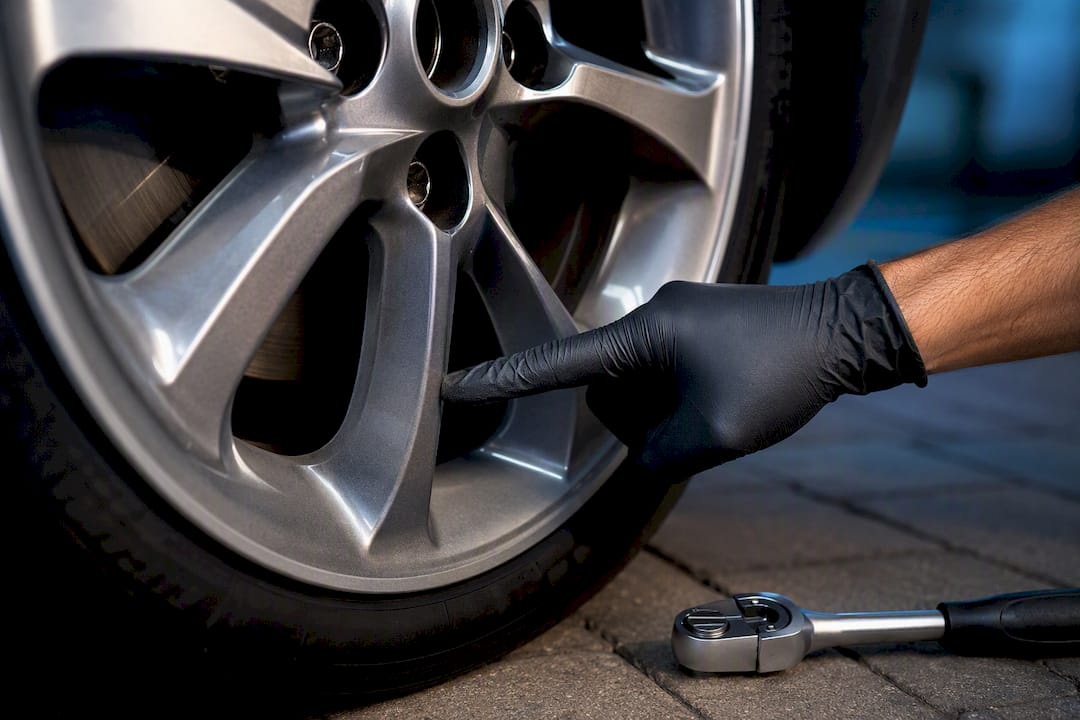
While you’re in there, glance at the brake pad thickness visible through the wheel spokes and check the rotor surface for grooving or uneven wear, both visible without removing the wheel on most vehicles. A sudden increase in how quickly dust reappears after cleaning, day one and it’s already dusty again, often means pads are wearing faster than normal and worth a proper inspection. This five-minute check costs nothing and catches problems well before they become a roadside breakdown or a failed safety inspection.
Why most brake dust advice misses the point
Most brake dust content online is a shopping list: buy this spray, use that brush, repeat weekly. What actually separates a wheel that looks good for years from one that’s permanently stained isn’t the product shelf. It’s sequencing and prevention.
The conventional advice treats every clean as a fresh battle against dust that’s already bonded. The better approach treats protection as the actual solution: get wheels properly decontaminated once, seal or coat them, and every clean after that becomes a two-minute rinse instead of a brush-and-chemical session. Iron content sitting at 50 to 80% of brake wear debris by mass means this isn’t ordinary dirt you’re fighting. It’s a metal that chemically bonds to your wheel the longer it sits.
If there’s one thing readers should prioritise first, it’s this: stop buying another spray bottle and start asking whether your wheels are actually protected. A coated wheel with a mediocre cleaning routine still outperforms an unprotected wheel with the best cleaner on the shelf.
— Isaac’s
Get baked-on brake dust handled properly, without the weekend lost to it
Doing this yourself works, but a full decontamination on four wheels with genuinely baked-on dust easily eats an entire Saturday, and one wrong chemical choice on a coated finish is expensive to fix. Professional detailers bring the sequence: decontaminate, correct, protect, straight to your driveway, workplace car park, or wherever your car happens to be parked on the Sunshine Coast.

The service list covers exactly the escalation path this article walked through: deep iron removal and wheel decontamination, correction for stubborn staining, and ceramic coating that makes the next twelve months of brake dust wipe off in a rinse instead of a scrub. The Ultimate Protection Package bundles wheel coating with full-vehicle protection for owners who want the job done once and forgotten about, while the Deluxe Detail and Revival Detail packages fold wheel decontamination into a broader clean if your whole car needs attention, not just the wheels. Because mobile detailing eliminates drop-off, waiting room, and shop scheduling delays, you can book a convenient time and have professional service brought directly to you with appropriate products for your wheel finish.
Sources
Backed by brake wear particle chemistry research, vehicle emission testing, and practical wheel cleaning methodology.
- Brake wear contribution to road traffic particulate matter (ScienceDirect)
- Influence of brake wear debris chemical properties on wheel dust (Heliyon, 2023)
- How to remove brake dust from wheels (TwoBucketClub)
FAQ
What cleans brake dust off your rims?
A pH-safe wheel cleaner handles most everyday brake dust, while an iron-reactive spray is needed for bonded, baked-on deposits. The iron remover works because brake wear debris is largely metallic, so it needs a chemical reaction rather than plain soap and water to lift.
Will WD-40 remove brake dust from wheels?
No, WD-40 isn’t formulated to break the chemical bond brake dust forms with metal surfaces, so it typically just smears the dust around rather than lifting it. Stick to a dedicated wheel cleaner or iron remover instead.
Is there a rim cleaner that can remove brake dust?
Yes, iron-reactive “ferrous fallout” sprays are purpose-built for this, turning purple or red as they dissolve embedded iron particles from brake dust. Isaac’s Pro Detailing uses this same iron-removal approach as part of its wheel decontamination service.
What is the best brake dust remover for alloy wheels?
For coated or painted alloy wheels, a pH-safe cleaner paired with an iron-reactive spray for bonded spots is the safest combination. Acid-based cleaners should only be used on bare or polished uncoated aluminium, since they can etch coated or clear-coated alloy finishes permanently.
How often should you clean brake dust off your wheels?
City and stop-and-go driving generally need a clean every one to two weeks, while steady highway driving can stretch to every three to four weeks. Track or performance driving warrants a decontamination immediately after each session.