

TL;DR:
- A tax-deductible detailing service is a vehicle cleaning expense that can be claimed as a business deduction when using the actual expense method. Only the actual expense method permits separate detailing deductions, and record-keeping, including receipts and mileage logs, is essential for a valid claim. The most benefit goes to gig workers, vehicle owners with high business-use, and those who meticulously track expenses and kilometres.
A tax-deductible detailing service is a professional vehicle cleaning expense you can claim as a business deduction when you use the actual expense method for vehicle-related tax claims. The standard industry term for this is a “deductible vehicle maintenance expense,” and detailing sits firmly within that category. If you drive for Uber, host cars on Turo, or run a small business with a company vehicle, understanding this distinction can put real money back in your pocket at tax time.
How does the tax deduction for vehicle detailing work?
The Australian Tax Office and the United States Internal Revenue Service both recognise two methods for claiming vehicle expenses: the standard mileage rate and the actual expense method. Which one you choose determines whether detailing is deductible at all.
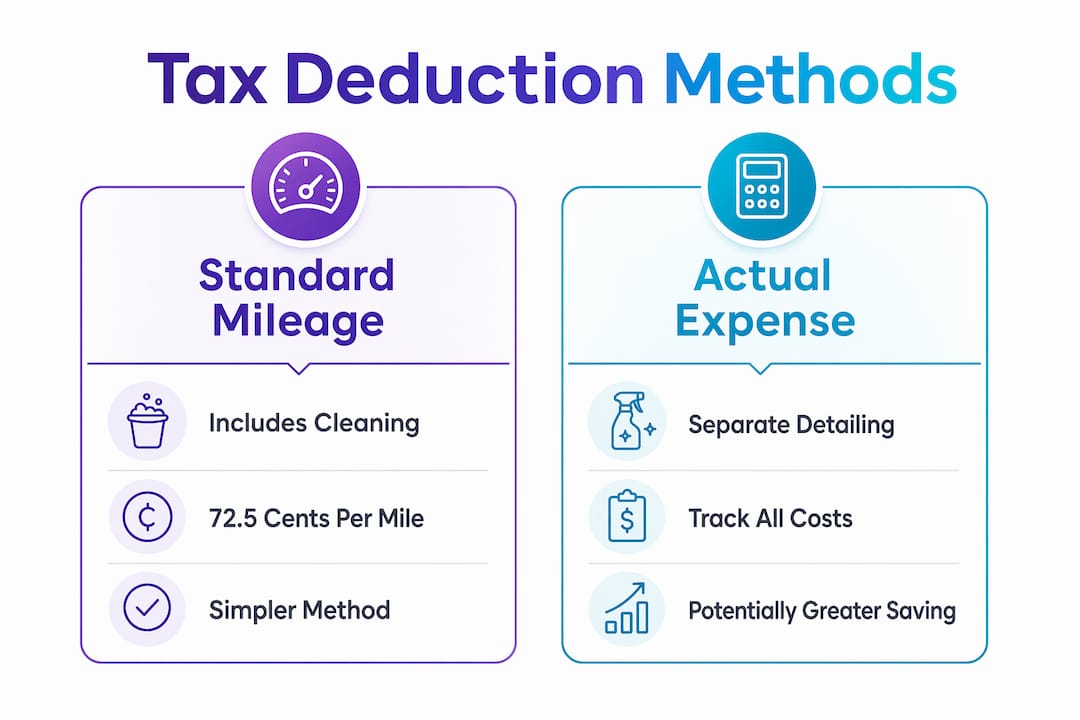
The standard mileage rate for 2026 is 72.5 cents per business mile in the US. That rate already bundles in cleaning costs, so you cannot claim detailing separately on top of it. Doing so is a common mistake that triggers audits.
The actual expense method works differently. You track every dollar spent running your vehicle, then multiply the total by your business-use percentage. If your vehicle is used 60% for business, you deduct 60% of your annual detailing costs. That is the only legitimate path to a detailing service tax write-off.
| Feature | Standard mileage rate | Actual expense method |
|---|---|---|
| 2026 rate | 72.5 cents per mile | N/A |
| Detailing deductible separately? | No | Yes |
| Calculation basis | Miles driven | Business-use percentage of real costs |
| Best suited to | Older, paid-off vehicles | Newer or high-operating-cost vehicles |
| Record-keeping required | Mileage log | Mileage log plus all receipts |
Pro Tip:Run both calculations before you lodge your return. The method that saves you the most money in year one may lock you in for future years, so the upfront maths matters.
What qualifies as a tax-deductible detailing expense?
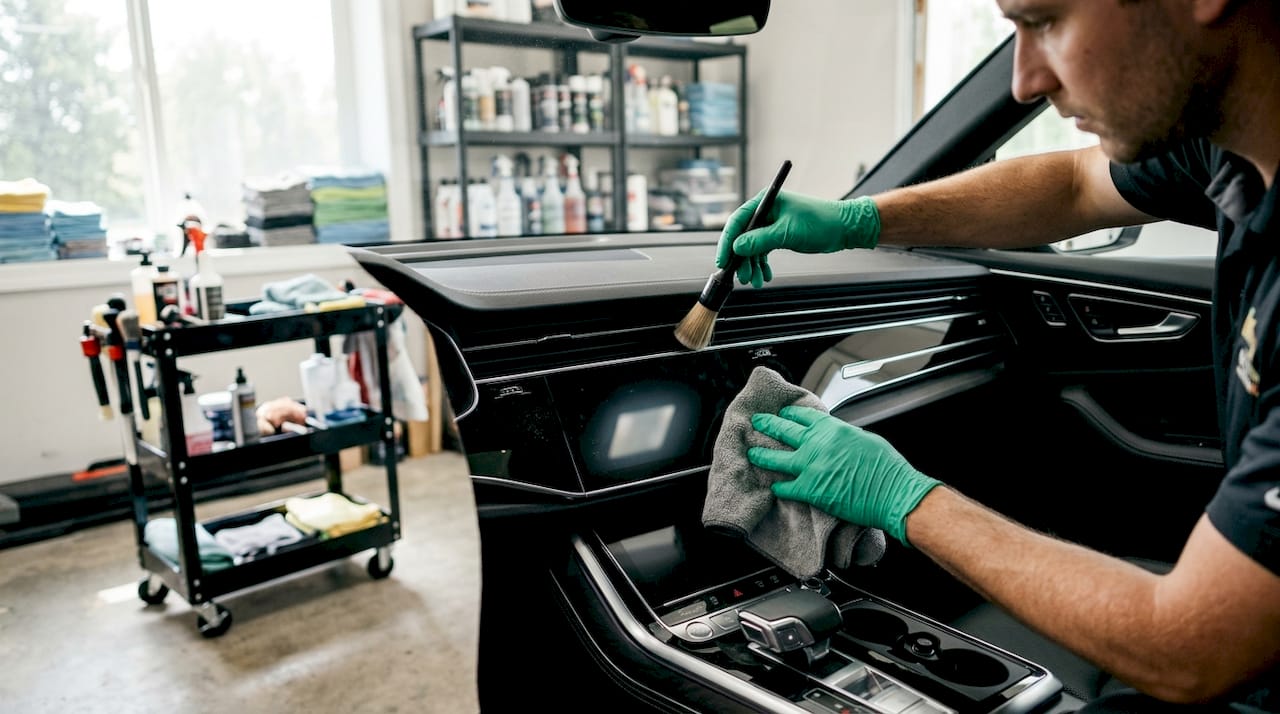
Deductible detailing expenses include interior deep cleaning, exterior polish, ceramic coating, and the cleaning supplies used to maintain a business vehicle. The key test is simple: the vehicle must be used for business purposes, and you must be using the actual expense method.
Specific services and supplies that qualify include:
- Interior cleaning: seat extraction, carpet shampooing, and odour elimination treatments
- Exterior services: cut and polish, paint correction, and iron removal
- Protective coatings:ceramic coating applied to paint, wheels, and leather
- Consumable supplies: car wash soap, microfibre towels, and vacuum tokens
- Specialised treatments: ozone deodorisation and fabric protection
To calculate your eligible deduction, divide your business kilometres by your total kilometres for the year. That percentage applies to every qualifying detailing cost. For example, a rideshare driver who covers 80% of their annual kilometres on the job can claim 80% of a $150 full detail as a business expense.
Gig workers on platforms like Turo rely heavily on vehicle presentation to attract bookings and maintain ratings. Detailing costs for these workers typically range from $30 to $200 per service depending on depth. Over a full year, those costs add up to a meaningful deduction when claimed correctly.
Pro Tip:Keep every receipt from your detailer, including itemised invoices that list each service separately. A single receipt labelled “car clean” is harder to defend than one that specifies interior extraction, exterior polish, and ceramic coating.
Who benefits most from claiming detailing deductions?
The actual expense method, and by extension the detailing service tax write-off, delivers the greatest benefit to specific groups of vehicle owners. Not every driver comes out ahead with this approach.
Rideshare and delivery drivers. Uber, DiDi, and food delivery drivers log high kilometres and need clean interiors to maintain passenger ratings. Their vehicles accumulate grime faster than average, making regular detailing a genuine business necessity rather than a luxury.
Turo hosts and car-share operators. These owners depend entirely on vehicle presentation for income. A dirty car earns lower ratings and fewer bookings. Professional detailing is a direct cost of earning revenue.
Small business owners with company vehicles. Tradespeople, real estate agents, and consultants who use a vehicle to visit clients can claim the business-use portion of detailing costs. A well-presented vehicle also reflects on the business itself.
Owners of newer or high-value vehicles. The actual expense method suits newer vehicles with higher operating costs better than the mileage rate. Detailing a late-model SUV or luxury sedan costs more, and that higher cost translates to a larger deduction under the actual expense method.
Mobile auto detailers. Professionals who run a detailing business can deduct both their vehicle costs and equipment such as pressure washers and extractors. This group benefits from deductions on two fronts simultaneously.
The standard mileage rate generally suits older, paid-off vehicles with low operating costs. If your car is fully owned and cheap to run, the mileage rate likely beats the actual expense method even before you factor in detailing.
How to claim detailing expenses correctly and avoid common pitfalls
Claiming a detailing expense tax treatment correctly comes down to documentation and method discipline. The rules are clear, but the mistakes are common.
- Keep a contemporaneous mileage log. The IRS requires records kept near the time of travel, not reconstructed at year end. Apps like MileIQ or a simple notebook updated daily both satisfy this requirement.
- Never double-dip. Claiming detailing separately while also using the standard mileage rate is a known audit trigger. The mileage rate already covers cleaning costs.
- Understand the lock-in rule. Once you claim Section 179 or bonus depreciation on a vehicle under the actual expense method, you cannot switch back to the standard mileage rate for that vehicle in future years.
- Store receipts digitally. Scan or photograph every detailing invoice and store it in a folder labelled by tax year. Cloud storage through Google Drive or Dropbox keeps records safe and accessible.
- Calculate your business-use percentage accurately. Use your mileage log to divide business kilometres by total kilometres at year end. Apply that percentage consistently to every actual expense you claim.
Pro Tip:Review your deduction method choice before you lodge your first return for a new vehicle. Switching from actual expenses to the mileage rate is restricted once you have claimed depreciation, so the decision made in year one follows you.
What other vehicle deductions complement your detailing write-off?
Detailing is one piece of a larger set of eligible car detailing deductions and vehicle expenses available under the actual expense method. Combining these deductions correctly can significantly reduce your taxable income.
| Expense type | Deductible under actual expense method? | Notes |
|---|---|---|
| Fuel | Yes | Business-use percentage applies |
| Insurance | Yes | Business-use percentage applies |
| Repairs and servicing | Yes | Business-use percentage applies |
| Registration | Yes | Business-use percentage applies |
| Depreciation / Section 179 | Yes | Full vehicle depreciation available |
| Parking fees and tolls | Yes, 100% | Deductible under either method |
| Car wash and detailing | Yes | Business-use percentage applies |
Parking fees and tolls are the one category deductible under both the mileage rate and the actual expense method. Every other vehicle cost sits exclusively within the actual expense column. Depreciation through Section 179 can deliver a large upfront deduction for business vehicles, but it permanently ties you to the actual expense method for that vehicle.
For Sunshine Coast vehicle owners, regular professional detailing also protects resale value, which matters when the vehicle eventually leaves your fleet. A well-maintained vehicle commands a higher sale price, and that outcome sits alongside the tax benefit as a genuine financial return.
Key takeaways
A tax-deductible detailing service is only claimable under the actual expense method, where your business-use percentage determines how much of each detailing cost you can write off.
| Point | Details |
|---|---|
| Method determines eligibility | Only the actual expense method allows a separate detailing deduction; the mileage rate does not. |
| Business-use percentage is the key figure | Divide business kilometres by total kilometres to calculate your deductible share of detailing costs. |
| Gig workers gain the most | Rideshare drivers and Turo hosts with high business-use percentages see the largest detailing deductions. |
| Documentation is non-negotiable | Contemporaneous mileage logs and itemised receipts are required to defend any vehicle expense claim. |
| Method choice has long-term consequences | Claiming Section 179 depreciation locks you into the actual expense method for that vehicle permanently. |
What I have learned from watching vehicle deductions play out
The biggest mistake I see is vehicle owners choosing the standard mileage rate because it feels simpler, then separately claiming a car wash or detail on top. That combination is the fastest way to attract unwanted attention from the tax office. The mileage rate is a flat rate precisely because it already covers cleaning, wear, and fuel. Claiming anything extra on top of it is not a grey area.
The owners who genuinely benefit from the detailing deduction are those with a clear business case for a clean vehicle. A Turo host who details between every booking has a defensible, documented expense. A tradie who occasionally cleans their ute has a weaker claim, especially if personal use is high.
My honest observation is that the actual expense method rewards discipline. The owners who track every kilometre, photograph every receipt, and calculate their business-use percentage accurately are the ones who claim confidently and without stress at audit time. The ones who estimate, reconstruct, or guess are the ones who lose deductions they were legitimately entitled to.
Professional detailing also delivers value well beyond the tax return. A vehicle that is regularly cleaned and protected with ceramic coating holds its condition longer, costs less in paint correction down the track, and presents better to clients and passengers. The tax benefit is real, but it is the secondary reason to detail professionally. The primary reason is that a clean vehicle is a better business asset.
— Isaac’s
Professional detailing services that qualify for your tax claim

Isaac’s Pro Detailing Sunshine Coast offers the full range of services that qualify as deductible vehicle maintenance expenses under the actual expense method. Interior seat and carpet extraction, exterior cut and polish, ceramic coating, and odour elimination are all legitimate business maintenance costs when your vehicle is used for income-generating purposes.
Every service comes with a detailed invoice that itemises each treatment, giving you exactly the documentation the tax office expects. Isaac’s operates fully mobile across the Sunshine Coast, so your vehicle is serviced at your home, workplace, or wherever suits you. Browse the complete service and wash menu to find the package that fits your vehicle and your business needs, or read the mobile detailing workflow guide to understand exactly what each service involves before you book.
FAQ
What is a tax-deductible detailing service?
A tax-deductible detailing service is a professional vehicle cleaning expense claimed as a business deduction under the actual expense method. It covers services like interior extraction, exterior polish, and ceramic coating when the vehicle is used for business purposes.
Can I claim detailing if I use the standard mileage rate?
No. The standard mileage rate already includes cleaning costs, so claiming detailing separately on top of it constitutes double-dipping and is a recognised audit trigger.
How do I calculate how much detailing I can deduct?
Divide your business kilometres by your total kilometres for the year to get your business-use percentage. Apply that percentage to your total detailing costs for the year to find your deductible amount.
Does ceramic coating count as a deductible detailing expense?
Yes. Ceramic coating is a legitimate business maintenance cost under the actual expense method when applied to a vehicle used for business purposes.
What records do I need to claim detailing expenses?
You need a contemporaneous mileage log recorded near the time of each trip and itemised receipts for every detailing service. Reconstructed records prepared at year end do not satisfy tax office requirements and can result in deductions being disallowed.