
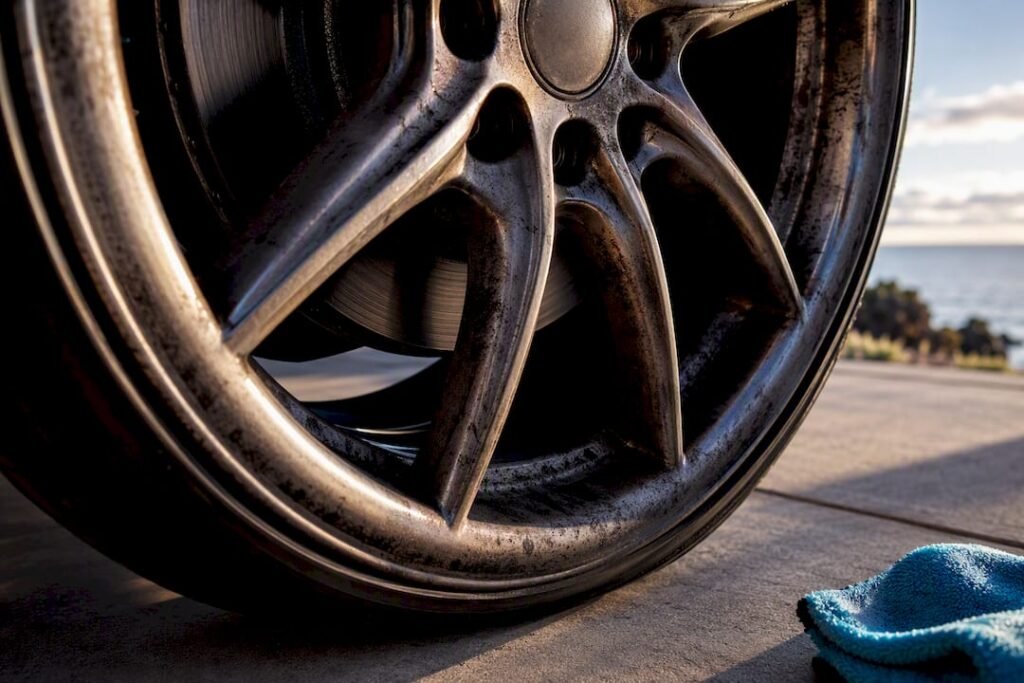
Brake dust sticks to wheels because hot metallic particles and pad resin fuse to the surface. Remove what’s already there with a pH-neutral wheel cleaner and an iron-reactive spray on cool wheels, then rinse and dry. To stop it coming back as fast, apply a wheel sealant or professional ceramic wheel coating and consider switching to ceramic brake pads, which shed less and lighter dust.
TL;DR:
- Switching to ceramic brake pads can significantly reduce the amount of sticky, dark brake dust that bonds to wheels, especially on regular driving.
- Regularly cleaning wheels every two to four weeks with a pH-neutral cleaner and iron remover prevents embedded particles from causing corrosion and etching.
- Applying a wheel sealant or ceramic coating creates a heat-resistant barrier that makes future cleaning easier but does not stop brake dust from forming.
- Professional iron decontamination and coating services are recommended for stubborn baked-on or rust-colored contamination that DIY methods cannot remove safely.
- Using proper techniques such as cooling wheels fully before cleaning and avoiding abrasive tools is essential to prevent damage and ensure effective brake dust removal.
Table of Contents
- Your quick checklist for tackling brake dust sticking to wheels
- Why brake dust clings to wheels in the first place
- The regular wheel-cleaning routine that actually works
- Dealing with baked-on brake dust that won’t budge
- What wheel sealants and ceramic coatings actually do
- Can changing your brake pads reduce dust at the source?
- How often should you clean and reapply protection?
- Why some owners still choose a mobile detailer over DIY
- Get your wheels professionally decontaminated and protected
- Sources
- FAQ
Your quick checklist for tackling brake dust sticking to wheels
Before you touch a bucket, run through this order of operations. Skipping steps is how people end up with swirl marks or stripped lacquer.
- Let the wheels cool fully. Never clean hot wheels, since thermal shock can crack finishes and makes chemicals react unevenly.
- Rinse first to knock off loose grit before any product touches the surface.
- Apply a pH-neutral wheel cleaner and let it dwell per the label.
- Follow with an iron-dissolving spray on any baked-on residue, watching for the colour change that tells you it’s working.
- Agitate gently with a soft wheel brush, rinse thoroughly, then dry with a clean microfibre towel.
- Finish with a wheel sealant or ceramic coating if you want the next clean to be easier.
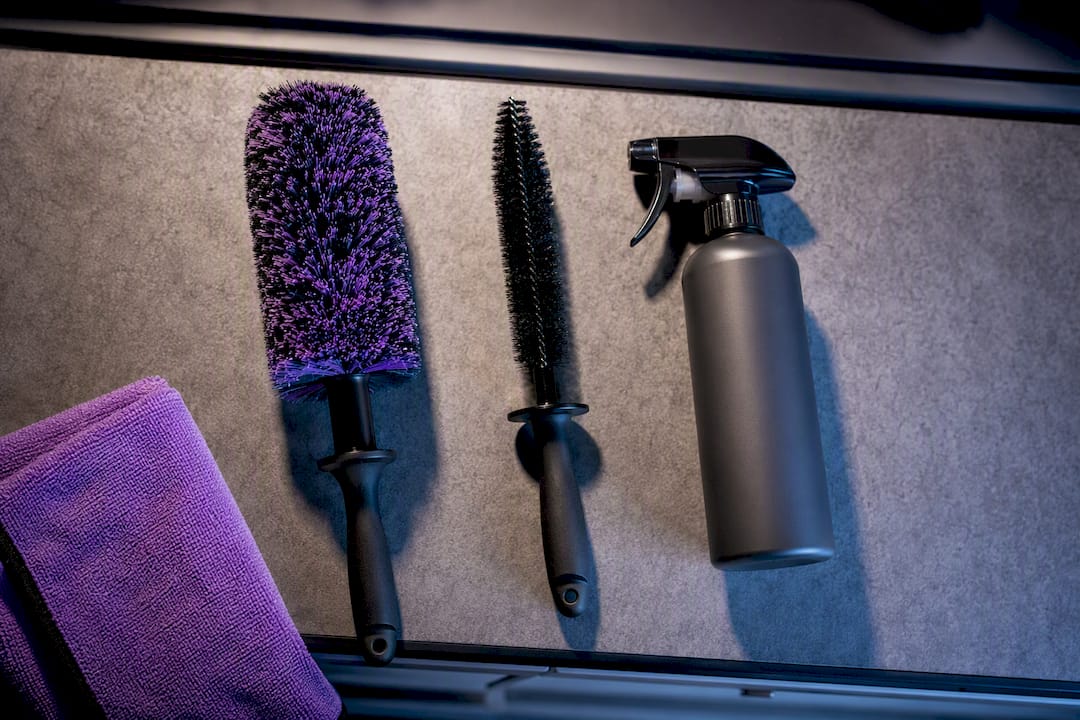
Keep a hose or pressure washer, two separate buckets, a pH-neutral cleaner, an iron remover, soft brushes, and microfibre towels in your kit. Never reach for WD-40 on brakes or pads. It leaves an oily film that can contaminate braking surfaces rather than clean them.
Pro Tip:Keep one wash mitt exclusively for wheels and never let it touch your paintwork. Wheels carry the highest concentration of ferrous grit on the car, and cross-contaminating your paint mitt is one of the fastest ways to introduce swirl marks.
Why brake dust clings to wheels in the first place
Brake dust isn’t just road grime. It’s a mix of iron filings shed from the rotor, resin and carbon fibres from the pad compound, and whatever fine debris gets kicked up off the road. Every time you brake, friction generates enough heat to make those metallic particles semi-molten for a fraction of a second, and research on brake wear particle emissions confirms that heat and pad resins allow those particles to bake or bond directly onto the wheel finish if they’re left there long enough.
That’s the mechanical explanation for something every driver has noticed: dust sticks harder to some wheels than others. Add a static charge from the spinning wheel and rushing air, and those particles don’t just land, they cling.
Pad material makes a real difference here. Semi-metallic pads shed more material overall, and that dust tends to be darker, greasier, and more prone to bonding. Ceramic pads produce less dust, and what does come off is lighter in colour and far less sticky.
Left alone for weeks, this isn’t just an appearance problem. Embedded iron particles can etch clear coats and, on bare or lacquered alloy, kick off corrosion that’s far more expensive to fix than a Sunday wash would have been.
The regular wheel-cleaning routine that actually works
Wheels don’t need a full decontamination every time you wash the car, but they do need consistency. A quick rinse after most drives keeps loose dust from settling in. A proper clean with brushes and product belongs in every full wash, roughly every two to four weeks for most vehicles, more often if you’re driving a dark-coloured wheel or doing a lot of stop-start city work.
Here’s the sequence that keeps wheels clean without damaging them:
- Let the wheels cool completely before starting.
- Pre-rinse to remove loose surface grit.
- Apply a pH-neutral wheel cleaner and let it dwell.
- Watch for a colour change if you’re using a product with iron-reactive properties, that’s the chemical doing its job on embedded metallic particles.
- Agitate gently with a soft-bristled wheel brush, working into barrels and behind spokes.
- Rinse thoroughly until no suds remain.
- Dry with a microfibre towel to prevent water spotting.
- Apply a sealant if you’re maintaining one.
The pH-neutral step matters more than most people realise. Acid-based wheel cleaners work fast, but repeated use can thin the protective lacquer on your wheel finish over just four to six cleaning cycles, leaving bare metal more exposed to corrosion down the track. A pH-neutral formula takes a little longer to cut through grime, but it won’t eat away at the clear coat with every wash.
Use dedicated wheel brushes, not the sponge you use on paint, and keep an iron-dissolving spray on hand for periodic decontamination rather than every single wash. That’s usually enough to keep brake dust from clinging to your rims between deeper cleans.
Dealing with baked-on brake dust that won’t budge
Some contamination sits past what a regular wash can shift. That rust-coloured staining you sometimes see, especially on wheels that have gone months without attention, is embedded iron that’s fused to the surface.
Iron-reactive decontaminators are built for exactly this. Spray one onto a cool, dry wheel and it will visibly change colour, usually to purple or red, as it chemically breaks down the metallic particles clinging to the finish. That colour shift isn’t cosmetic theatre. It’s the product working, and it’s the clearest sign you’re using the right tool for embedded contamination rather than surface dust. This partner guide on safe dwell times for brake dust removal covers how long to leave these products before rinsing.
A few rules matter here:
- Always follow the label’s dwell time. Leaving a decontaminator on too long can be as damaging as not using one at all.
- Agitate with soft brushes only. Abrasive pads or scouring tools drag metal particles across the finish and cause fine scratching.
- Avoid repeated use of aggressive acid-based cleaners. They’re effective on heavy contamination, but frequent use risks thinning the clear coat.
If you’re looking at rust-coloured staining that won’t shift with a standard iron remover, or you’re not certain what finish your wheels actually have, that’s the point to call in a professional rather than experiment. A mobile detailer with proper iron-removal treatment has access to stronger, safer chemistries and the experience to judge dwell times on a case-by-case basis.
What wheel sealants and ceramic coatings actually do
Here’s the part most marketing skips: a ceramic wheel coating doesn’t stop your brakes producing dust. Nothing short of changing your pad compound does that. What a coating does is create a smooth, heat-resistant barrier so those hot metallic particles can’t anchor into the microscopic pores of the wheel finish the way they would on bare alloy.
That barrier is why coated wheels wipe clean with a rinse and a wipe, where uncoated wheels need scrubbing. It’s a maintenance advantage, not a dust-prevention one.
A few things worth knowing before you commit to one:
- Professional-grade wheel coatings can last 12 months or more when applied and maintained correctly, though heavy daily driving will shorten that window.
- Application demands fully decontaminated, cool, bone-dry wheels. Trace moisture during application weakens the chemical bond before it’s even cured.
- Coatings still need periodic iron decontamination to stay effective. They change how often you scrub, not whether you ever need to.
Detailer communities are consistent on this point too: coatings make brake dust easier to remove and reduce how hard you have to scrub, but nobody serious claims they block it outright. If you want the full breakdown of coating types and what upkeep actually looks like, our guide to wheel coating benefits and care covers it in more detail.
Pro Tip:Book a coating application for a dry, mild day. Even light humidity in the air can reduce bond strength before the ceramic has had a chance to cure properly.
Can changing your brake pads reduce dust at the source?
Yes, and it’s arguably the most effective lever most owners never pull. Ceramic brake pads shed less material per braking cycle than semi-metallic compounds, and what they do shed is lighter in colour and far less prone to bonding.
The trade-off is real, though. Some performance pads stay semi-metallic because that compound handles heat better under hard braking, which matters if you’re towing or doing track days. For most daily drivers, the dust reduction from switching to ceramic outweighs the marginal performance difference.
Rotor condition and driving style play a role too. Aggressive braking generates more heat and more debris regardless of pad compound, so smoother, earlier braking naturally cuts down how much dust your wheels have to deal with. Any pad swap should go through a qualified mechanic to make sure it suits your vehicle and braking demands.
How often should you clean and reapply protection?
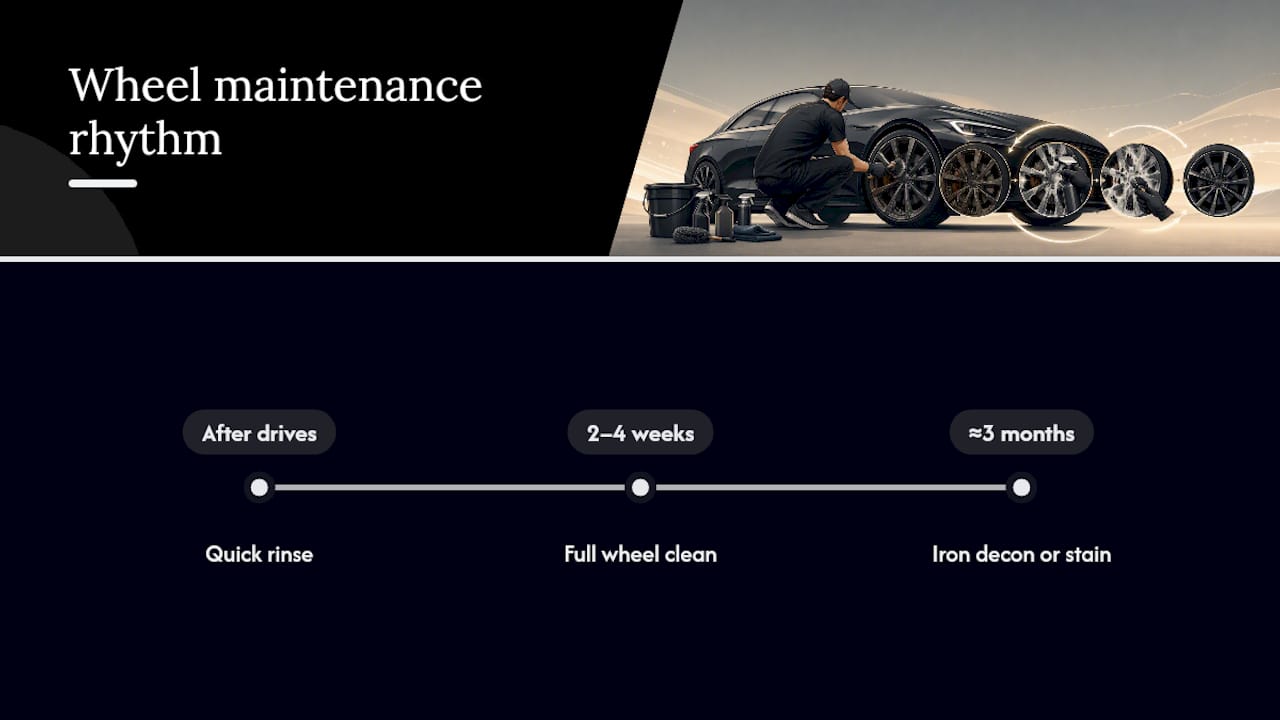
A workable rhythm: quick rinse after most drives, full wheel clean every wash cycle (two to four weeks), and iron decontamination whenever you spot purple-tinged staining or roughly every three months on high-mileage vehicles.
Budget-wise, DIY pH-neutral cleaners run around $15 to $50, iron-removal sprays sit between $30 and $70, and professional decontamination or ceramic wheel coating pricing varies by vehicle and condition. Coatings cost more upfront but cut the ongoing labour of keeping wheels looking clean.
Why some owners still choose a mobile detailer over DIY
Most owners can manage a basic wash-and-decontaminate routine at home. Where DIY hits its ceiling is baked-on iron contamination on wheels of unknown finish, or getting a genuinely durable ceramic coating bonded without a controlled, moisture-free application environment.
A mobile detailing appointment brings professional-grade decontamination and coating application to your driveway, without the guesswork of matching chemistry to your specific wheel finish. That convenience is the whole point of a mobile service: the same standard of work, at your home or workplace, without a workshop drop-off.
— isaac’s
Get your wheels professionally decontaminated and protected
Professional mobile detailing services handle the parts of brake dust removal that are hardest to get right at home: full iron decontamination, safe pH-balanced washing, and ceramic wheel coatings applied under the dry, controlled conditions they actually need to bond properly. All of it can happen at your place, whether that’s home, work, or wherever your car happens to be parked.
If your wheels are already showing rust-coloured staining or you’re tired of scrubbing the same patches every fortnight, a professional deep clean resets the surface properly before any coating goes on. Check the wash menu for current wheel-care packages and pricing, or get in touch to book a mobile appointment and have it sorted at a time that suits you.
Sources
- Brake wear particle emissions: a review
- Brake dust causes, cleaning and prevention
- Low-dust brake pads explained: materials and performance
- How to stop brake dust from clinging to rims
FAQ
How can I stop brake dust from clinging to my rims?
Wash regularly with a pH-neutral cleaner, decontaminate with an iron remover when staining appears, and apply a wheel sealant or ceramic coating so future dust doesn’t bond as easily.
Will WD-40 remove brake dust from rims?
No. WD-40 isn’t formulated for wheel cleaning and can leave an oily film that contaminates braking surfaces rather than lifting dust.
Why do I get so much brake dust on my wheels?
It comes down to pad compound and driving style. Semi-metallic pads shed more dust than ceramic pads, and aggressive or frequent braking generates more heat and debris regardless of pad type.
How do I stop brake dust sticking to alloy wheels?
Keep up a regular pH-neutral wash routine, use an iron-reactive spray on embedded contamination, and add a wheel sealant or professional ceramic coating so particles can’t anchor into the finish’s pores.